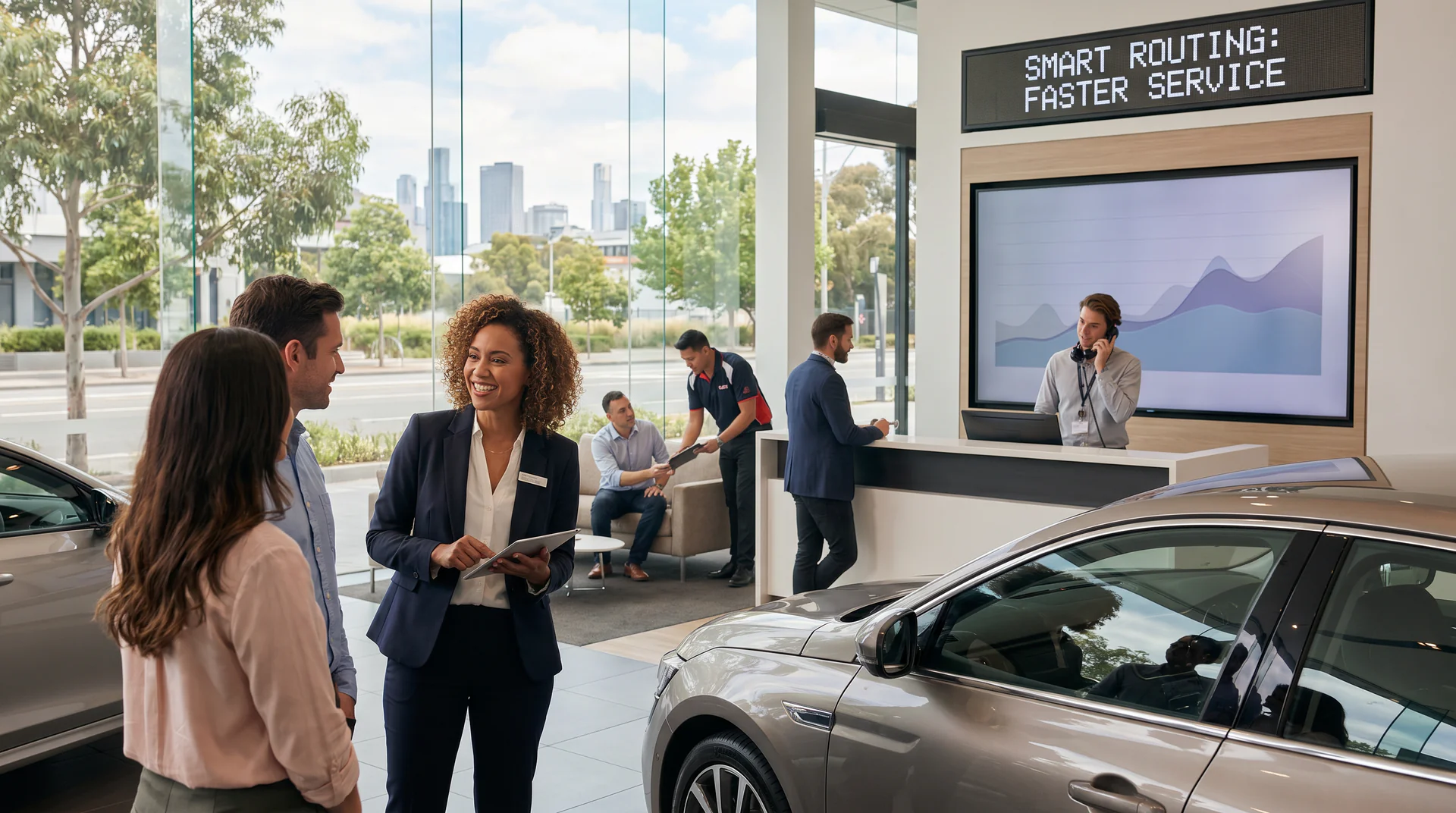
AI Call Routing for Car Dealerships
Learn how AI call routing for car dealerships cuts missed calls, speeds up service, and captures more leads without adding headcount.

The Short Answer
AI call routing for car dealerships means deploying a voice AI genie that answers every inbound call, figures out why the customer is calling, and routes them to the right department or person without any manual sorting. No hold queues for the wrong team. No “let me transfer you” loops. The right person picks up the right call, every time. That’s the core of what this technology does, and the rest of this guide walks through why it matters and how to make it work for your dealership.
Why Dealerships Have a Call Problem
Think about what happens when someone calls a dealership at 10:30 on a Tuesday morning.
The front desk picks up. The caller wants to know if a used hatchback is still available. The receptionist isn’t sure, so they put the caller on hold and hunt for someone in used sales. That person is with a customer on the lot. Three minutes pass. The caller hangs up.
That caller is now browsing a competitor’s website.
This happens dozens of times a day across dealerships of every size. Industry estimates suggest that somewhere between 30 and 40 percent of inbound dealership calls don’t result in a meaningful conversation because of poor routing, missed transfers, or callers dropping off in the queue. That’s not a staffing failure. It’s a routing failure.
The departments in a dealership have very different needs. Sales, finance, service, parts, and fleet all deal with different customers asking different questions. A caller who wants to book a service appointment shouldn’t have to wade through a sales greeting. A caller checking on a warranty claim shouldn’t end up in the parts department. Getting the wrong start to a conversation costs you time and sometimes the customer entirely.
For smaller dealerships running with lean front-office teams, the problem compounds. One receptionist handling five lines can’t perfectly sort calls under pressure. And after hours, the phone just rings out.
What AI Call Routing Actually Does
A voice AI genie deployed at your dealership answers every call with a branded greeting. It listens to what the caller says, in natural language, and identifies the intent behind the call. Then it routes.
Here’s what that looks like in practice.
A caller says, “I want to bring my car in for an oil change.” The genie recognises a service intent, confirms availability, and either routes to your service team or, if they’re busy, books the appointment directly and sends a confirmation.
A caller says, “I saw the Ranger on your website, is it still there?” The genie identifies a sales inquiry, checks whether the vehicle details are in the knowledge base, provides a quick answer, and routes to the right sales consultant.
A caller says, “I need to talk to someone about my finance agreement.” The genie routes to finance without any manual involvement.
None of this requires a human to answer, assess, and then transfer. The genie handles the first leg entirely.
This matters for three reasons.
Speed. The average person will wait about 90 seconds on hold before frustration kicks in. When calls are routed correctly on the first contact, hold times drop sharply.
Accuracy. A voice AI genie doesn’t have a bad day. It doesn’t get confused about which line is which. It routes consistently, every call.
Coverage. The genie works after hours, on weekends, and during public holidays. A Saturday afternoon caller who wants to know your service hours doesn’t have to leave a voicemail and wait until Monday.
How It Works for Smaller Dealerships
The phrase “AI call routing for car dealerships for small business” comes up a lot, and with good reason. Smaller independent dealers and single-franchise outlets often assume this kind of technology is only viable for large groups with IT budgets to match.
That’s not the case.
A voice AI genie deploys without a developer, without custom phone infrastructure, and without a months-long implementation project. You upload your dealership’s information, including FAQs, department contact details, service hours, and key vehicle details, into the genie’s knowledge base. You customise the voice and greeting to match your brand. Then you go live on your existing phone number.
For a dealership running a small front-desk team, the immediate benefit is that the genie handles the sorting and basic question-answering that currently eats up reception time. Staff can focus on customers who are physically in the showroom rather than managing a constantly ringing phone.
Callers who need specific information, like current finance rates, trade-in processes, or how to log a warranty claim, get answers from the genie before they’re even transferred. That means when they do reach a human, the conversation starts at a more useful point.
There’s also the cost angle. A traditional call answering setup with after-hours staffing can run into thousands of dollars per month. A voice AI solution operates on a flat monthly rate per genie, which makes budgeting straightforward. There are no per-minute charges that balloon during busy periods.
Setting Up AI Call Routing: The Practical Steps
Getting a voice AI genie live at your dealership doesn’t take long. Here’s how the process works.
Step 1: Build the knowledge base.
Start with the information your callers most commonly ask for. This includes service department hours, booking procedures, the sales team roster and their areas (new, used, fleet), current promotions, finance inquiry process, parts ordering, and your after-hours policy. Upload this as documents, paste in your website content, or add FAQs manually. The more complete the knowledge base, the better the genie’s answers.
Step 2: Define your routing logic.
Work out which departments need their own routing path. For most dealerships, this means separate paths for sales (new and used), service, finance, parts, and general enquiries. Assign the right contacts or queues to each. Include fallback logic for after-hours, so callers who can’t be transferred still get useful information and a clear next step.
Step 3: Customise the experience.
Give your genie a name and a voice that fits your brand. A volume dealership might want something efficient and direct. A boutique prestige dealer might want a warmer, more conversational tone. This is your brand on the phone, so make it sound like you.
Step 4: Go live and monitor.
Once deployed, the genie generates conversation data with every call. You’ll see what topics come up most often, where callers drop off, which department takes the most volume, and how many leads are being captured after hours. Use that data to refine the knowledge base and routing logic over the first few weeks.
Beyond Basic Routing: What Else the Genie Does
Routing is the foundation, but it’s not the ceiling.
A well-configured genie for a car dealership can also capture leads from callers who don’t want to be transferred. Someone calling at 8pm on a Sunday to ask about a specific vehicle can leave their details with the genie, which logs the inquiry and sends an alert to the sales team. That lead is warm and documented by the time a salesperson follows up Monday morning.
The genie can handle service booking directly, checking availability and confirming appointments without any human involvement. For busy service departments, this removes a significant volume of inbound calls from the reception workload.
It can also answer detailed questions about vehicle features, towing capacities, warranty terms, or financing options, using the knowledge base you’ve built. That means callers who are in the research phase get useful information immediately instead of being told “someone will call you back.”
Over time, the conversation analytics show you exactly what your customers care about. If a large number of callers are asking about extended warranty options, that’s a signal to make that information more prominent on your website and in your sales process. The genie isn’t just handling calls. It’s telling you what customers actually want.
Common Routing Failures and How to Avoid Them
Getting AI call routing right means avoiding a few predictable mistakes.
Thin knowledge bases. If your genie can’t answer basic questions about service hours or booking procedures, callers will feel like they’ve hit a dead end. Spend time building out the knowledge base before you go live. Include edge cases. Include the questions your team gets asked ten times a week.
No fallback for edge cases. Some callers will say something the genie doesn’t recognise. Build clear fallback paths that route these callers to a human or, after hours, capture their details for a callback. A genie that says “I’m not sure about that, but I can take your details and have someone call you back” is far better than one that just loops.
Ignoring the analytics. The call data your genie generates is genuinely useful. Review it regularly. If you see a high volume of calls about a topic that isn’t in your knowledge base, add it. If a particular routing path is generating lots of drop-offs, investigate why.
Not testing after-hours coverage. Call your own number at 7pm on a Saturday. Does the experience match what you’d want a customer to have? After-hours is often where the most leads are lost, and it’s also where a well-configured genie makes the biggest immediate difference.
Making the Decision
If your dealership regularly misses calls, loses leads to after-hours gaps, or has front-desk staff spending significant time on call sorting rather than customer service, AI call routing is worth looking at seriously.
It’s not a magic fix. It takes time to build a solid knowledge base and dial in the routing logic. But once it’s running, it operates consistently, scales to your call volume without adding headcount, and keeps capturing leads when your team isn’t there.
For smaller dealerships especially, it’s a practical way to extend coverage and compete with larger operations that have more staff on the phones.
The automotive industry moves fast. Customers expect quick answers. A genie that answers every call, routes it correctly, and never drops a lead after hours is a real operational advantage.
See how Help Genie works for automotive businesses at /automotive, or run the numbers on potential revenue impact using the ROI calculator.
Help Genie Tips
Get more from your voice genie

Add custom pronunciations for your industry
Genie mispronouncing a brand name, medical term, or street name? Add custom pronunciations so your voice genie nails every word your callers expect to hear.

Route urgent calls to a real person instantly
Set up smart transfer rules so your genie hands off to the right team member when it detects urgency, a VIP caller, or a question it cannot answer. Conference or warm handoff.

Cover nights, weekends, and holidays automatically
Your genie picks up every call outside business hours, qualifies leads, handles emergencies, and books appointments for the next morning. No answering service needed.

Push leads straight into your CRM
Connect Help Genie to Salesforce, HubSpot, or Pipedrive through Zapier or webhooks. Every qualified lead lands in your pipeline automatically with full conversation context.
Ready to try it?
Set up a voice genie for your business in minutes.