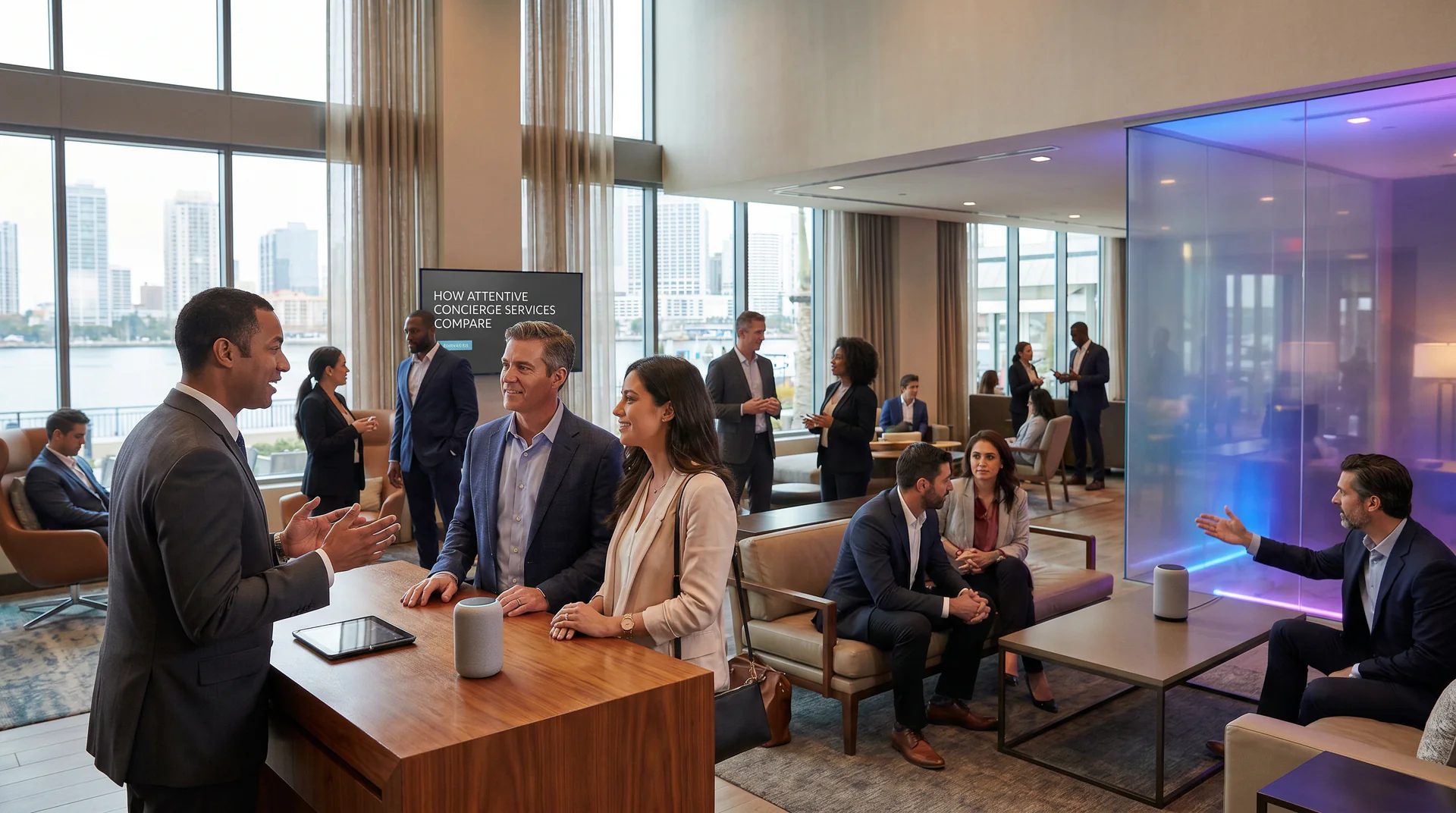
How Attentive Concierge Services Compare in Benefits and Features for Hotel Amenities
A clear breakdown of how attentive concierge services compare in benefits and features for hotel amenities, from staffed desks to voice AI genies.

The Short Answer
Attentive concierge services vary widely in how they handle hotel amenities. Traditional staffed concierge desks offer personal judgment and relationship-building but are limited by hours and headcount. Digital concierge platforms add 24/7 coverage and self-service but often feel impersonal. Voice AI genies sit in a third category: always available, branded to the property, and capable of handling amenity inquiries, room service questions, local recommendations, and booking flows without a queue or a shift change.
If you want to compare options, the core dimensions are availability, personalization, cost, and coverage depth.
Why This Question Matters Right Now
Hotels are under real pressure on two fronts. Guests expect faster answers than ever. And staffing budgets are tighter than they were five years ago.
A front desk team handling check-ins, complaints, and concierge requests at the same time is going to drop balls. It is not a failure of effort. It is a capacity problem.
The result is a gap between what guests expect and what most properties can deliver. That gap is exactly where concierge service decisions get made. Whether you run a boutique inn with eight rooms or a 200-room full-service property, the same question applies. Which concierge approach actually delivers attentive service across your amenities, at scale, without falling apart at 11pm on a Saturday?
This breakdown helps you answer that.
The Four Concierge Models Hotels Actually Use
1. Dedicated Staffed Concierge Desk
This is the traditional model. A trained concierge sits at a dedicated desk and handles everything from dinner reservations to airport transfers to local sightseeing recommendations.
What it does well: Personal rapport, nuanced judgment, and the ability to read a guest’s mood and respond accordingly. A skilled concierge builds relationships across repeat stays. They know the regulars. They remember preferences.
Where it falls short: The desk is empty after hours. Cover during peak periods requires multiple hires. Training is slow and inconsistent across staff. And for smaller properties, the cost of a full-time concierge is hard to justify when demand is uneven.
For properties competing on luxury and service differentiation, this model still makes sense as the primary layer. But it cannot stand alone anymore.
2. In-Room Tablet or App-Based Concierge
Many mid-range and upscale hotels have deployed tablet-based systems or guest-facing apps. Guests can browse amenity menus, request towels, order room service, and view local recommendations through a screen in the room or on their phone.
What it does well: Self-service at any hour, reduced front desk pressure for routine requests, and a clean record of what guests ordered and when.
Where it falls short: Adoption rates are uneven. Many guests ignore the tablet entirely. App downloads add friction. And these systems are mostly transactional. They process requests but they do not answer questions. If a guest wants to know whether the pool is heated, whether the restaurant has gluten-free options, or what time the spa closes, a static app often fails them.
Tablets and apps reduce workload. They do not replace attentive service.
3. Chat-Based Messaging Platforms
Some hotels use SMS or in-app messaging to connect guests with staff. The guest texts a number, a team member responds, and the conversation flows like a chat thread.
What it does well: Familiar format for most guests, low friction, and a record of the conversation. Staff can handle multiple threads at once, which improves efficiency versus phone calls.
Where it falls short: It still requires a human on the other end. Response times slip when staff are busy. After-hours coverage requires dedicated overnight staff or a service agreement with a third-party answering provider. And the quality of the answer depends entirely on which staff member picks up the thread.
For hotels that want attentive service through messaging, this model works during staffed hours. It does not solve the 24/7 problem.
4. Voice AI Genies
This is the model that directly addresses the gaps above. A voice AI genie is a branded AI agent built on the hotel’s own knowledge base. It answers questions about amenities, handles common booking requests, captures guest preferences, and routes complex issues to the right person.
The genie does not replace a human concierge. It handles the volume of routine questions so human staff can focus on the conversations that genuinely need them.
What it does well:
- Available around the clock, including at 2am when a guest wants to know if room service is still running
- Answers are drawn from the hotel’s own knowledge base, so they are accurate and on-brand
- Covers amenity details, spa bookings, restaurant hours, pool rules, local transport options, and check-out procedures without a queue
- Captures lead and preference data from every conversation, which feeds into future personalization
- Consistent tone across every interaction, because it is always the same genie speaking
Where it falls short: A genie works from what it knows. If the knowledge base is not kept current, answers go stale. And for highly complex or emotionally charged situations, a genie should hand off to a human. That routing needs to be set up thoughtfully.
For a full breakdown of how voice AI fits into the travel and hospitality space, see the Help Genie travel and hospitality page.
Comparing the Models on the Dimensions That Matter
Availability
Staffed desk: business hours, maybe extended. Not 24/7 without significant cost.
App or tablet: 24/7 for transactions, not for questions.
Chat messaging: tied to staffing, response times vary.
Voice AI genie: 24/7, consistent response time, no queue.
Depth of Amenity Knowledge
Staffed desk: high, but varies by individual staff member and tenure.
App or tablet: limited to what was programmed into the menu at launch.
Chat messaging: depends on the person responding.
Voice AI genie: draws from a comprehensive knowledge base. Can cover hundreds of amenity details, policies, and local recommendations if the knowledge base is built well.
Cost at Scale
Staffed desk: high fixed cost. Each additional coverage hour requires additional headcount.
App or tablet: moderate setup cost, low ongoing cost, but limited utility.
Chat messaging: moderate. Requires staff time plus platform fees.
Voice AI genie: flat-rate pricing. One genie covers unlimited guest conversations without per-call or per-minute billing.
Personalization
Staffed desk: highest, especially for repeat guests with relationships.
App or tablet: low unless integrated with a property management system.
Chat messaging: moderate, depends on staff.
Voice AI genie: grows over time as the knowledge base and conversation data build. Progressive lead capture and preference tracking make each interaction more useful than the last.
Brand Consistency
Staffed desk: varies by staff member, training, and day.
App or tablet: consistent in format, but often generic.
Chat messaging: inconsistent, staff-dependent.
Voice AI genie: fully branded. The genie speaks in the hotel’s voice, uses the hotel’s tone, and represents the property’s personality in every conversation.
What “Attentive” Actually Means in This Context
The word attentive is doing a lot of work in how hotels describe their concierge services. But attentive does not just mean fast. It means relevant, accurate, and present.
A guest asking about amenities at 7am before a full day of activity does not want to wait for a desk to open. They want to know right now whether the gym has lockers, whether breakfast service extends past 10am, and whether they can rent a bike from the property.
Attentive service at that moment looks like an immediate, accurate answer. The source of that answer matters less than the quality of it.
That is where voice AI genies close the gap that staffed concierges leave open. Not by replacing the personal relationship, but by making sure no question goes unanswered because the desk was busy or the shift had not started yet.
Small properties benefit from this especially. A boutique hotel with four front desk staff cannot match the round-the-clock coverage of a large resort with a full concierge team. But it can deploy a genie that knows the property inside and out and answers every amenity question with accuracy and warmth.
What Small Hotels and Independent Properties Should Know
The “for small business” dimension of this question is worth addressing directly.
Large hotel chains have resources for every concierge model simultaneously. Small and independent properties do not. They need to pick the layer that delivers the most impact per dollar spent.
For most small properties, the answer is a voice AI genie as the primary coverage layer, backed by a real person for complex situations.
Here is why. A genie does not call in sick. It does not need onboarding. It does not give a different answer on a Friday afternoon than it does on a Monday morning. And it starts working the moment you deploy it.
The investment is a fraction of what a part-time concierge hire costs. The coverage is better. And the insights generated from every guest conversation feed back into how the property operates.
For properties exploring this model, the Help Genie ROI calculator shows what the numbers look like at different property sizes and call volumes.
Building a Concierge Stack That Actually Works
The best hotel concierge setups use layers. They do not pick one model and ignore the rest.
A practical stack for most properties looks like this:
A voice AI genie handles the volume. Amenity inquiries, room service questions, local recommendations, and routine booking requests go through the genie at any hour.
A messaging channel or front desk handles escalations. When a guest has a complaint, a special request that requires judgment, or a question the genie cannot answer confidently, it routes to a human.
Staff focus on relationships. With the routine volume handled, front desk and concierge staff can spend time on the interactions that genuinely benefit from a human touch.
This is not a reduction in attentive service. It is an increase in it. More guests get answered faster. Staff have more time per conversation when a conversation genuinely needs them.
For more on how this plays out across hospitality use cases, explore the Help Genie resources section.
The Bottom Line
When you compare attentive concierge services on benefits and features for hotel amenities, the honest answer is that no single model wins on every dimension. Staffed concierge desks win on relationship depth. Apps win on self-service simplicity. Chat wins on familiarity.
Voice AI genies win on availability, consistency, scalability, and cost per interaction. For most properties, that combination makes them the most practical primary layer, with human staff handling what only humans should handle.
If your guests are waiting for answers about your amenities because the desk is busy or the shift has not started, that is a solvable problem.
See how a Help Genie voice AI genie works for travel and hospitality properties at helpgenie.ai/travel-hospitality.
Help Genie Tips
Get more from your voice genie

Route urgent calls to a real person instantly
Set up smart transfer rules so your genie hands off to the right team member when it detects urgency, a VIP caller, or a question it cannot answer. Conference or warm handoff.

Capture exactly the info you need from every caller
Define custom fields your genie should collect: budget, timeline, property type, vehicle make, service needed. Every call ends with structured data, not a scribbled note.

Pick the perfect voice for your brand
Choose from dozens of natural-sounding voices or clone your own. Adjust tone stability, speaking speed, and similarity to match exactly how you want your business to sound on the phone.
Explore voices
Train your genie with your own business data
Upload PDFs, spreadsheets, website pages, or just paste text. Your genie learns your pricing, services, policies, and FAQs instantly with no coding and no wait.
See how it worksReady to try it?
Set up a voice genie for your business in minutes.