 Industry Insights general
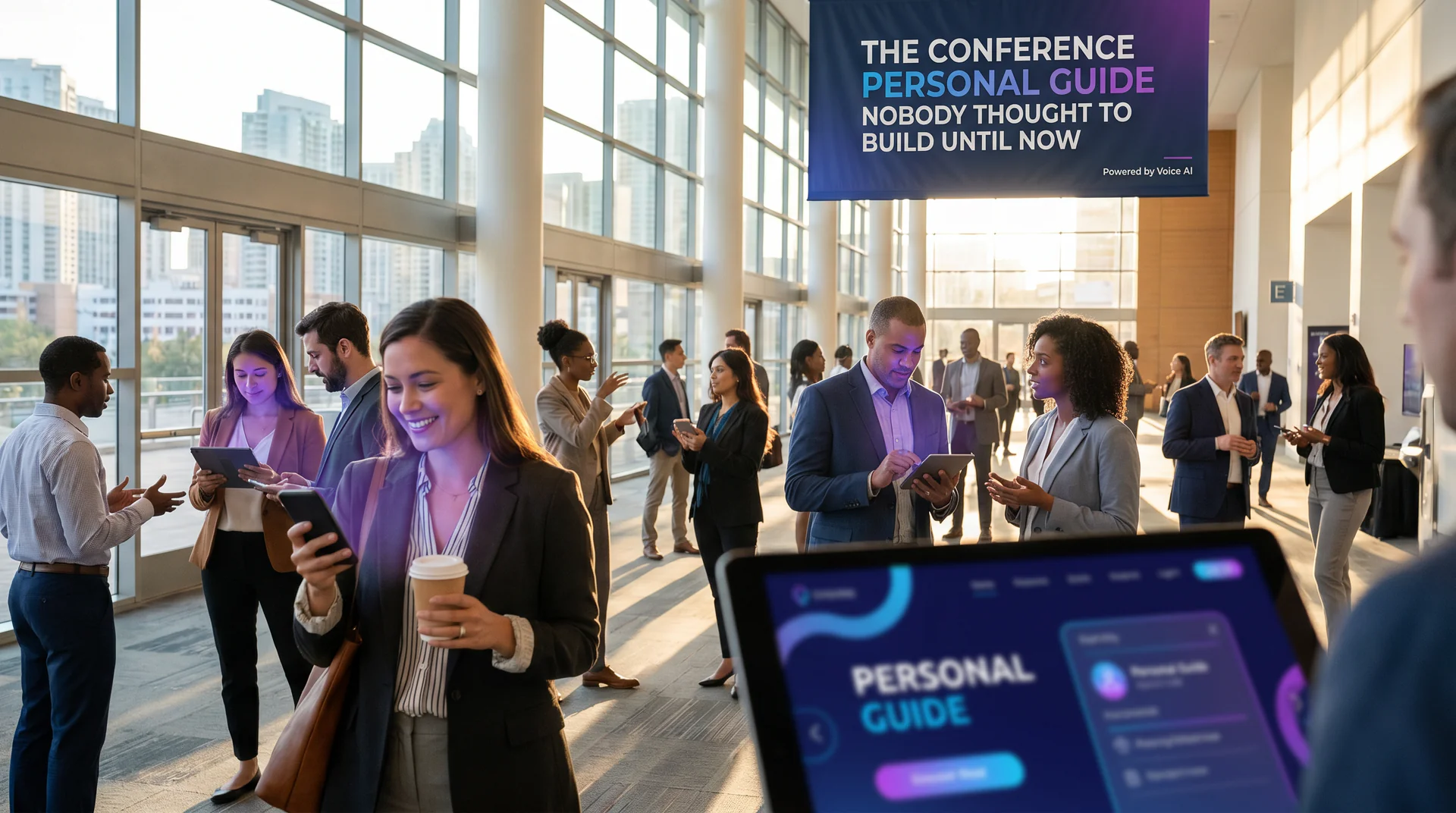
 The Conference Personal Guide Nobody Thought to Build Until Now
 Help Genie
 3,000 People. Zero Personal Guides.
Here is a pattern we keep seeing.
A conference opens its doors. Thousands of attendees walk in. They have a printed agenda they will probably lose by 10am, an event app that 80% of them will not open after day one, and a rough plan that starts dissolving the moment the first session fills up and they are standing in the corridor wondering what is happening in the other six rooms.
Nobody has a personal guide. Nobody has someone to ask. The information exists. It is just spread across a website, a PDF, a Slack channel, a floor map pinned near the registration desk, and the head of the events coordinator who is already fielding seventeen questions from sponsors.
This is not a small problem. Conferences are expensive to attend and expensive to run. The gap between what attendees came for and what they actually find in a given 45-minute window is where the value leaks out.
Voice AI is closing that gap. And the pattern it reveals on both sides of the room, attendee and organizer, is worth paying close attention to.
Why This Happens: The Structural Reasons
The information problem at large events is not new. Organizers have tried solving it with apps, printed guides, info desks, and volunteer teams. None of them scale.
An info desk covers maybe 2-3% of the questions that actually need answering on a busy conference floor. Apps require someone to open them, search correctly, and hope the content was updated after the 9am session change. Printed agendas are static from the moment they hit the printer.
The deeper problem is personalization. Every attendee came for a different reason. Someone from a food manufacturing company in regional Queensland is not looking for the same next step as a retail buyer from London attending the same conference. The agenda is the same for both of them. The personal guide should not be.
This is where a genie running for the event changes the math.
A genie knows the full agenda, the speaker lineup, what changed this morning, where lunch is being served, and what is happening in all seven rooms right now. More importantly, it can take a question like “I am here to learn about supply chain and I have not eaten yet, what should I do for the next 45 minutes” and give a useful, specific answer. Not a search result. An answer.
That capability does not exist at scale in any other format. A human volunteer team cannot personalize at 3,000-person scale. An app cannot hold a conversation.
What It Looks Like in Practice
Large Industry Conferences
At a trade conference with several thousand attendees, the typical session management problem looks like this. A popular morning keynote fills up. People who wanted that session are now free, unguided, and choosing between wandering the expo floor or heading to a session that was not on their original list.
Without a guide, most of them default to checking their phones or grabbing a coffee. The event loses 30-40 minutes of productive attendee time per person, multiplied by hundreds of people.
With a genie as their conference personal guide, those attendees can ask what is worth seeing right now given what they came to learn. The genie surfaces the breakout happening in Room 4 that directly matches their interest. It tells them the speaker has written specifically about their sector. It tells them the session runs until 11:15 and lunch is on Level 2.
That is a personal guide. It is exactly what a well-connected colleague would tell you if they happened to be standing next to you with the full conference picture in their head.
Events and Small Business Conferences
For smaller events, the challenge is different but the pattern holds. A regional business conference with 200-400 attendees does not have the budget for a large volunteer team or a custom-built app. The organizer is usually doing three jobs at once.
A genie deployed for the event can handle the steady stream of questions that would otherwise land on that organizer. Where is the parking validated? Is the afternoon workshop the same location as this morning? Can I still register for the advanced session or is it full?
These are not complex questions. But they take time, and they pull the organizer away from the things only they can do.
The genie also captures something the organizer would otherwise miss completely. Every question asked is data. Which session had people confused about location? Which workshop had a waiting list of people asking if spots opened up? Which speaker’s topic had attendees asking follow-up questions in the corridor that never made it onto the stage?
This is the part that matters most for the organizer running events as part of a small business model. The feedback that usually comes back as a 12% survey response rate, four weeks after the event, is now a live read of the room.
Trade Shows and Expo Formats
At trade shows, the attendee question changes again. People are not just looking for sessions. They are looking for people. Which exhibitor is relevant to what I am buying this quarter? Who on the show floor is working in food manufacturing for retail? Where are they likely to be right now?
A conference personal guide built on voice AI can handle this. Ask the genie who you should be talking to about a specific topic and it can pull from the exhibitor list, the attendee directory, the session speakers, and the floor map to give you a starting point. Three names. Where they are likely to be. What they do.
That is not a search function. That is a guide.
What This Means for Owner-Operators
If you run events as part of your business model, this pattern has a direct implication.
Your attendees are not getting the experience they paid for. Not because you have not tried. Because the information delivery problem at events has not had a good solution until now.
The events industry is one where reviews, referrals, and repeat attendance are everything. A first-time attendee who leaves feeling like they found what they came for is a returning attendee. One who felt lost and missed the sessions they actually wanted is unlikely to come back, and unlikely to recommend the event to colleagues.
The genie changes that equation on the attendee side. But the organizer-side data is equally valuable.
Most event organizers are making programming decisions for the next event based on impressions, post-event surveys with low response rates, and their own gut feel about what worked. That is a thin foundation for a $50,000-$500,000 production budget.
When every question 3,000 attendees ask is captured and analyzed, you stop guessing. You know which topics were underserved. You know which sessions had demand that spilled into the corridor. You know what new connections people wanted to make and could not find. You build the next event on that signal.
That is a meaningful operational advantage for anyone running conferences professionally. The conference personal guide for small business events carries the same logic at a smaller scale. Even 200 attendees generate enough conversational data across a full conference day to give you a clear picture of what they actually came for versus what you programmed.
The Pattern Worth Watching
The observation that keeps surfacing is this: event organizers are used to publishing information. They have not had a tool that delivers it conversationally, at scale, and captures the questions being asked in real time.
Voice AI fills that gap. Not by replacing the printed agenda or the info desk, but by doing something neither of those can do. It holds a conversation. It adapts to the person asking. It remembers what they told it earlier in the day.
The conference personal guide is not a luxury feature for large events with big tech budgets. It is a practical solution to a problem every event organizer knows. The information is there. Getting it to the right person at the right moment is the hard part.
A genie makes that part manageable.
See How It Works for Events
If you run conferences, trade shows, or corporate events, the events industry page shows how a genie can work as a personal guide for your attendees and a data layer for your team.
You can also explore how voice AI works across other live-format industries at explore genies, or run your own numbers on what missed questions and poor session flow cost you per event at the ROI calculator.
The next event you run does not have to guess what attendees came for. It can know.
Keep exploring
Further reading and useful tools
Best AgentZap Alternatives (2026)
Honest roundup of AgentZap alternatives for AI receptionists. Compare minute-based AI, flat-rate voice genies, and human answering services.
ComparisonBest Smith.ai Alternatives (2026)
Honest roundup of the top Smith.ai alternatives, from human answering services to flat-rate voice AI. Compare pricing models and find the right fit.
BlogWe answered a lot of calls with AI. Here's what surprised us.
Tim Boyle shares what actually happened when we put voice AI into production. The results were not what we expected.
BlogManuals Are Dead. Here's What Replaces Them
Nobody reads the manual. They call and ask. Here's why your knowledge base should be something people can talk to, not scroll through.
Industry InsightsQ2 2026 Phone Conversion Benchmarks What the Answer-Time Gap Is Costing Trades and Real Estate Businesses
Six Q2 2026 benchmarks on inbound phone conversion across trades and real estate. The answer-time gap is the biggest driver of lost revenue.
Industry InsightsSpeed to Answer Voice Genies vs Human Receptionists Across Six Key Metrics
How fast you answer predicts whether you win the lead. Here's how voice genies, internal receptionists, and outsourced services compare across six metrics.
Help Genie
The Help Genie Team
The Help Genie team builds voice AI genies that resolve everyday support on their own — across phone, chat, web, and email — in your voice, 24/7. We write about what we learn shipping it to real businesses.
Building voice AI for 11+ industries, from trades to hospitality.
- voice AI
- customer support
- lead capture
- multi-channel genies