 Industry Insights manufacturing
 Why Almost Half of Manufacturer Calls Go to Voicemail After 5pm
 Help Genie
 The Hours You’re Closed Are the Hours They’re Calling
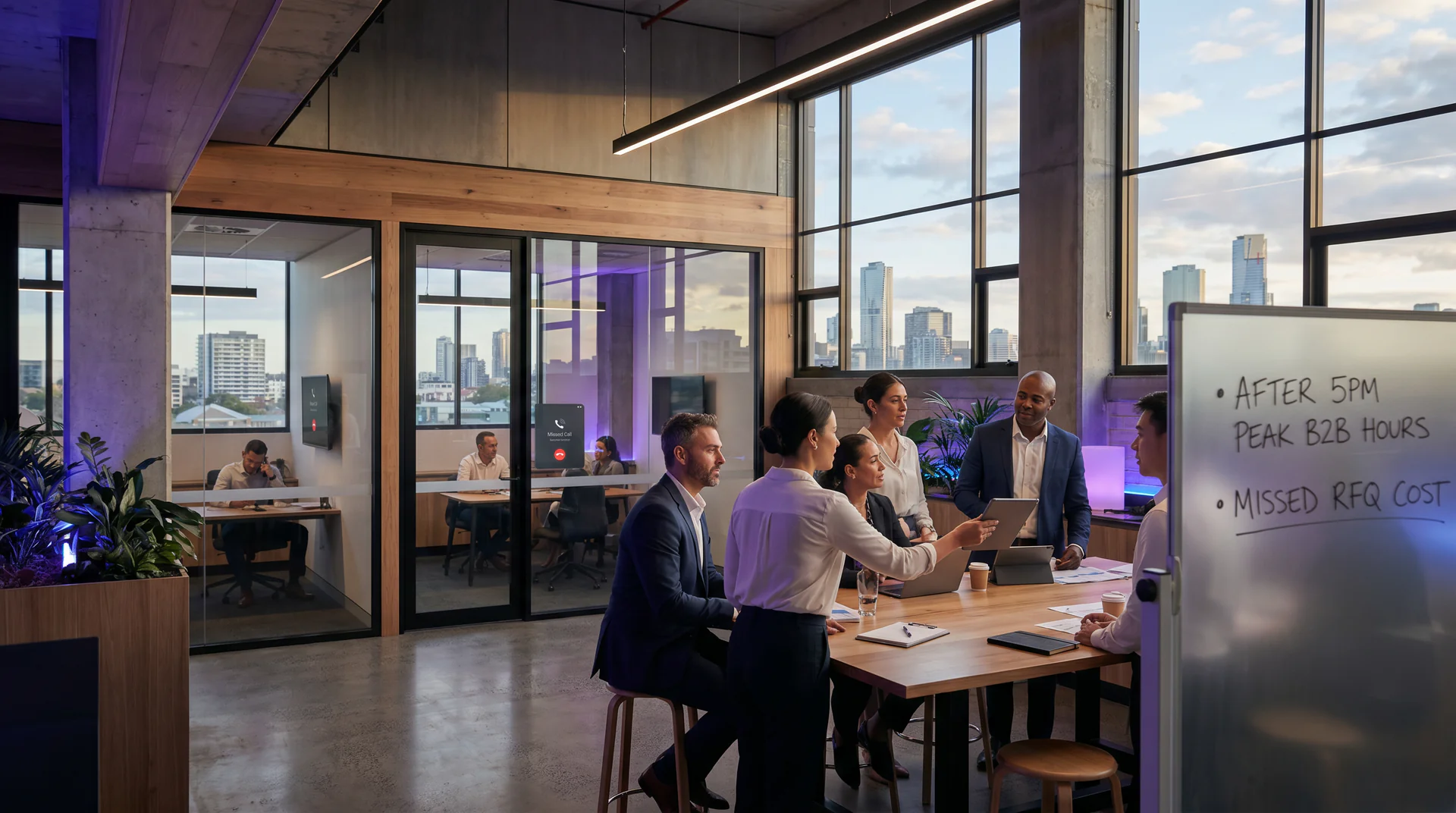
Most manufacturers close the front desk at 5pm. The phone rolls to voicemail. Staff head home.
Meanwhile, a procurement manager at a distributor in a different time zone is sitting at their desk at 3pm their time, ready to place an RFQ. A plant manager wrapping up a production review at 6pm local wants a quote before tomorrow’s standup. A maintenance buyer clearing their inbox at 7pm is choosing between three suppliers.
None of them leave a voicemail. They move on.
This is not a rare edge case. Based on patterns observed across B2B inbound research, somewhere between 40% and 50% of manufacturer inbound inquiries arrive outside the 9-to-5 window of the business receiving them. The reception desk hours inherited from a 1990s office model no longer match the actual demand curve. And the cost of that mismatch, measured in lost RFQs and slower win rates, is significant.
Here are five data points that explain the problem.
Data Point 1: 40-50% of Inbound Arrives Outside Local Business Hours
The manufacturing sector sells B2B. That means the people calling are not consumers checking a retail opening time. They are procurement officers, plant engineers, operations managers, and distributors. Many of them work across multiple time zones. Many of them call during their own productive hours, which may or may not align with yours.
Industry research on B2B inbound patterns consistently shows that 40% to 50% of inbound contact attempts, calls, form fills, and web inquiries arrive outside the recipient company’s core business hours. For manufacturers with national or international distribution, that share skews higher.
The 5pm cutoff was designed for a world where your customers were geographically close and worked the same shift. That world does not describe modern manufacturing supply chains.
Data Point 2: 60-70% of After-Hours Voicemails Get No Callback Within the Hour
Voicemail is not a safety net. It is where leads go to cool off.
Studies of B2B callback behavior show that 60% to 70% of voicemails left outside business hours receive no callback within the first hour of the next business day. By the time your sales team arrives at 8:30am and begins working through the overnight queue, a meaningful share of those callers have already moved on, either decided to wait for a different vendor who answered, or simply lost urgency.
Manufacturing missed calls compound this problem. Unlike a consumer query about a product return, a missed RFQ call often carries a tight decision timeline. Procurement teams working to a production schedule need answers now. Waiting overnight is not neutral. It is a signal to the buyer that you are less responsive than the next vendor on their list.
Data Point 3: First Vendor to Respond Wins 35-50% More Often
Speed of response is one of the most studied variables in B2B sales conversion, and the findings are consistent. Research across B2B sales environments shows the first vendor to respond to an inbound inquiry wins the deal 35% to 50% more often than vendors who respond later, even when price and product are comparable.
This is not about being pushy. It is about being present at the moment of intent.
When a procurement manager calls with an RFQ, they are in decision mode. They have a problem, a deadline, and a shortlist. The vendor who picks up, or responds within minutes, shapes the conversation. The vendor who returns the call the following morning is playing catch-up from the first sentence.
For manufacturers competing on tight margins, win rate is the lever that matters most. A 5% improvement in win rate across a year’s worth of RFQ volume is worth more than most cost-reduction initiatives. And a substantial share of that improvement is available simply by being present after 5pm.
Data Point 4: The Average Missed RFQ Carries Significant Downstream Value
A single missed call in manufacturing is not a lost $50 retail transaction. Depending on the product category, a single RFQ from a qualified distributor or procurement team can represent $5,000 to $500,000 or more in order value, with recurring purchase potential on top.
Even at the conservative end, if a manufacturer misses 10 to 20 qualified after-hours inquiries per month, and those inquiries carry an average first-order value in the $10,000 to $50,000 range, the monthly revenue exposure from B2B voicemail conversion failures is material.
The problem is that most manufacturers do not track this exposure. Voicemails that are not returned do not show up as lost deals in the CRM. They are invisible losses. The deal that never started does not generate a closed-lost record.
This is why manufacturer after-hours calls are systematically under-prioritised. The pain is real but hard to see on a dashboard.
Data Point 5: After-Hours Human Coverage Costs 3-5x More Than Voice AI
Some manufacturers have tried to solve this with human coverage. An after-hours dispatcher or sales coordinator taking calls from 5pm to 9pm, five days a week, plus weekend coverage, represents a full-time or near-full-time salary commitment.
Depending on the market, that role costs $50,000 to $90,000 annually, before on-costs, training, turnover, and the reality that a single person cannot handle peak volume during shift changes or busy periods.
Voice AI covers the same window at a fraction of that cost, without sick days, without scheduling complexity, and without a knowledge gap when the product range expands. A genie built on a manufacturer’s knowledge base, drawing on spec sheets, pricing guides, distributor FAQs, and fault-code documentation, can handle a first-contact inquiry with enough accuracy to capture the lead, qualify the intent, and route the follow-up correctly.
The comparison is not “human versus machine”. It is “adequate coverage versus no coverage”, and for most mid-sized manufacturers, no coverage is exactly what exists after 5pm today.
Why the 5pm Cutoff Still Exists
The obvious question is why manufacturers have not fixed this already.
Part of the answer is structural. Manufacturing businesses grew up with sales reps managing named accounts by phone and in person. Inbound from unknown callers was lower volume and lower priority. The model worked when the supply chain was regional and the buyer’s alternatives were limited.
Part of it is budget sequencing. Hiring headcount for after-hours is a hard sell to a CFO when you cannot easily show the revenue it would have captured. The invisible-loss problem makes the ROI case difficult to construct.
And part of it is simply inertia. The voicemail system has been there since the late 1990s. Nobody has been assigned to fix it.
What It Looks Like in Practice
Consider a mid-sized industrial components manufacturer with a national distributor network. Their sales team works 8am to 5pm. Their website gets steady traffic through the evening from procurement teams working late and buyers in other time zones.
Without after-hours coverage, every one of those contacts either fills out a static form and waits, or calls and hits voicemail. The form leads get processed the next morning. The voicemails get returned when someone has time.
With a genie deployed on the same knowledge base that powers their internal fault-code documentation (the kind of structured product information manufacturers already maintain), incoming calls after 5pm get an immediate response. The genie captures the inquiry type, the product category, the urgency level, and the contact details. It routes urgent fault or downtime-related calls differently from standard RFQ calls. It sends a summary to the relevant account manager before 7am.
By morning, the sales team is not starting cold. They have a warm, qualified lead with context. That is a different conversation than “Hi, sorry I missed your call yesterday, how can I help?”
This is the model described in our manufacturing industry overview and it maps directly to the kind of structured product support covered in our use case on fault code troubleshooting for voice AI.
The Implication for Manufacturer-Owners
If you run a manufacturing business and your phone goes to voicemail at 5pm, you are not operating a closed business. You are operating a business that is actively handing leads to competitors who are answering.
The fix is not complicated. It requires acknowledging that your demand curve does not follow your office hours. Then it requires putting something in place, at minimum a voice AI genie that can hold the first conversation, capture intent, and ensure the follow-up lands the next morning with enough context to close.
The cost of B2B voicemail conversion failures at scale is not recoverable. You cannot call back a procurement team that chose another vendor overnight. But you can stop the bleed going forward.
See the Numbers for Your Business
The five data points above are industry-level patterns. Your actual exposure depends on your inbound volume, your average deal value, and how many of your customers are calling from a different time zone.
If you want to work through what after-hours coverage is worth for your specific situation, the ROI calculator is built for exactly this. Run your own numbers. Then decide whether a 5pm cutoff still makes sense.