Office Equipment Callout Cost: The $185 Paper Jam Problem Nobody Talks About
The Call Nobody Should Have to Make
A service callout. $185. Two hours. One technician.
The job? Clearing a paper jam.
If you run an office equipment business, you’ve seen this more times than you can count. A technician drives 40 minutes across town, spends three minutes in a server room, and drives back. The customer is relieved. Your tech is frustrated. And the invoice looks embarrassing for everyone involved.
This is the pattern we keep seeing across office equipment dealers, managed print providers, and copier service businesses. A large slice of callouts, conservatively 30-40% by field estimates, are avoidable with the right information delivered at the right moment. Not a manual. Not a hold queue. Not a callback from the service desk tomorrow morning.
The right answer, delivered in four seconds, at the machine.
Why This Keeps Happening
The structural reason is simple. Office equipment is complex enough that end users don’t feel confident troubleshooting it. But most issues aren’t actually complex. They’re just unfamiliar.
A paper jam in Tray 2 on a mid-range multifunction printer has a documented resolution sequence. It’s in the service manual. It’s on the manufacturer’s support site. But the office manager standing in front of a blinking machine at 9:47am on a Tuesday isn’t going to hunt through a PDF. She’s going to call your service line.
And your service line is either going to walk her through it (best case), put her on hold until a technician is free (likely), or log a callout because nobody picked up (too common).
The callout gets logged. The tech gets dispatched. The job closes. And $185 leaves your margin.
There are three compounding factors that make this worse:
The knowledge is locked away. Service manuals are written for technicians, not users. Troubleshooting guides live on intranets nobody visits. The machine itself often has an error code on screen, but translating that code requires a lookup table most users don’t know exists.
The phone line is the path of least resistance. Calling feels faster than searching. For an office manager who needs the printer running in the next ten minutes, calling your support number is the obvious move. If your team answers and resolves it verbally, great. If not, a callout gets created.
Callouts are billed, so the incentive to reduce them isn’t always obvious. Some service businesses quietly rely on avoidable callouts to fill technician schedules. But as labor costs rise and technician time becomes more constrained, this math flips. An hour spent clearing a paper jam is an hour not spent on a complex fault that actually needs skilled hands.
What This Looks Like Across the Industry
Copier Dealers and Managed Print Providers
This is where the pattern is most visible. A typical managed print contract covers “all service and consumables” for a flat monthly fee. Every callout that goes out the door costs the dealer real money, whether the customer sees it or not.
Common avoidable callouts in this segment: paper jams, low toner warnings misread as printer failures, network connectivity drops that look like printer faults, and print queue errors cleared by restarting the spooler service.
None of these require a technician. All of them get logged as callouts when the end user can’t resolve them independently.
A genie deployed on a QR code sticker on the side of every machine changes the workflow. The office manager scans the code, describes the issue in plain language, and gets a step-by-step resolution. If the genie’s knowledge base includes the machine’s error codes and the most common fault sequences, it resolves the issue in under a minute. The callout never gets logged. The tech keeps driving to the job that actually needs a tech.
Office Technology Retailers
Retailers face a different version of the same problem. A customer buys a multifunction device. It goes home or to a small office. Three weeks later, something goes sideways. Scanning to email stops working. The wireless connection drops. A print job gets stuck.
The customer calls the retailer. Not the manufacturer. Not the IT department. The store.
Your floor staff are good at selling. They’re not always equipped to walk someone through a network configuration over the phone. So the call either ends with a frustrated customer or escalates to a service visit.
Retailers that have deployed a genie against their product knowledge base, installation guides, and common fault patterns are resolving a significant share of these calls before they reach staff. The genie handles the “my scanner isn’t working” call. Your team handles the “I want to upgrade my whole office” call.
Small Business and SME End Users
For small businesses buying or leasing office equipment, the office equipment callout cost is a real line item. A single service visit at $150-$200, before parts, adds up fast if it’s happening once or twice a month across a small fleet.
Most small businesses don’t have IT staff. The person who manages the printer is also managing the accounts and the front desk. When something breaks, she calls the number on the maintenance agreement.
If that number goes to a hold queue or an after-hours voicemail, the callout gets lodged. The next morning a tech gets dispatched. A job that could have been resolved with a two-minute guided walkthrough becomes a half-day event.
Voice AI deployed through a phone number or QR code gives that office manager somewhere to turn that isn’t a hold queue. The genie asks what machine she’s using, what the screen says, and walks her through the resolution. It’s available at 11pm when she’s trying to finish a proposal. It knows the machine because the knowledge base was built from the actual service documentation.
What It Means for Owner-Operators
If you run an office equipment business, the callout cost conversation usually focuses on labor rates and travel time. Those are real costs. But the bigger opportunity is in the calls that shouldn’t become callouts at all.
A conservative estimate: if 30% of your service calls are avoidable with better information delivery, and your average callout runs $150-$200 all-in, a business dispatching 50 callouts a month is spending somewhere between $2,250 and $3,000 a month on avoidable visits. That’s before accounting for the technician time that could have gone toward higher-value work.
This is the math that shifts when you put a genie on the side of every machine you deploy.
The genie doesn’t replace your technicians. It filters the queue. The calls that actually need skilled hands still come through. But the paper jams, the network resets, the toner confusion, the error codes with documented resolutions: those get handled before they become dispatch orders.
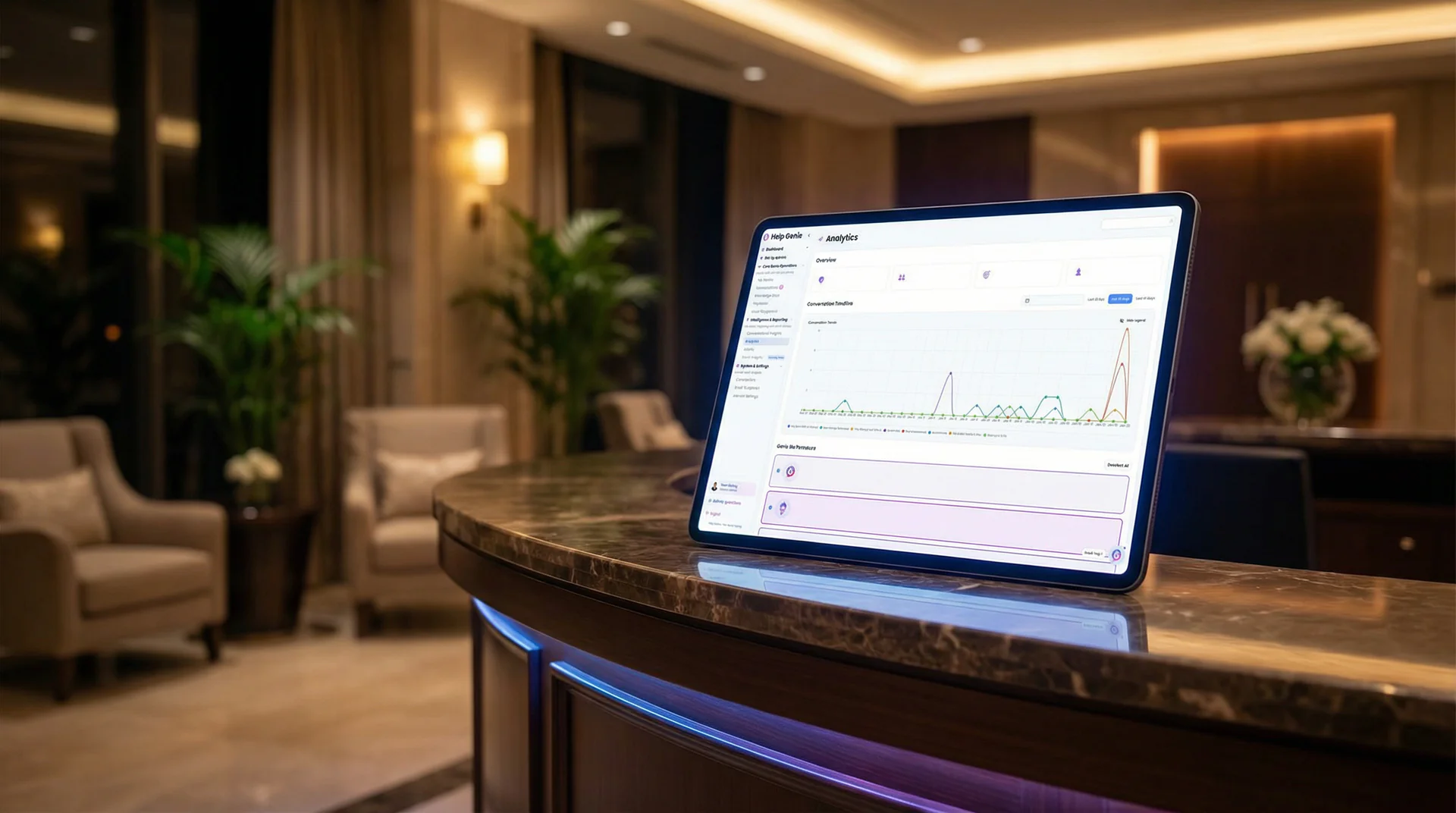
There’s a secondary benefit that’s easy to miss. Every conversation the genie has gets logged. You can see which machines are generating the most support queries, which error codes come up repeatedly, and which resolutions are landing. That data shapes your service strategy, your customer training, and eventually your product recommendations.
The genie captures leads while it handles support. A customer calling about a paper jam on a five-year-old machine might be ready to talk about replacement. The genie can surface that conversation at the right moment, hand off a qualified lead, and flag it for your sales team.
The Sticker on the Side of Every Machine
Here’s the version of this that works in the field.
You ship a machine. On the side, there’s a QR code sticker. It says: “Got a question? Scan here.” The customer scans it. They talk to your genie. The genie knows the machine, knows the common faults, knows your service policies.
Most of the time, the issue gets resolved right there.
When it doesn’t, the genie captures the customer’s details, logs the fault description, and creates a service request with context already attached. Your tech arrives knowing what they’re walking into.
The callout still happens when it needs to. But the ones that shouldn’t happen, don’t.
That’s the shift. Not fewer technicians. Fewer wasted trips.
If you’re running an office equipment business and you want to see what this looks like in practice, the office equipment industry page shows how other dealers are deploying genies across their fleet. Or if you want to run the numbers for your own callout volume, the ROI calculator is a good starting point.
The $185 paper jam callout is a solvable problem. Most of them are.