 Industry Insights general
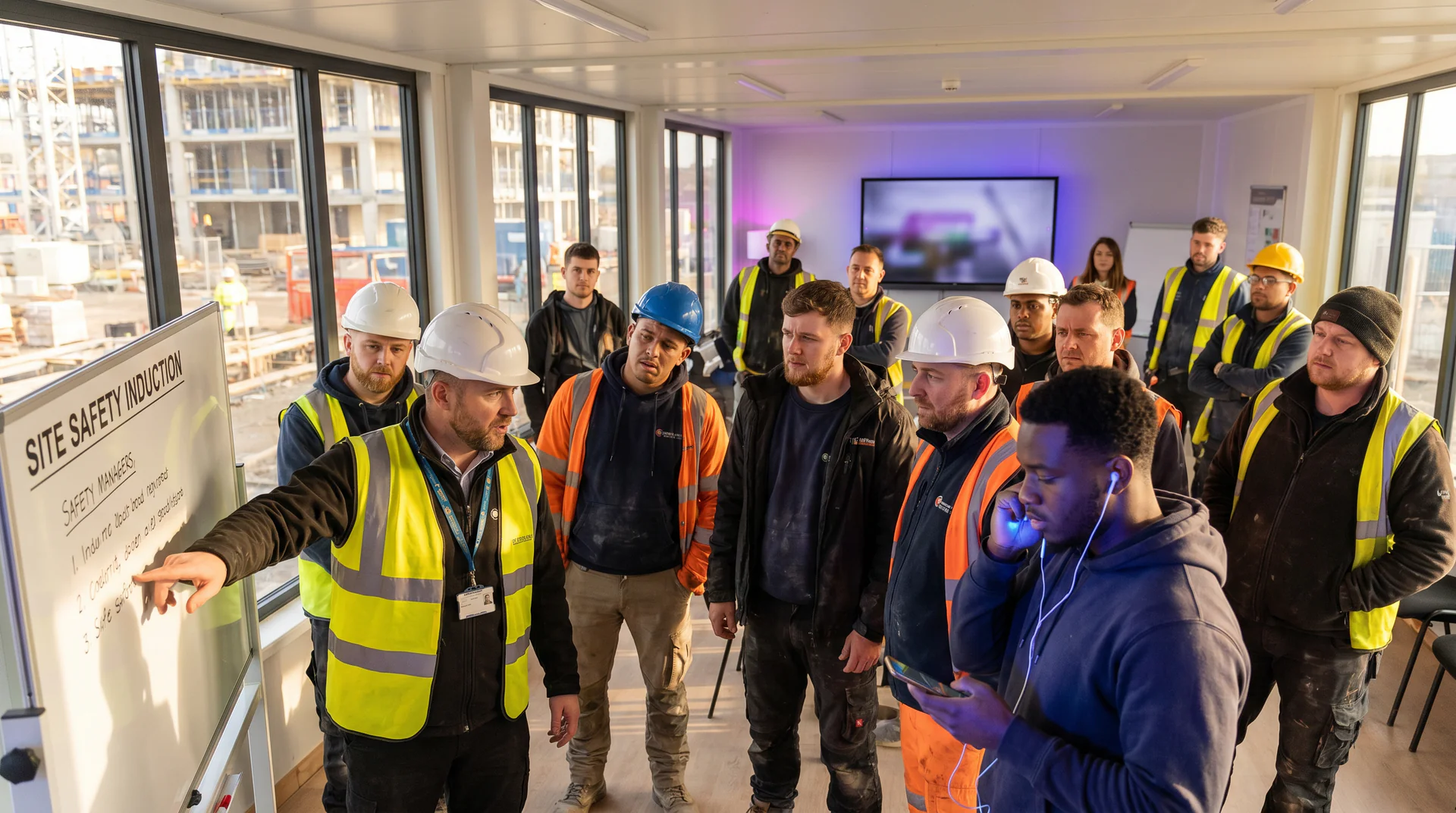
 The Safety Induction Is in English. Half the Crew Isn't.
 Help Genie
 The Gap Between Signed and Understood
On most active build sites, somewhere between 30 and 60 percent of the workforce isn’t a first-language English speaker. That number is higher in major metros. It’s higher still on specialist trades crews, in agricultural processing, and in logistics yards where labour is sourced from specific migrant communities.
Then we hand those workers a 14-page safety induction. In English. We run a 30-minute toolbox talk. In English. Everyone signs the attendance sheet. And the site supervisor walks away believing the compliance box is ticked.
It isn’t.
There are two boxes. The compliance box says “everyone was present and signed the form.” The safety box says “everyone understood what they just heard.” Those are not the same box. Most sites are ticking one and calling it two.
This pattern keeps showing up. It shows up in incident reports after the fact. It shows up in near-miss conversations. And it’s starting to show up in regulator questions that don’t have good answers yet.
Why This Keeps Happening
The short answer is that compliance was designed around documentation, not comprehension.
Sign-in sheets, induction checklists, and witnessed signatures all serve a legal function. They create a record. They demonstrate that a process was followed. But they say nothing about whether the person who signed actually understood the exclusion zone, the fall protection procedure, or the daily hazard register that was updated that morning.
The longer answer involves how safety inductions get built. They’re built by safety officers, site managers, and HR teams who are working in English. The document is approved, printed, filed. The toolbox talk script is written once and delivered verbatim every Monday morning. The system is internally consistent. It just doesn’t account for the person standing in the third row who speaks Tagalog at home and can follow conversational English well enough to nod but not well enough to parse “lock-out tag-out protocol for energized plant equipment.”
There’s also a social dynamic that makes the gap worse. Workers who aren’t confident in English are often reluctant to raise their hand in a group setting and say they didn’t follow. They’ll sign the form. They’ll stand quietly. They’ll figure it out on site.
And usually they do. Until they don’t.
What It Looks Like Across Three Industries
Construction and Civil Works
This is where the pattern is most visible and the risk is highest.
Method statements get updated mid-project. A new exclusion zone gets added when a crane swing changes. Fall protection requirements shift when a scaffold configuration is amended. These updates need to reach every person on site that morning, including the crew who arrived at 5:30am before the pre-start meeting.
The site safety toolbox talk for small business operators is typically one supervisor, one printed update, and a verbal rundown. If the crew speaks three languages between them, one of those languages is getting the message clearly. The other two are getting a version of it filtered through someone who’s translating on the fly.
That’s not a criticism of the supervisor. That’s just the structural reality of how information moves on a multilingual site.
Agricultural Processing and Packing
Large seasonal processing operations often bring in workers from specific communities. It’s common to find a packing shed where 70 to 80 percent of the floor is from one language group and the remaining workers are from two or three others.
Chemical handling is the critical risk here. Cleaning agents, pest control procedures, and food-grade sanitization protocols have specific steps. Miss a step or apply the wrong concentration and you have a worker injury or a food safety event. The induction covers all of this. In English.
The site safety toolbox talk in these environments is often delivered by a line supervisor whose job is throughput, not safety instruction. They’re not bad at it. But they’re delivering a complex procedure to a group that is nodding along, and nodding along is not the same as understanding.
Logistics and Warehousing
Warehouses running 24-hour shifts with rotating crews face a particular version of this problem. Safety updates don’t always catch night crews. Hazard notifications posted in English go unread. A new forklift traffic pattern gets communicated at the day-shift briefing and never quite makes it to the workers who only come in at 10pm.
The voice AI site safety application here is straightforward. A worker scans a QR code at the start of their shift. A genie walks them through the current hazard register, the updated traffic protocol, and any new equipment exclusions. It does this in the language that worker actually thinks in. It asks a confirmation question at the end. It logs the response.
That’s not a replacement for a human safety officer. It’s the gap-filler between human briefings that currently doesn’t exist.
The Regulator Question That’s Coming
The question regulators are starting to ask, and will ask more often, is not “was the induction conducted?” It’s “how do you know the workers understood the procedure?”
Right now, the honest answer at most sites is “they signed the form.”
That answer is going to get harder to defend. Not because regulators are being unreasonable. Because the evidence base for what “good” looks like is shifting. When comprehension-verified safety inductions become possible and cost-effective, “we just did it the old way” stops being a reasonable response.
A genie running on a worker’s phone in their own language creates a different kind of evidence trail. It records that the worker heard the fall protection procedure in Filipino. It records that they answered the confirmation question correctly. It records the timestamp and the site location. That’s something a sign-in sheet cannot do.
For small business operators running a site safety toolbox talk with a mixed-language crew, that evidence trail is also a protection. If there’s an incident and the question is “did your Filipino crew understand the new exclusion zone protocol on Tuesday morning,” the answer is no longer “they were there.” It’s a log.
What This Means for Owner-Operators
If you’re running a small to mid-size site, this isn’t an abstract enterprise problem. It’s a Monday morning problem.
You have a method statement update. You have six people on site, three of whom have limited English. You have 10 minutes before work starts. You do your best.
The site safety toolbox talk for small business doesn’t need to be a perfect multilingual delivery. But it does need to reach people in a form they can actually absorb. That’s the standard you’re being held to, whether the current documentation system reflects it or not.
Voice AI running from a shared device or a personal phone is a practical tool for this gap. Not because it replaces the toolbox talk. Because it extends it into the languages where the information actually needs to land.
The same source documents. The same authority. The same procedures. Just delivered in the language the worker thinks in. A genie pulling from your uploaded safety documents can answer “what is the exclusion zone around the crane this morning” in Spanish, in Tagalog, in Mandarin, in Hindi. It’s not a different safety standard. It’s the same standard, actually reached.
Sites that close this gap will have fewer incidents. The math on that is simple. Fewer incidents means fewer injuries, fewer shutdowns, fewer legal costs, and fewer conversations with a regulator asking how you know your crew understood.
Sites that don’t close it will keep ticking the compliance box and leaving the safety box empty. That’s a defensible position right up until it isn’t.
Start Where You Are
You don’t need to rebuild your entire safety process to get this right. Start with the documents you already have. Your method statements, your hazard registers, your lock-out tag-out procedures. Upload them. Deploy a genie that can answer questions from those documents in multiple languages. Put a QR code at the site entrance.
That’s the minimum viable version. It works on day one.
If you’re in construction, trades, manufacturing, or logistics and you want to see how voice AI fits into a real site safety workflow, explore what Help Genie’s platform can do for your industry.
See how it works for trades and construction or explore the full platform.
Keep exploring
Further reading and useful tools
Best AgentZap Alternatives (2026)
Honest roundup of AgentZap alternatives for AI receptionists. Compare minute-based AI, flat-rate voice genies, and human answering services.
ComparisonBest Smith.ai Alternatives (2026)
Honest roundup of the top Smith.ai alternatives, from human answering services to flat-rate voice AI. Compare pricing models and find the right fit.
BlogWe answered a lot of calls with AI. Here's what surprised us.
Tim Boyle shares what actually happened when we put voice AI into production. The results were not what we expected.
BlogManuals Are Dead. Here's What Replaces Them
Nobody reads the manual. They call and ask. Here's why your knowledge base should be something people can talk to, not scroll through.
Industry InsightsQ2 2026 Phone Conversion Benchmarks What the Answer-Time Gap Is Costing Trades and Real Estate Businesses
Six Q2 2026 benchmarks on inbound phone conversion across trades and real estate. The answer-time gap is the biggest driver of lost revenue.
Industry InsightsSpeed to Answer Voice Genies vs Human Receptionists Across Six Key Metrics
How fast you answer predicts whether you win the lead. Here's how voice genies, internal receptionists, and outsourced services compare across six metrics.
Help Genie
The Help Genie Team
The Help Genie team builds voice AI genies that resolve everyday support on their own — across phone, chat, web, and email — in your voice, 24/7. We write about what we learn shipping it to real businesses.
Building voice AI for 11+ industries, from trades to hospitality.
- voice AI
- customer support
- lead capture
- multi-channel genies