 Use Case manufacturing
 Ask the Pump. Ask the SOP. Ask Your Industrial Genie.
Voice AI for industrial and manufacturing sites. Any worker asks any question in plain language and gets the answer in seconds. No manuals, no waiting.
 Help Genie
 It’s 2am and the Pump Is Down
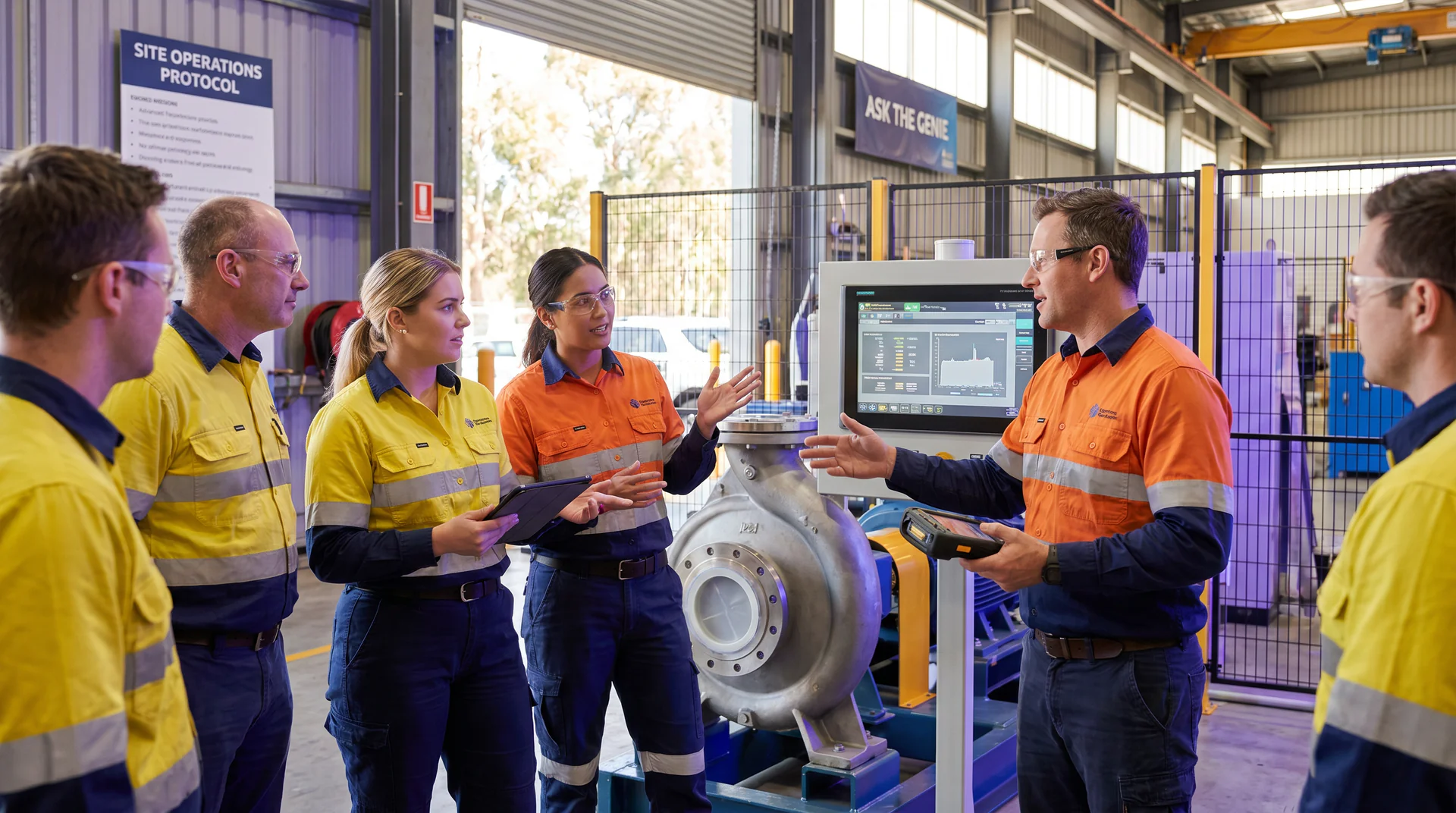
Jake is a contract fitter. He’s on night shift at a mid-size processing plant. A centrifugal pump starts making a noise it shouldn’t. Vibration. Heat. The operator shuts it down and calls Jake over.
Jake has been on site for three weeks. He knows his trade. But he doesn’t know this specific pump. He doesn’t know the service intervals logged against it, the last bearing replacement, or whether the manufacturer recommends a soft-foot check before restarting.
The maintenance supervisor is off site. The equipment manual is in a binder somewhere in the site office. That binder might be the 2019 edition. There might be a more current revision on someone’s desktop.
Jake makes a judgment call. He’s good at his job, so the call is probably right. But “probably” is not a word you want attached to rotating equipment at 2am.
This is the gap. Not a skill gap. An information gap.
The Problem Is Access, Not Expertise
Every industrial site runs on knowledge. Operating manuals. Service interval schedules. Datasheets. Job Safety Analyses. Maintenance logs. Standard Operating Procedures.
Most of that knowledge exists somewhere. It’s in a PDF on a shared drive. It’s in a binder in the foreman’s office. It’s in the head of the senior fitter who retired eighteen months ago.
The problem is access. Getting to the right document, finding the right section, cross-referencing it with the maintenance log, and doing all of that in the middle of a live fault situation is slow. Often it doesn’t happen at all. Workers do what they know, call who they can reach, or make a call and move on.
For small industrial operations and contract-heavy sites, the problem is sharper. There’s less institutional memory on any given shift. Contractors rotate. Apprentices outnumber experienced trades. The people who built the knowledge base aren’t always there when you need them.
The cost shows up in a few ways. Unplanned downtime that runs longer than it should. Repeat faults because the root cause wasn’t checked against the service history. Safety incidents that trace back to a missed step in a JSA. These aren’t rare edge cases. Industry estimates put unplanned downtime costs at anywhere from $50,000 to $500,000 per hour for process-dependent manufacturing operations, depending on the sector.
The fix isn’t more binders. It’s faster access.
Ask the Pump. Ask the Bearing. Ask the SOP.
Here’s what changes when you deploy an industrial genie built on your actual documentation.
Your genie reads every operating manual, every service interval schedule, every datasheet, every JSA, every maintenance record you give it. That becomes its knowledge base. Not a summary. Not a rewrite. The actual content, searchable by anyone who asks a question in plain language.
Jake, back at that pump, pulls out his phone. He asks:
“What are the bearing specs for the P-204 centrifugal pump and when was the last replacement logged?”
The genie answers in under five seconds. Bearing model, tolerance, last service date pulled from the maintenance log. It also flags that the manufacturer recommends checking shaft alignment after any bearing event above a set temperature threshold.
Jake didn’t have to know to ask that second part. The genie surfaced it because it’s in the documentation.
That’s the difference between a search engine and a genie. A search engine returns documents. The genie reads them and answers the question.
How It Works on a Real Industrial Site
The setup follows three steps, and none of them require a developer.
Step one: upload your documents. Maintenance logs, datasheets, SOPs, JSAs, equipment manuals, manufacturer bulletins. Whatever you have. PDF, Word, website content, it all goes into the knowledge base. You can also add FAQs manually if there are common questions that come up repeatedly on site.
Step two: customize your genie. This is where you set the genie’s scope. What it should answer. What it should escalate. You can set it to capture the asker’s name and crew ID so there’s a record of every query. You can configure it to flag certain question types for supervisor follow-up.
Step three: go live. The genie deploys to a phone number, a QR code on the equipment itself, or a web link. Workers access it on the phone they already carry. No app to download. No login process to remember. Voice or text, in their own words.
A fitter in a noisy shed can speak the question. An apprentice who isn’t sure how to phrase it technically can describe what they’re seeing in plain language. The genie handles both.
QR codes on physical assets are particularly effective in industrial settings. Stick the code on the pump, the compressor, the control panel. A worker scans it and the genie opens pre-scoped to that asset’s documentation. They ask their question. They get their answer.
What Workers Are Actually Asking
On a typical industrial site, the most common queries break into a few categories.
Service and maintenance questions come up constantly. “What’s the oil spec for this gearbox?” “When is the next planned maintenance window on conveyor 3?” “What torque setting does the manual specify for the flange bolts?”
Fault diagnosis questions follow. “This valve is leaking past the seat, what does the troubleshooting section say?” “The temperature alarm is reading high on the heat exchanger, what are the first three checks?”
Safety and procedure questions are critical. “What PPE does the JSA require for working in this area?” “What’s the lockout sequence for this machine?” “Is there a confined space permit required for this task?”
And documentation queries. “Was there a service bulletin issued for this model after 2022?” “What did the last inspection find on this unit?”
Every one of those questions has an answer somewhere in the documentation. The genie finds it in seconds instead of minutes or not at all.
The Outcome
The shift is measurable across a few dimensions.
Response time drops from minutes to seconds. Finding the right section of the right document manually takes anywhere from 5 to 25 minutes, assuming you find the right document at all. The genie answers in under 10 seconds in most cases. On a night shift with a fault in progress, that’s meaningful.
Knowledge gaps close across skill levels. An apprentice asking the genie gets the same answer as a senior fitter asking the same question. The genie doesn’t know who’s asking. It just answers from the knowledge base. Industrial operations that have piloted voice AI knowledge tools report measurable reductions in repeat faults and missed steps, with some estimating 20-35% fewer callbacks on the same fault within a service period.
Contractors come up to speed faster. A contractor who’s been on site for three days is operating at a fraction of the knowledge depth of a long-term employee. The genie closes that gap. They can ask about site-specific procedures, equipment quirks, and safety requirements without needing the supervisor to walk them through it.
Every query is logged. The genie keeps a record of what was asked, when, and what it answered. That’s useful data. If the same question comes up repeatedly, it signals a gap in training or documentation. If an unusual fault pattern shows up in the query logs before it shows up in the maintenance reports, that’s early visibility.
Supervisors get time back. A significant portion of supervisor interruptions on industrial sites are information questions. “Where’s the manual for this?” “What does the SOP say?” A genie handles those. Supervisors stay focused on decisions that actually need them.
Small Sites Benefit Most
For large industrial operations, the case for an industrial knowledge genie is clear. But the argument is actually stronger for small and mid-size sites.
A 40-person fabrication shop doesn’t have a full-time maintenance engineer on every shift. A contract mining support business doesn’t have a dedicated documentation team. These operations carry the same knowledge complexity as large sites but with far fewer people to hold that knowledge.
“Industrial ask your for small business” isn’t a niche use case. It’s often the primary use case. The genie gives a small operation enterprise-level knowledge access without the headcount.
The Manual Isn’t the Problem. Access Is.
The documentation exists. The knowledge is there. The problem is that it’s locked in formats and locations that slow workers down at exactly the moment they need it most.
An industrial genie doesn’t replace the documentation. It makes the documentation answerable. Any worker, any question, any time, in plain language, on a phone they already have.
Ask the pump. Ask the bearing. Ask the SOP. Ask the maintenance log.
The answer is already in there. Now it takes five seconds to get it out.
See how voice AI fits your manufacturing or industrial operation at /industrial, or use the ROI calculator to put numbers against the time your team spends hunting for answers.