 Use Case manufacturing
 How Mining Teams Get Answers at 2am
A mining genie reads every manual, SOP, and JSA so your fitters get voice answers in seconds, not a phone call to a senior at 2am.
 Help Genie
 It’s 2am on the Pit Floor
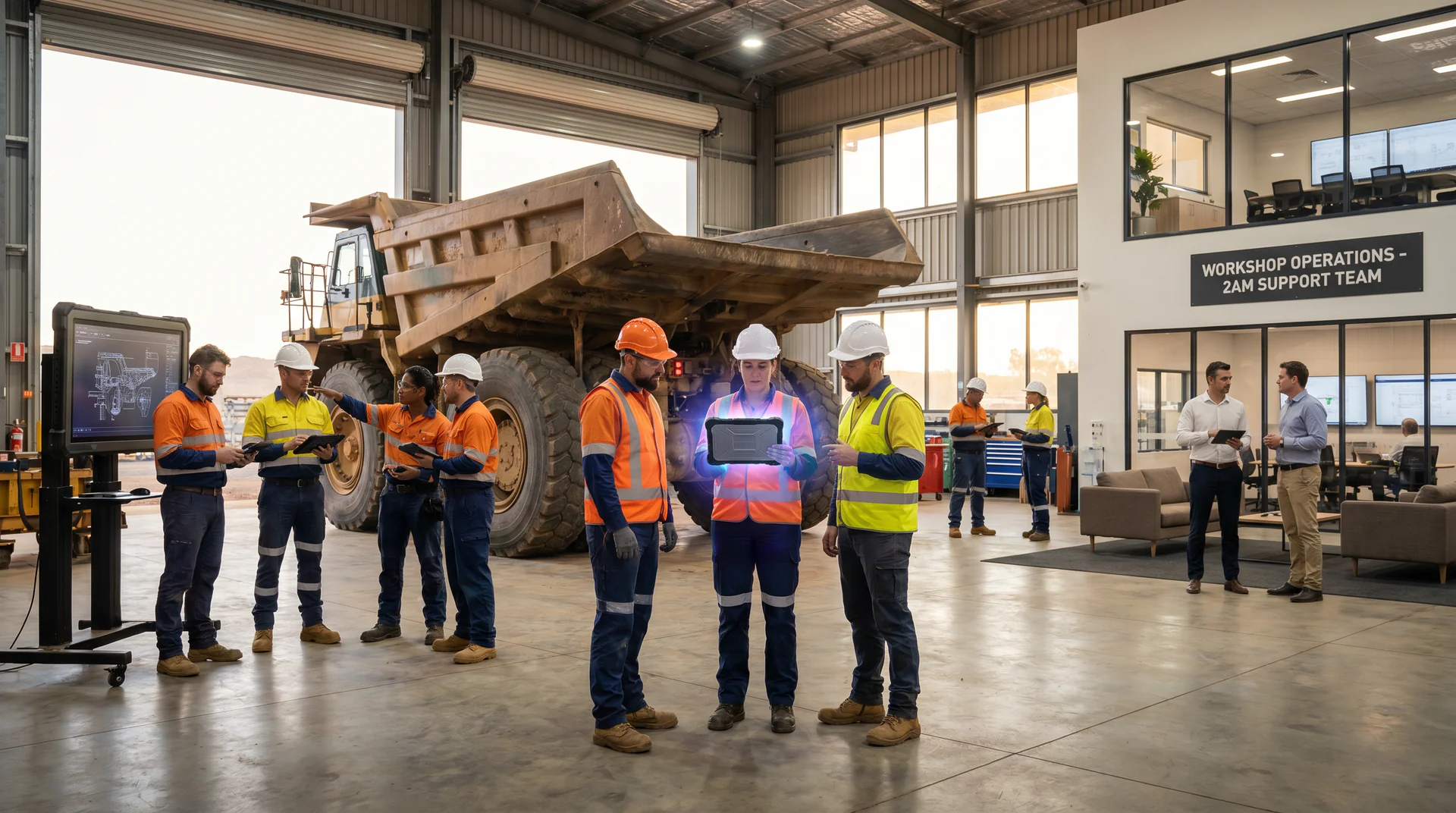
The fitter crouches next to a conveyor. Something’s wrong with the tail pulley bearing. The machine is down. His shift supervisor is on the other end of the site. The maintenance binder is back in the crib room, and even if he had it, he’d need the right page fast.
He could call the senior technician. But it’s 2am. And this is the third time this week someone’s called him for something that was written down somewhere.
So instead, he pulls out his phone. He asks the question in his own words.
Five seconds later, he has a voice answer. Page reference included.
That’s what a mining genie does.
The Gap That Costs Operations Money
Mining operations run on documentation. Every haul truck has an operating manual. Every conveyor has a maintenance procedure. Every task has a Job Safety Analysis. Every shutdown has an SOP. Suppliers send datasheets. Regulatory bodies send updates. Safety briefings happen at the start of every shift.
The documentation exists. That’s not the problem.
The problem is access at the moment someone needs it.
At 2am, on the pit floor, covered in dust, the SOP binder is not close enough to be useful. The right page is not obvious. The person who knows where to look is asleep. So workers make a call, make a guess, or make a delay. None of those options are good.
Senior technicians become unofficial help desks. They carry years of knowledge, but they also carry phones that ring at all hours. A 10-minute call to walk someone through a procedure they could have read in 30 seconds is not the best use of that expertise.
Multiply that across a full roster. Across multiple sites. Across every shift that runs overnight.
The cost shows up in downtime, in decision delays, in senior people burning out from being the human index for documentation they already wrote.
What a Mining Genie Actually Does
A mining genie reads everything. Every operating manual. Every maintenance procedure. Every JSA. Every shutdown SOP. Every supplier datasheet. You upload the documents into the knowledge base, and the genie learns them.
It doesn’t summarize them loosely. It answers questions from them, with references to the source material.
Here’s how that works in practice.
Step 1: The Worker Asks in Plain Language
The fitter doesn’t search a document management system. He doesn’t remember a folder path or a file name. He asks the way he’d ask a colleague.
“What’s the torque spec for the tail pulley bearing on this conveyor?”
“What’s the lockout procedure before I open this panel?”
“What PPE does the JSA require for this task?”
The genie receives the question in natural language, via voice or text, and it understands what’s being asked.
Step 2: The Genie Finds the Answer
The genie works through the knowledge base. It looks at the documents you’ve uploaded. It finds the relevant procedure, the correct specification, the exact safety requirement. This is not a guess. It’s a retrieval from the documentation you already created and approved.
For voice AI mining use cases, the response comes back as a spoken answer. The fitter hears the torque spec. He hears the page reference so he can verify it if needed.
The whole exchange takes seconds.
Step 3: The Work Continues
No call to a senior. No delay waiting for a callback. No guesswork. The fitter has the information he needs, from the source, in the format that works at 2am in a hard-hat.
The machine gets fixed faster. The shift continues.
What “Ask Your” Means for Mining Operations
The phrase “ask your” is how workers naturally talk about this.
Ask your haul truck. Ask your conveyor. Ask your safety manual. Ask your SOP binder.
It’s not a metaphor. When the knowledge base is loaded with the right documentation, workers can literally ask their equipment’s manuals a question and get an answer. The information that lives in those documents stops being static and starts being accessible.
For small operations, this matters especially. A small mining contractor or a regional operation running a lean roster doesn’t have layers of technical staff on call overnight. The voice AI mining genie fills that gap without adding headcount. The answer is available whether the shift runs in the middle of the day or the middle of the night.
For larger operations, the benefit is different but equally real. Senior engineers stop fielding routine questions. They get their time back. The documentation program the company invested in actually gets used, instead of sitting in folders no one navigates under pressure.
The Documents That Go Into a Mining Genie
Almost any document that workers currently need to look something up in can be loaded into the knowledge base.
Operating manuals for mobile plant and fixed plant. Maintenance schedules and service intervals. JSAs for high-risk tasks. Shutdown and isolation procedures. Supplier datasheets for parts and chemicals. Safety data sheets. Emergency response plans. Site-specific rules and induction materials.
You can also add FAQs your team has built up over time. Common questions, common answers, written down and loaded in.
The genie doesn’t need the documents to be formatted in a particular way. You upload what you have. PDFs, website content, plain text. The knowledge base does the rest.
If a document changes, you update the knowledge base. The genie answers from the latest version.
Concrete Outcomes Worth Knowing
Numbers in mining operations vary by site size, equipment type, and roster structure. But some ranges are worth knowing.
Operations that move documentation access to a voice AI genie typically see unplanned call-outs to senior staff drop by 30-50% for procedural questions. That’s not a guess. It reflects what happens when workers have an accessible, reliable source for information they previously had to phone someone to get.
Mean time to resolution on documented procedures tends to fall as well. A worker who can get an answer in under a minute is back on the task faster than one who waits for a callback or drives to the crib room to find a binder.
The cost of a single unplanned equipment outage in mining can run into tens of thousands of dollars per hour depending on the operation. Anything that reduces the time between “machine down” and “correct procedure found” is directly connected to that number.
And for small mining businesses, the pitch is simpler. You can’t afford a 24-hour technical helpdesk. A genie mining ask setup means your lean team has access to everything you’ve documented, any time of day, without anyone on call.
What Doesn’t Change
The genie doesn’t replace judgment. A fitter still assesses the situation. A supervisor still makes the call on whether to proceed. A safety officer still owns the JSA.
The genie gives people the information they need to make better decisions faster. It doesn’t make decisions for them.
It also doesn’t replace the documentation itself. If the procedure isn’t written down and uploaded, the genie doesn’t invent an answer. It tells the worker what it found and, if the answer isn’t there, it says so. That’s the honest response, and it’s more useful than a confident guess.
How Setup Works
Getting a mining genie live doesn’t require a development team or a months-long project.
You upload your documents to the knowledge base. You customize the genie for your site, your terminology, your voice. Then you make it available to your team, via a phone number, a QR code on equipment, a web link, or an embeddable widget in your internal tools.
A QR code on the side of a haul truck that opens the genie for that machine is not a complicated thing to build. A worker scans it, asks their question, gets their answer. That’s the experience.
From upload to live typically takes days, not months. You don’t need to restructure your documentation. You use what you have.
Start Asking Your
The documentation your team already wrote is doing a fraction of the work it could. It’s sitting in folders and binders, waiting for someone to look it up at the right moment.
A genie mining ask setup turns that documentation into an on-call resource. Your fitters, operators, and maintenance crews get answers in plain language, in seconds, from the source material you created and approved.
Your senior people get their nights back.
Visit /manufacturing to see how Help Genie supports manufacturing and industrial operations. Or run your own numbers at /roi-calculator to see what faster documentation access could mean for your site.