 Use Case manufacturing
 Voice AI for Mining Documentation
How mining teams use a voice AI genie to get instant answers from shutdown SOPs, JSAs, and maintenance procedures at 2am on the pit floor.
 Help Genie
 2am on the Pit Floor
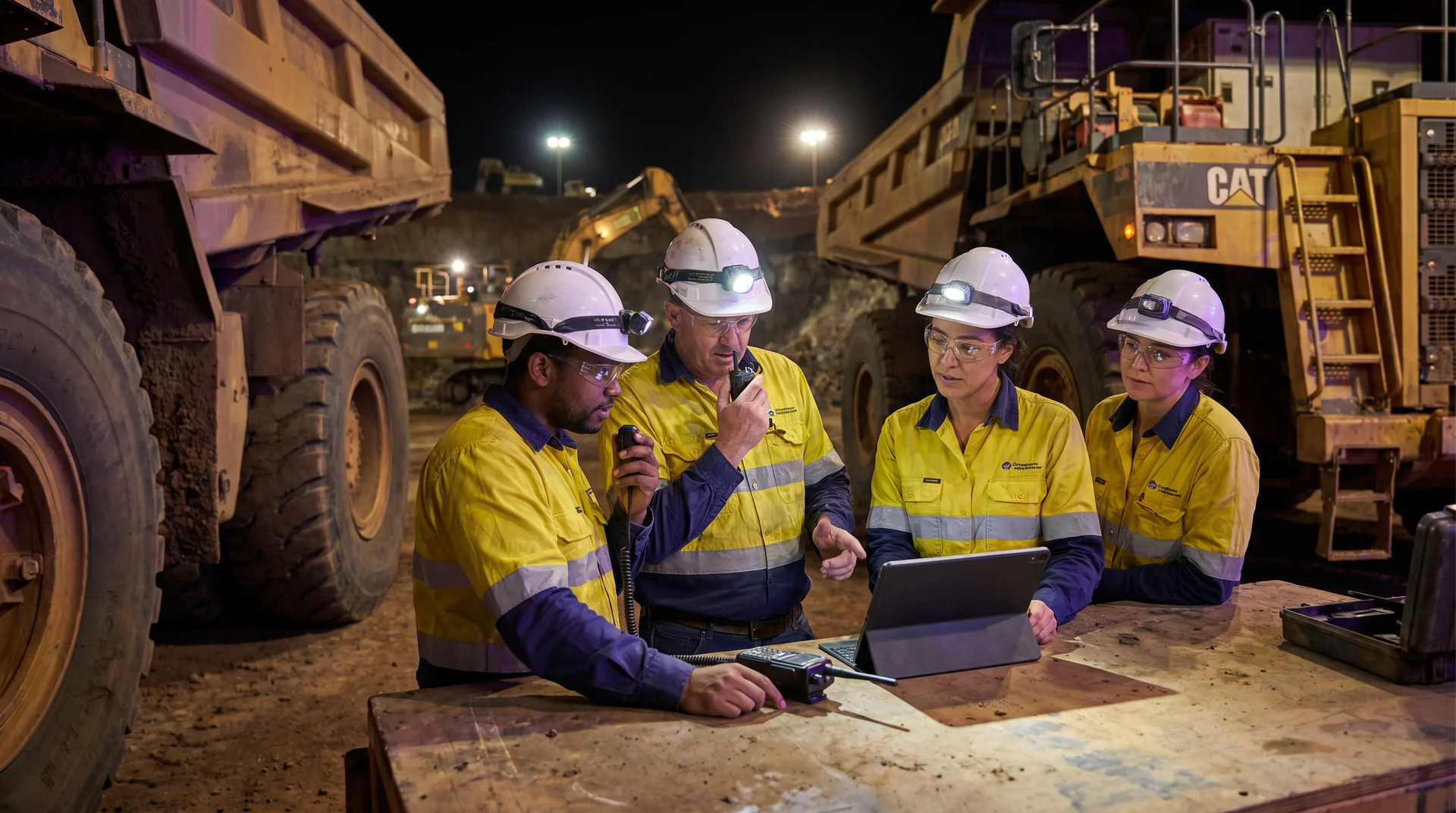
It’s the middle of a planned shutdown. Your maintenance crew is mid-procedure on a piece of heavy equipment. Something doesn’t look right. The technician pulls up the maintenance procedure on their tablet and finds a reference to another document. That document references two more. One of them has a revision notice that may or may not apply to this specific machine configuration.
It’s 2am. The senior engineer who knows this procedure cold is asleep. Or on leave. Or three hours away.
So what happens? Someone makes a call. Wakes someone up. Spends 10 minutes explaining the situation. Gets an answer that should have been in the document to begin with.
This is the daily reality of documentation-heavy environments like mining. The knowledge exists. It’s written down. It’s just not accessible when and where people actually need it.
That’s the gap a voice AI genie closes.
The Documentation Is There. The Access Is Not.
Mining operations run on documentation. Shutdown SOPs. Job Safety Analyses. Maintenance procedures. Permit-to-work frameworks. Isolation registers. Cross-referenced checklists that made perfect sense to the engineer who wrote them and become a maze for anyone navigating them at speed, under pressure, in the dark.
The information isn’t the problem. Access is.
Here’s what typically breaks down without a genie in place:
Senior people become the help desk. Your most experienced engineers and supervisors spend significant portions of their time answering questions that are already answered in documents. They become a human search engine for your own knowledge base. That’s expensive, and it doesn’t scale.
Night shifts and shutdowns create knowledge gaps. Most expertise sits with day shift and senior staff. Scheduled shutdowns often run through nights and weekends precisely because that’s when production can pause. That’s also when documentation access is weakest.
Cross-referenced documents create dead ends. A procedure that says “refer to section 4.3 of document XR-117” is only useful if XR-117 is findable, current, and legible at 2am. Often it isn’t.
Verbal instructions replace written ones. When documents are hard to navigate, people default to asking a person. That person gives an answer from memory. Memory is fallible. This is how procedural drift happens.
The cost isn’t always visible. But across an operation with planned shutdowns running every 6-12 weeks, and maintenance crews of 20-50 people who each lose 15-30 minutes per shift to documentation friction, the numbers add up fast.
How the Genie Handles It
This is where the mining direct invite model works.
Send Help Genie your shutdown SOP. Your JSA library. The maintenance procedure with the 14 cross-references nobody can navigate at 2am on the pit floor. The team loads it into the genie’s knowledge base and builds a voice AI agent on top of it.
Then you stress-test it before it ever goes live to your crew.
Here’s how the conversation flow works in practice.
Step 1: The Technician Asks
The technician on the pit floor doesn’t open a PDF. They don’t search a document management system. They speak to the genie. Voice answer in around 5 seconds.
“What’s the isolation sequence for the crusher feed conveyor?”
The genie pulls from the knowledge base and answers directly. Not a link to a document. Not a menu of options. An answer.
Step 2: The Genie Provides the Page Reference
If the technician wants to verify, or needs to show a supervisor, the genie can reference exactly where in the source document that answer came from. Page number. Section. Document title.
This matters in a regulatory environment. Mining operations in most jurisdictions require documented evidence that procedures were followed. “The genie told me” isn’t enough. “Section 7.2 of Shutdown SOP Rev 14” is.
Step 3: Cross-References Don’t Break the Flow
This is where a lot of document management systems fail. The genie holds all the connected documents in its knowledge base at once. When a procedure references another document, the genie already knows both. It doesn’t hand the technician a breadcrumb trail. It answers the underlying question.
“The procedure says to refer to XR-117 section 4.3. What does that section say about pressure testing tolerance?”
The genie answers. No tab-switching. No search. No midnight phone call.
Step 4: Escalation When It Counts
Not every question has a documented answer. Some situations genuinely need a human. The genie knows this. When a question falls outside the knowledge base or involves judgment that documentation can’t cover, it flags that clearly and routes to whoever is on call.
The difference: your senior people only get woken up for the things that actually need them.
What You Get Back
The most direct benefit is time. Senior engineers and supervisors stop being the help desk for documentation they already wrote. That time goes back to actual engineering work, or to sleep, which matters for safety in its own right.
Beyond time, there are a few concrete patterns operations tend to see when they deploy a genie on top of their documentation:
After-hours call volume to senior staff drops by 40-60% in the first month of deployment, based on what early users across similar knowledge-heavy industries have reported. Mining is a reasonable parallel to manufacturing operations where this pattern holds.
Shutdown duration shortens. When crews can resolve documentation questions in seconds instead of minutes or hours, planned shutdowns run tighter. Even a 30-minute reduction across a multi-day shutdown has measurable cost impact when you’re running heavy equipment on tight production schedules.
Procedural consistency improves. When the genie answers from a single source of truth, crew members across different shifts get the same answer. Verbal drift, where instructions get paraphrased differently by different supervisors, reduces.
New crew members get up to speed faster. A technician in their first few weeks can ask the genie questions they might be embarrassed to ask a supervisor. The genie is patient, available, and never makes anyone feel stupid for asking.
The Stress-Test Invitation
The mining direct invite isn’t a sales pitch. It’s an operational test.
Send the documents. Build the genie. Run your worst-case questions against it before your crew does. The 14-cross-reference maintenance procedure at 2am is exactly the right scenario to put it through.
If it handles that, it earns its place on the pit floor.
This is how operations with complex knowledge bases should evaluate any voice AI tool. Not on demos with curated examples. On real documents. Real questions. Real failure modes.
The genie either knows your SOPs or it doesn’t. You’ll find out fast.
Why Voice Specifically
Written search has limits in field environments. Gloves, low light, loud equipment, pressure. Typing a search query into a document management system on a phone while standing in a crusher enclosure is not a realistic workflow.
Voice is different. Speaking a question is natural in any physical environment. The genie answers in plain language without requiring the user to read and interpret a page of text while managing other tasks.
This is also why the knowledge base approach matters more than a script or a menu. Scripts assume you know the question in advance. A knowledge base built from your actual documents handles the real questions your crew actually asks, in the language they use, without forcing them through a decision tree.
Who This Applies To
The mining direct invite use-case applies most directly to:
Operations running regular planned shutdowns. If your maintenance calendar includes shutdowns of 12 hours or more, and your procedures run to multiple documents with cross-references, the documentation navigation problem is costing you time and increasing procedural risk.
Operations with significant knowledge concentration. If two or three senior people are the primary holders of operational knowledge, and that knowledge isn’t fully documented or isn’t easily accessible, voice AI on top of your existing documentation is a risk mitigation as much as an efficiency tool.
Smaller mining operations and contractors. Larger operations often have document management systems and dedicated technical writers. Smaller operations and contracting businesses frequently have the documents but not the infrastructure to make them accessible. A genie closes that gap without requiring an enterprise software rollout.
This fits squarely within what Help Genie does for the manufacturing and industrial sectors. The knowledge exists in your operation. The genie makes it accessible.
Start With What You Already Have
You don’t need to write new content. You don’t need to restructure your documentation. You send what you have.
Shutdown SOP. JSA library. Maintenance procedures. Permit-to-work templates. Whatever documentation your crew relies on and struggles to navigate under pressure.
The knowledge base builds from those documents. The genie answers from them. Your senior people get their time back.
See how it works for your operation at /explore, or run the numbers on what documentation friction is actually costing you at /roi-calculator.