 Use Case trades
 The 7am Trades Counter Question That Walks Out the Door
A plumber on a job, 3 rings, no answer. See how a voice AI genie handles the trades counter question before the call goes to a competitor.
 Help Genie
 7am. The Phone Rings.
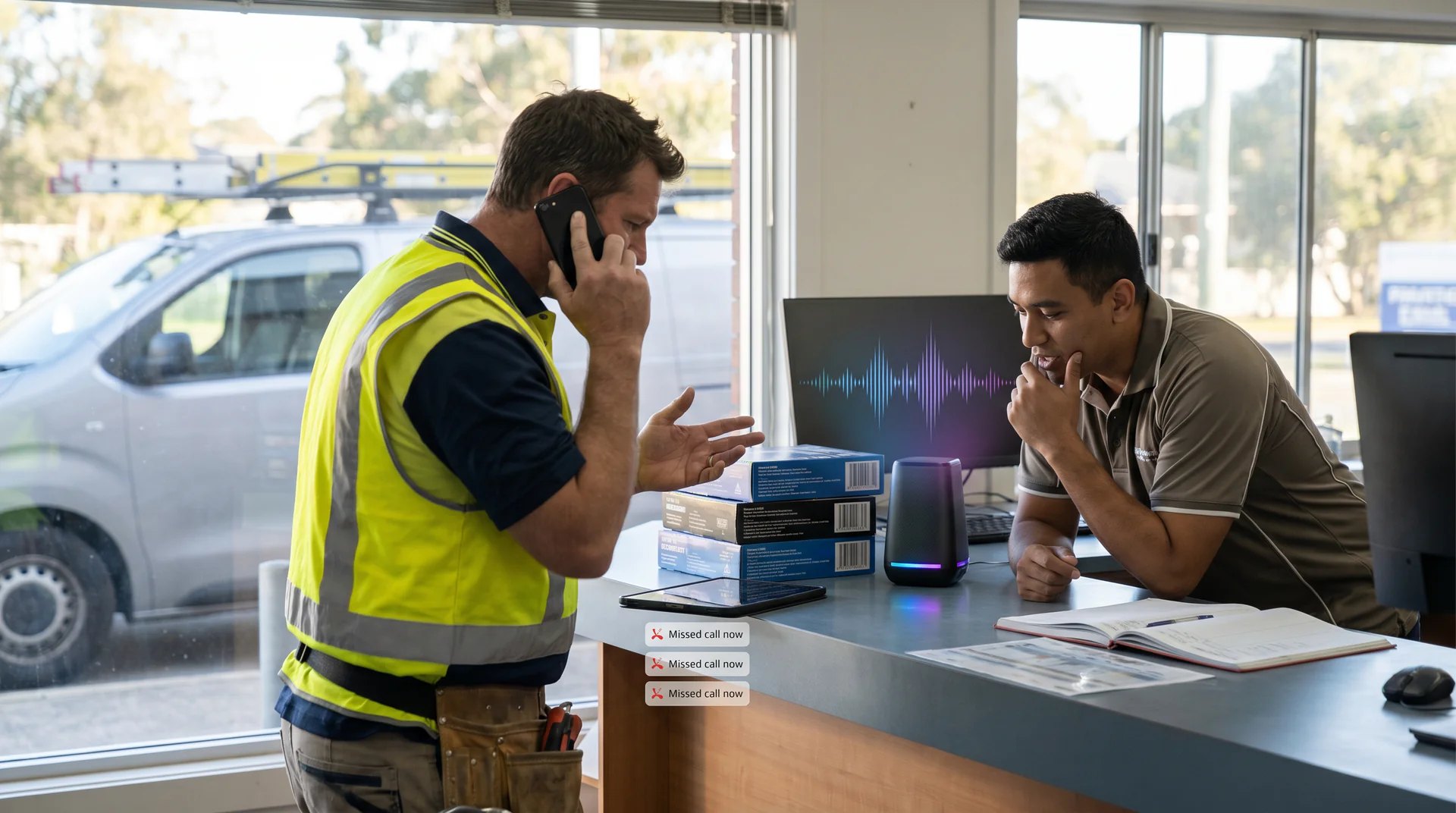
A plumber is crouched under a sink. Water’s dripping. He’s got maybe 20 minutes before the homeowner starts asking questions. He needs one thing: a quick answer from his supplier.
He calls the counter. It rings. Three times. No one picks up.
The counter staff is handling another customer. The senior guy is somewhere in the back. Nobody gets to the phone in time.
So the plumber hangs up and dials the next number in his contacts.
That’s it. That’s the whole story. No dramatic fallout. No complaint. He just moves on. And the job you could have locked in before 8am goes to whoever picks up first.
This is the trades counter question. It’s not a complicated ask. It’s stock availability, store hours, maybe a quick price check. The kind of call your team handles a hundred times a week. And it’s the kind of call that slips through the cracks constantly, because the trades day starts early and your counter doesn’t always have the hands to match it.
The Gap Nobody Talks About
Trades businesses lose revenue in quiet ways. Not because they’re bad at the work. Not because their pricing is off. But because the window between a tradesperson asking a question and going elsewhere is about 30 seconds.
A plumber on a job doesn’t wait. An electrician sourcing parts doesn’t leave three voicemails. They’re billing by the hour and they need answers now. If you’re not there, the next supplier is.
The problem gets worse at the edges of the day. Early mornings, lunchtime rushes, late afternoon when your team is doing stocktakes or wrapping up. That’s when calls pile up and counter staff can’t split themselves across two conversations at once.
A lot of trades supply businesses have tried to fix this with voicemail. A recorded message with store hours, maybe a “call back later” prompt. But tradespeople don’t call back later. They’ve already moved on.
Some have tried a “check the website” approach. That works fine for someone sitting at a desk. It doesn’t work for someone in a crawl space on a mobile signal, trying to ask one quick question.
The gap isn’t technology. It’s timing. The question arrives at the wrong moment, and there’s nothing in place to catch it.
What the Genie Does
A trades genie answers in under 5 seconds. Every time. No hold music. No “we’re currently assisting other customers.” Just a direct answer.
Here’s how it plays out for that plumber at 7am.
He calls the number. The genie answers.
Not with a phone tree. Not with “press 1 for sales, press 2 for accounts.” The genie greets him and asks what he needs.
He asks about 25mm copper and store hours.
The genie pulls the answer from your knowledge base. Stock levels, product codes, current availability, all loaded from your inventory data and store configuration. It tells him yes, you have it, how many lengths are in stock, and what time the counter opens.
He says he wants to swing by and pick it up.
The genie books a counter pickup. It asks for his name and vehicle or trade account number if you need it. It confirms the order and tells him which bay to pull into.
He gets a text with the details.
Bay number. Time. Contact name if he has a question when he arrives. Done.
The whole conversation takes under two minutes. He’s back under the sink before the homeowner notices he stopped.
On your end, the counter team gets an alert. There’s a pickup booked for 8:15am. Stock is flagged. When he walks in, your team knows who he is and what he’s there for. No confusion, no hunting around.
The Setup Behind It
The genie doesn’t guess. It works from what you give it.
Your knowledge base includes the things your counter staff know by heart: product lines and common SKUs, store hours and any variations across locations, pricing tiers for trade account holders, pickup and delivery options.
You don’t need a developer to set this up. You upload your product catalogue, your FAQs, your store policies. The genie learns from that. When stock levels change, you update the knowledge base and it reflects immediately.
The voice and tone match your brand. If your team is direct and no-nonsense, the genie is too. If you serve a mix of tradespeople and retail customers, you can configure different flows for each.
The genie can handle calls via a phone number, or it can field questions through a website embed if someone’s looking up stock on their phone between jobs. The same knowledge base powers both.
What This Looks Like Over a Week
Let’s put some shape around the scale of this.
A busy trades counter might take 80 to 150 inbound calls on a weekday. A meaningful chunk of those are simple: stock checks, hours, pricing, pickup confirmations. Industry estimates suggest that somewhere between 20 and 35% of calls to small-to-medium trade suppliers go unanswered or ring out during peak periods.
That’s not because the team doesn’t care. It’s because one person can only handle one conversation at a time.
If your average sale to a tradesperson runs anywhere from $80 to $400, and you’re missing 15 to 20 calls a day across the week, the revenue walking out the door adds up fast. Not all of those calls convert. But many of them would have, if someone picked up.
The genie doesn’t replace your counter staff. It catches what they can’t. Your team handles the complex stuff: trade account queries, custom orders, returns, product recommendations that need a real conversation. The genie handles the high-volume, low-complexity questions that eat up time and fall through gaps.
That split is where the value sits. Counter staff free to give full attention to walk-in customers. Simple inbound calls answered instantly. No missed question because someone was already on another call.
One More Scenario Worth Noting
It’s not just the 7am call.
Think about the Friday afternoon rush, when three people call in the last 20 minutes before close. Or the Saturday morning when you’re running with one person on the counter. Or the after-hours call from a tradesperson who wants to confirm stock before an early Monday start.
The genie handles all of it the same way. Consistent. Accurate. Fast.
And every conversation gets logged. You can see what questions came in, what products people are asking about, whether there are patterns in your missed calls. That data tells you things your counter team might not even notice: which products are getting more interest, what time of day your call volume spikes, whether your store hours are a common source of confusion.
Insights like that help you run the business better, not just answer calls faster.
The Easiest Job to Keep
Here’s the thing about the plumber calling at 7am. He’s not a hard customer to win. He already knows your business. He called you first.
All he needed was an answer. Stock on hand, hours, where to pick it up. That’s it.
The job you would have lost was the easiest one to keep.
A trades genie doesn’t change your inventory, your pricing, or your team. It just makes sure that when someone calls with a straightforward question at the wrong moment, they get an answer instead of three rings and silence.
That’s the trades counter question, solved.
See It in Action
If you’re running a trade supply business or a trades service operation and you’re thinking about where calls go missing, the trades industry page shows how other businesses in the sector are using voice AI genies.
The ROI calculator can help you put a number on what unanswered calls are costing you each week.
Or head to /explore to see which genie fits your setup and go from there.
Start free. No credit card. Live in minutes.