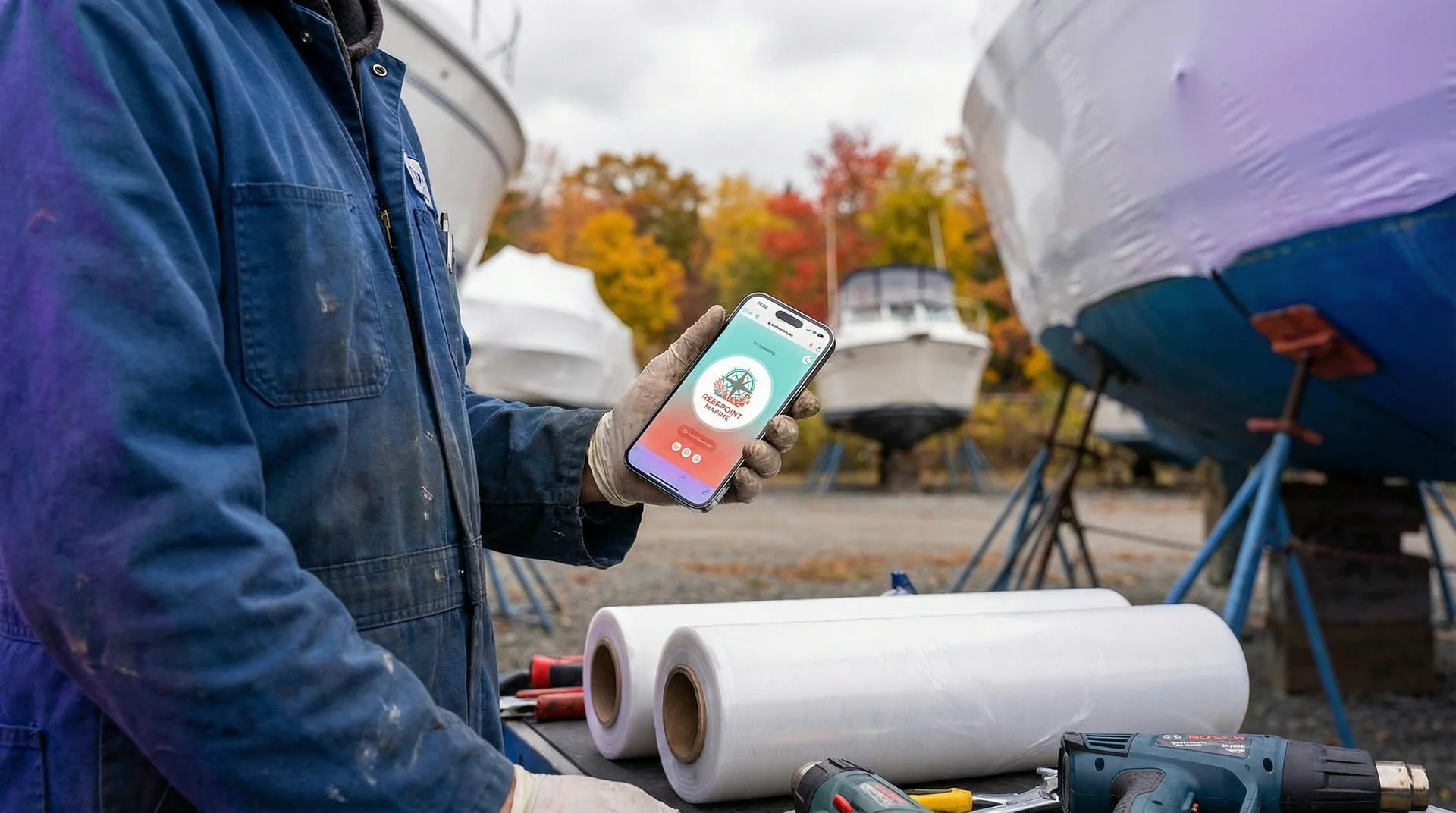
AI for Marine Service Winterization Call Surges
Marine service providers face 4-6x call spikes during winterization season. Learn how AI voice genies handle boat specs, scheduling, and parts coordination.

Every marine service provider in the northern U.S. knows the math. You have roughly six to eight weeks between mid-September and early November to haul, winterize, and store every boat your yard handles. Miss that window, and a customer’s engine block cracks. Your phone doesn’t care about your timeline.
During peak season, call volume can spike four to six times above normal. Boat owners who spent the summer ignoring your reminder postcards suddenly want to talk. They all want the same thing: get their boat out of the water and protected before the first freeze. And they all call in the same three-week window.
The Seasonal Bottleneck Nobody Plans For
A typical marine service yard with 100 to 300 boats per season runs with a small crew. Two to five service technicians. One office person, maybe two. That team handles haul-outs, engine winterization, shrink wrapping, systems flushing, and storage placement. The office handles scheduling, parts ordering, and every phone call.
The marine services world has a structural problem. The people doing the work are the same people answering the phone. When a service tech is pulling a 35-foot sailboat out of the water, they’re not picking up calls. When the office manager is coordinating bay assignments and ordering antifreeze by the drum, they’re not scheduling the next haul-out appointment.
The result is predictable. Calls go to voicemail. Boat owners don’t leave messages. They call the yard down the road. Revenue per winterization service runs $500 to $2,000 per boat, with seasonal storage adding $1,000 to $5,000. Every missed call during the fall rush is real money walking out the door.
This isn’t a staffing problem you can hire your way out of. You don’t need a full-time receptionist for eight months of the year. You need one for the six weeks when everything happens at once.
How AI Handles Winterization Intake at Scale
The intake conversation for winterization is surprisingly structured. Every boat owner calling about winterization needs to communicate the same core information, and the service yard needs to collect it before scheduling makes sense.
The Winterization Pro handles this intake automatically. When a boat owner calls during the fall rush, it collects:
- Boat type and size — sail vs. power, length, beam
- Engine configuration — inboard, outboard, I/O, or diesel
- Specific services needed — shrink wrap, engine winterization, systems flush, bottom paint, gear storage
- Current location — in-water at a slip, on a mooring, at another facility
- Preferred haul-out window — date range and flexibility
This isn’t a generic answering service reading from a script. The conversation adapts based on what the owner says. A 22-foot outboard center console needs different winterization than a 40-foot diesel trawler, and the intake reflects that.
- "Someone called about winterizing their boat"
- No details on boat type, engine, or services needed
- Office manager plays phone tag for two days
- Haul-out gets scheduled without parts pre-ordered
- Complete boat profile: type, length, engine, location
- Services specified and confirmed during first call
- Parts needs flagged before the appointment
- Haul-out scheduled with tech assignment and bay allocation
Scheduling That Accounts for Yard Capacity
Winterization scheduling isn’t like booking a haircut. You can’t just pick an open time slot. Haul-outs depend on marine railway or travel lift availability, tide conditions for some facilities, tech specialization, and storage bay capacity. Double-booking a haul-out day means boats sitting in the water past their scheduled date, which in northern climates can mean real damage.
The Service Scheduler manages this complexity. It knows how many haul-outs can happen per day, which techs handle which engine types, and how storage bays are filling up. When a boat owner calls to schedule, the AI offers available windows that actually work for the yard’s capacity.
This matters more than it sounds. A human receptionist taking calls during a busy day might book three haul-outs on a day when the travel lift is already scheduled for maintenance. Or schedule a diesel winterization on a day when your diesel tech is on vacation. These mistakes create cascading problems that eat into the already tight seasonal window.
The Parts Problem Nobody Talks About
Here’s something that trips up marine service yards every fall. A boat comes in for winterization, and the tech discovers it needs new impellers, a thermostat, or zincs. Those parts aren’t in stock. Now the boat is sitting on stands, half-winterized, taking up bay space while parts ship in. Multiply that by twenty boats and your yard is gridlocked.
The Parts Finder addresses this by identifying common parts needs during the intake call. When the AI collects engine type and model information, it can flag the standard winterization parts that engine requires. The parts department gets a heads-up days or weeks before the appointment, giving them time to stock up.
This isn’t about the AI knowing every marine engine part number. It’s about collecting the information that lets your parts team do their job proactively instead of reactively.
Try the Winterization Pro, your seasonal intake specialist to see how it handles a winterization inquiry.
Spring Commissioning: The Mirror Image
Everything about winterization applies in reverse during spring commissioning. The same compressed timeline. The same call surge. The same need to collect boat details, schedule services, and coordinate parts.
Spring adds its own wrinkles. Bottom paint scheduling depends on launch dates. Systems checks require different expertise than winterization. Boat owners want their vessel ready for Memorial Day weekend, and every yard in the region is working toward the same deadline.
The same AI infrastructure that handles fall intake handles spring just as well. The conversation changes from “What winterization services do you need?” to “What commissioning services do you need?” but the underlying structure is identical: collect boat details, identify services, check parts, schedule within capacity.
Regional Timing: Why Geography Changes the Playbook
The winterization window varies significantly by region, and that variation affects how yards need to manage their phone coverage.
Great Lakes yards typically start their rush in mid-September and need everything hauled by early November. That’s a tight window with significant weather risk. One bad storm in October can push the whole schedule back and create an even more intense phone surge as owners panic about getting their boats out.
Northeast yards along the Connecticut, Massachusetts, and Maine coasts run a similar timeline but deal with additional complexity from tidal haul-outs and the concentration of sailboats that require mast stepping and rigging work.
Pacific Northwest yards in Washington and Oregon have a slightly longer window but contend with rain that affects shrink-wrap schedules and outdoor storage preparation.
In all of these regions, the same dynamic plays out. Boat owners who were relaxed in August become urgent in October. The phone volume reflects that urgency, and the yards that capture every call during that window fill their storage capacity first.
The Revenue Math for a 200-Boat Yard
Consider a marine service yard that handles 200 boats per season. Average winterization is $1,000 per boat. Average seasonal storage is $2,500 per boat. That’s $700,000 in seasonal revenue concentrated in a six-to-eight-week booking window.
If that yard misses 15% of inbound calls during the rush and half of those callers go elsewhere, that’s 15 boats at $3,500 each. Over $50,000 in lost revenue because someone couldn’t answer the phone during the busiest weeks of the year.
The cost of an AI voice solution for those same six to eight weeks is a fraction of a single lost winterization booking. The math isn’t close.
For yards in the Great Lakes region, the Northeast, and the Pacific Northwest, winterization is non-negotiable. Boat owners who don’t get their vessel properly winterized risk catastrophic engine damage. They’re going to get it done somewhere. The question is whether they get it done at your yard or the one that picked up the phone.

What This Looks Like for Your Yard
Marine service providers who’ve adopted AI call handling report two consistent outcomes. First, their phone coverage during peak season goes from spotty to complete. Every call gets answered, every boat’s details get captured, and nothing falls through. Second, their scheduling efficiency improves because the information collected on the first call is accurate and complete.
The marine services subcategory includes genies built for the specific workflows that service yards run. From boat dealer lead capture on the sales side to winterization intake and service scheduling on the operations side, the tools match how marine businesses actually work.
Marine service yards face predictable, intense call surges twice a year. AI voice genies don't just answer those calls. They collect structured boat data, coordinate parts needs, and schedule within real yard capacity constraints, turning a chaotic seasonal bottleneck into a managed workflow.
Winterization season doesn’t have to mean missed calls and lost boats. Help Genie’s marine service genies handle the intake, scheduling, and parts coordination that keeps your yard running through the busiest weeks of the year.
Help Genie Tips
Get more from your voice genie

Build on-call schedules for after-hours routing
Different team members on different nights? Configure on-call schedules so your genie always routes calls to whoever is available, without you lifting a finger.
Route urgent calls to a real person instantly
Set up smart transfer rules so your genie hands off to the right team member when it detects urgency, a VIP caller, or a question it cannot answer. Conference or warm handoff.

Cover nights, weekends, and holidays automatically
Your genie picks up every call outside business hours, qualifies leads, handles emergencies, and books appointments for the next morning. No answering service needed.

Capture exactly the info you need from every caller
Define custom fields your genie should collect: budget, timeline, property type, vehicle make, service needed. Every call ends with structured data, not a scribbled note.
Ready to try it?
Set up a voice genie for your business in minutes.
Keep exploring
Further reading and useful tools
Voice AI for Marine: The Complete Guide
A practical guide to voice AI for boat dealerships, marinas, and marine service shops, so you never miss a weekend enquiry or seasonal booking again.
Use CaseAI Lead Capture for Boat Dealerships
How The Dock Greeter voice genie qualifies boat buyers, captures boating preferences, and connects serious prospects with the right sales rep instantly.
BlogAI Dock Management for Marinas
Marinas lose transient boaters when calls go unanswered during boating season. Learn how AI voice genies handle slip inquiries, bookings, and coordination.
BlogHow Marinas Use AI to Handle the Spring Launch Booking Rush
Spring launch season overwhelms marina staff with calls about launch dates, slip availability, maintenance, and seasonal rates. AI voice genies handle the surge so no revenue walks to a competing marina.
ComparisonBest AgentZap Alternatives (2026)
Honest roundup of AgentZap alternatives for AI receptionists. Compare minute-based AI, flat-rate voice genies, and human answering services.
ComparisonBest Smith.ai Alternatives (2026)
Honest roundup of the top Smith.ai alternatives, from human answering services to flat-rate voice AI. Compare pricing models and find the right fit.
Help Genie
The Help Genie Team
The Help Genie team builds voice AI genies that resolve everyday support on their own — across phone, chat, web, and email — in your voice, 24/7. We write about what we learn shipping it to real businesses.
Building voice AI for 11+ industries, from trades to hospitality.
- voice AI
- customer support
- lead capture
- multi-channel genies