How to Train Your Voice Genie to Speak Your Industry's Language
A voice genie that uses the wrong terminology loses caller trust instantly. Learn how to customize vocabulary, responses, and decision trees for your specific industry.

A homeowner calls a plumbing company and tells the voice genie they need a “tankless water heater installed.” The voice genie responds by asking about their “hot water tank replacement.” The homeowner pauses. Those are two different things. A tankless system and a traditional tank are different products, different price points, different installation requirements. The caller now doubts whether this company actually knows plumbing.
Terminology matters. Every industry has its own vocabulary, and callers use that vocabulary as a competence signal. When the voice answering the phone uses the wrong words, the caller’s confidence drops immediately.
Training your voice genie to speak your industry’s language isn’t a nice-to-have. It’s the difference between a caller who books an appointment and a caller who hangs up and tries the next company on Google.
Why Generic Vocabulary Fails
Out-of-the-box AI assistants use general language. They understand common words and can handle basic conversations. But industries don’t speak in general language. They speak in specifics that carry meaning.
Consider these examples across different trades and service industries:
Plumbing: “Sewer scope” vs. “drain camera inspection.” “PRV” (pressure reducing valve) vs. “water pressure regulator.” “Rough-in” vs. “pre-finish plumbing.” A homeowner might use any of these terms, and the voice genie needs to understand all of them and respond with the correct terminology for the context.
HVAC: “Mini-split” vs. “ductless system.” “Two-stage” vs. “variable speed.” “Heat pump” vs. “reverse cycle.” An HVAC customer asking about a “mini-split for my garage” expects the voice genie to know that’s a ductless system, not to ask “Do you mean a space heater?”
Electrical: “Panel upgrade” vs. “service change.” “Dedicated circuit” vs. “separate line.” “GFCI” vs. “those outlets with the buttons.” Electricians’ customers range from contractors who speak technical language to homeowners who describe things in plain terms. The voice genie has to understand both and bridge between them.
Marine: “Bottom paint” vs. “antifouling.” “Haul-out” vs. “dry dock.” “Winterization” vs. “shrink wrap and fluid change.” Boat owners use these terms interchangeably, and a voice genie that doesn’t recognize them sounds like it belongs at a car dealership, not a marina.
- Voice genie uses generic terms that signal inexperience
- Misinterprets industry-specific requests and asks irrelevant questions
- Caller loses confidence and questions the company's expertise
- Leads get misrouted or miscategorized due to terminology gaps
- Uses correct terminology that builds instant credibility
- Understands technical and colloquial terms for the same service
- Asks follow-up questions that demonstrate real industry knowledge
- Routes and categorizes leads accurately based on service type
The Three Layers of Industry Training
Customizing a voice genie for your industry happens across three distinct layers. Each one builds on the previous.
Layer 1: Vocabulary Mapping
Start with a list of every service you offer. For each service, document:
- The technical term your team uses internally (e.g., “hydrojetting”)
- The common customer term callers typically use (e.g., “high-pressure drain cleaning” or “blast out my sewer line”)
- Related terms that might come up (e.g., “clogged main line,” “root intrusion,” “backed up sewer”)
- Terms that sound similar but mean something different (e.g., “snaking” is a different service from hydrojetting, even though the caller might use them interchangeably)
The Troubleshooter for plumbing businesses demonstrates this well. When a caller says “my toilet keeps running,” the voice genie knows this is a flapper valve or fill valve issue, not a clog. When they say “my toilet is backing up,” that’s a drain issue. Same fixture, completely different service calls, different urgency levels, different pricing.
This vocabulary mapping also catches regional variations. In some parts of the country, a “spigot” is what others call a “hose bib” or “outdoor faucet.” A “crawl space” and a “cellar” might describe the same area in different regions. Your voice genie needs to match your local market’s language.
Layer 2: Response Calibration
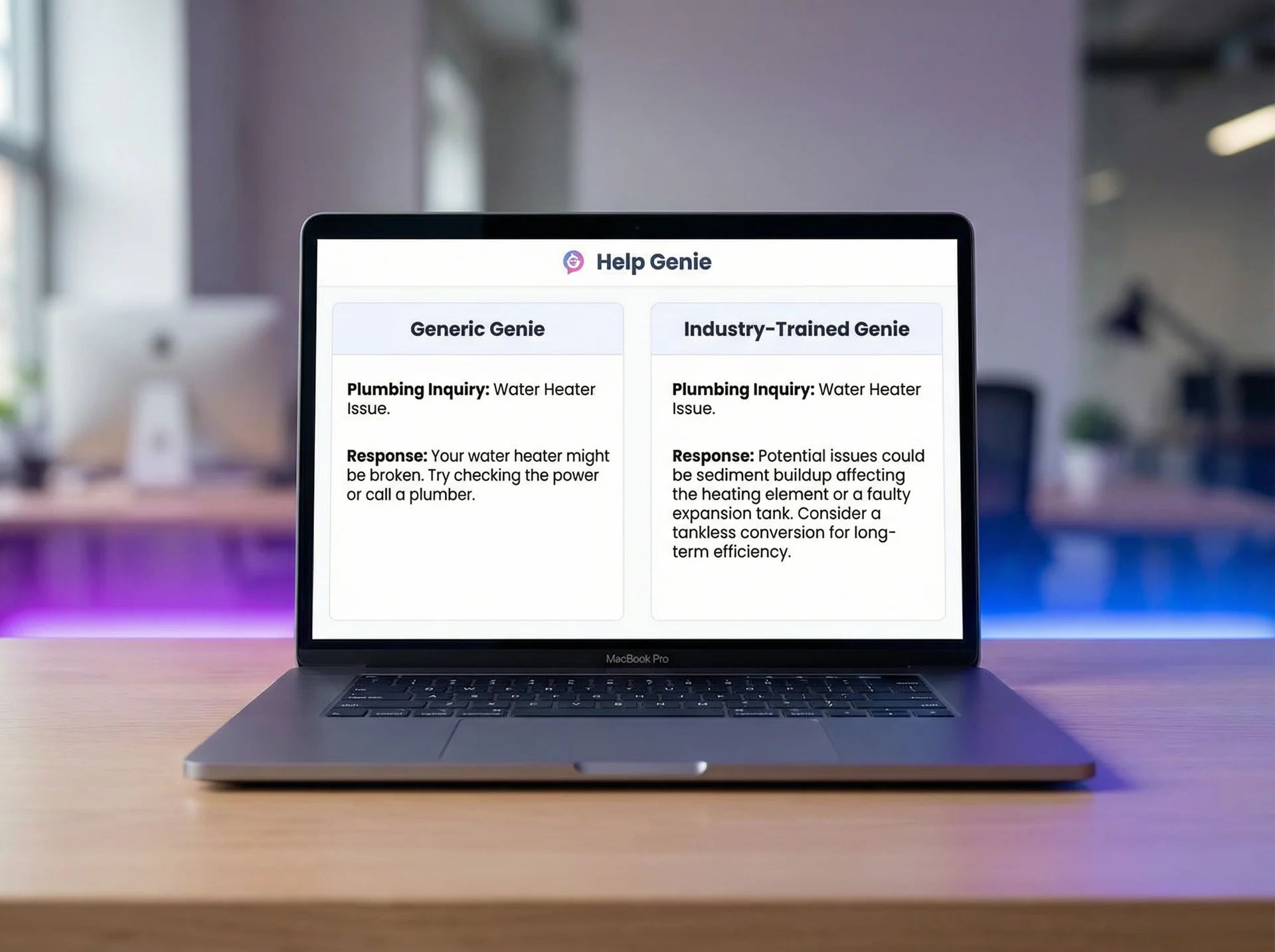
Once the vocabulary is mapped, the next step is calibrating how the voice genie talks about your services. This is about tone, specificity, and the level of technical detail that matches your typical caller.
A plumbing company serving primarily homeowners needs the voice genie to speak plainly: “It sounds like you might have a water pressure issue. Our technicians can check your pressure reducing valve and diagnose what’s causing the low pressure.”
A plumbing company that works primarily with general contractors and commercial clients needs a different register: “We can schedule a site visit for the backflow preventer certification. Do you have the RPZ model number and the last test report?”
Same industry, same types of work, completely different caller expectations for how the conversation should sound.
Layer 3: Decision Tree Logic
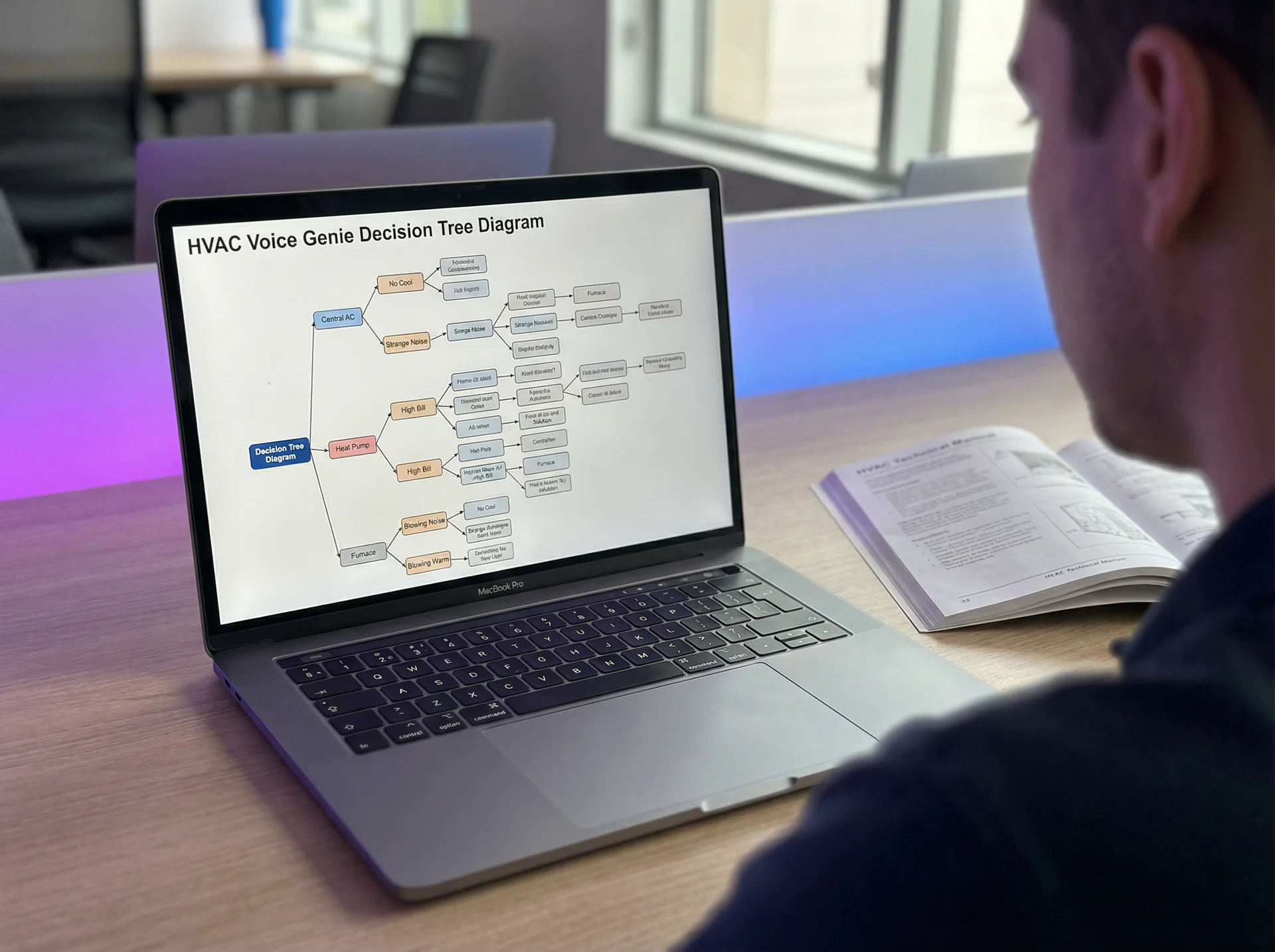
The most sophisticated layer of training is the decision tree that mirrors how your best phone staff triages calls. This is where the voice genie learns to ask the right follow-up questions and route calls appropriately.
For an HVAC company, the decision tree might branch on:
- Emergency vs. non-emergency. “My AC stopped working and it’s 95 degrees” gets routed differently than “I want to schedule a tune-up before summer.”
- Repair vs. replacement vs. new installation. Each requires different information gathering and different team routing.
- System type. Central air, heat pump, mini-split, boiler. The follow-up questions and scheduling change based on what the caller has.
- Under warranty vs. out of warranty. This affects pricing conversations and which technician gets assigned.
The Comfort Consultant walks through this exact triage logic. The voice genie asks about symptoms, system age, and whether the unit is making unusual sounds. These questions aren’t random. They’re the same diagnostic questions a senior dispatcher would ask to send the right technician with the right parts.
For an electrical company, the decision tree prioritizes safety:
- Burning smell or sparking. Immediate safety instructions and emergency routing.
- Power outage. Is it the whole house or one circuit? Is it a utility issue or an internal problem?
- Panel upgrade. What’s the current amperage? How old is the home? Are they adding a hot tub, EV charger, or workshop?
- Outlet or switch issues. Which room? Is it a GFCI outlet? Has anything changed recently (new appliance, water exposure)?
Real Examples From the Field
A plumbing company in Phoenix trained their voice genie to recognize the difference between “my water heater is leaking” (potentially urgent, possible flooding) and “my water heater is making noise” (likely sediment buildup, non-emergency). The voice genie asks about the location and severity of the leak, whether water is actively spreading, and whether the homeowner knows how to shut off the supply valve. Emergency leaks get same-day dispatch. Noisy water heaters get next-available scheduling.
An HVAC company in Atlanta customized their voice genie to handle the nuances of heat pump troubleshooting. When a caller says “my heat pump is blowing cold air,” the voice genie asks whether it’s in heating or cooling mode, because “cold air in heating mode” means something very different from “not-cold-enough air in cooling mode.” That distinction changes the urgency, the likely diagnosis, and the parts the technician might need.
How to Build Your Terminology Library
The fastest way to build your vocabulary and decision tree is to listen to your own calls. Pull 50 recent call recordings and document:
- What terms callers used to describe their problems or needs
- What follow-up questions your best staff asked and in what order
- Where calls went wrong due to miscommunication or missing information
- What information the technician or sales team needed that the call didn’t capture
This audit gives you the raw material for all three training layers. The terms callers use become your vocabulary map. Your best staff’s questions become your decision tree. The gaps become your priority training items.
Start with the trades overview to see voice genies built for plumbing, HVAC, and electrical businesses. Each one demonstrates what industry-specific training looks like in practice. Then customize the vocabulary, responses, and decision logic to match exactly how your business and your callers talk about the work you do.
Your voice genie should sound like it works at your company. Not like it works at a call center that also handles pizza delivery and dentist appointments.
Help Genie Tips
Get more from your voice genie

Build on-call schedules for after-hours routing
Different team members on different nights? Configure on-call schedules so your genie always routes calls to whoever is available, without you lifting a finger.

Sync appointments to Google Calendar or Outlook
When your genie books a showing, service call, or consultation, it can push the appointment directly to your calendar. No double-booking, no manual entry.

Set different genie behavior for after-hours calls
Your genie can act differently at night. Triage emergencies, collect more info from callers, or simply take messages. You control what happens when the office is closed.

Clone and customize genies for different locations or roles
Running multiple locations or departments? Clone an existing genie, swap the details, and deploy. Each genie gets its own number, knowledge, and branding.
Ready to try it?
Set up a voice genie for your business in minutes.
Keep exploring
Further reading and useful tools
BlueLine Plumbing: After-Hours Voice AI Triage for Auckland Trades
How an Auckland plumbing firm used a branded voice genie to capture after-hours emergencies and routine bookings — illustrative scenario with example metrics.
ComparisonBest AI Receptionist for Plumbers in 2026
The best AI receptionist for plumbers in 2026. Honest roundup for burst-pipe emergencies, after-hours calls, job booking, and service-area qualification.
Industry InsightsState of AI in the Trades Industry, Q1 2026
Key data points and trends on AI adoption among trades businesses, including plumbing, HVAC, and electrical companies.
ComparisonAI vs Human Receptionist for Plumbing Emergencies
AI or a human receptionist for your plumbing company? Compare after-hours emergencies, triage, cost, and booking. See the real numbers before you hire.
BlogAfter-Hours Plumbing Calls: AI That Never Misses an Emergency
AI after-hours call handling for plumbers triages emergencies, walks callers through water shut-off, and dispatches your on-call tech.
GuideAI Answering Service for Australia: A Complete Setup Guide
How Australian service businesses deploy voice AI genies on local numbers — AUD pricing, Sydney and Melbourne context, after-hours triage, and a practical path to go live.
Help Genie
The Help Genie Team
The Help Genie team builds voice AI genies that resolve everyday support on their own — across phone, chat, web, and email — in your voice, 24/7. We write about what we learn shipping it to real businesses.
Building voice AI for 11+ industries, from trades to hospitality.
- voice AI
- customer support
- lead capture
- multi-channel genies