 Use Case travel hospitality
 How a 23-Room Hotel Handles International Guests at 11pm
See how voice AI helps small hotels answer international guest questions in any language, 24/7, without hiring multilingual staff.
 Help Genie
 11pm. One Staff Member. A Guest Who Doesn’t Speak English.
Picture this.
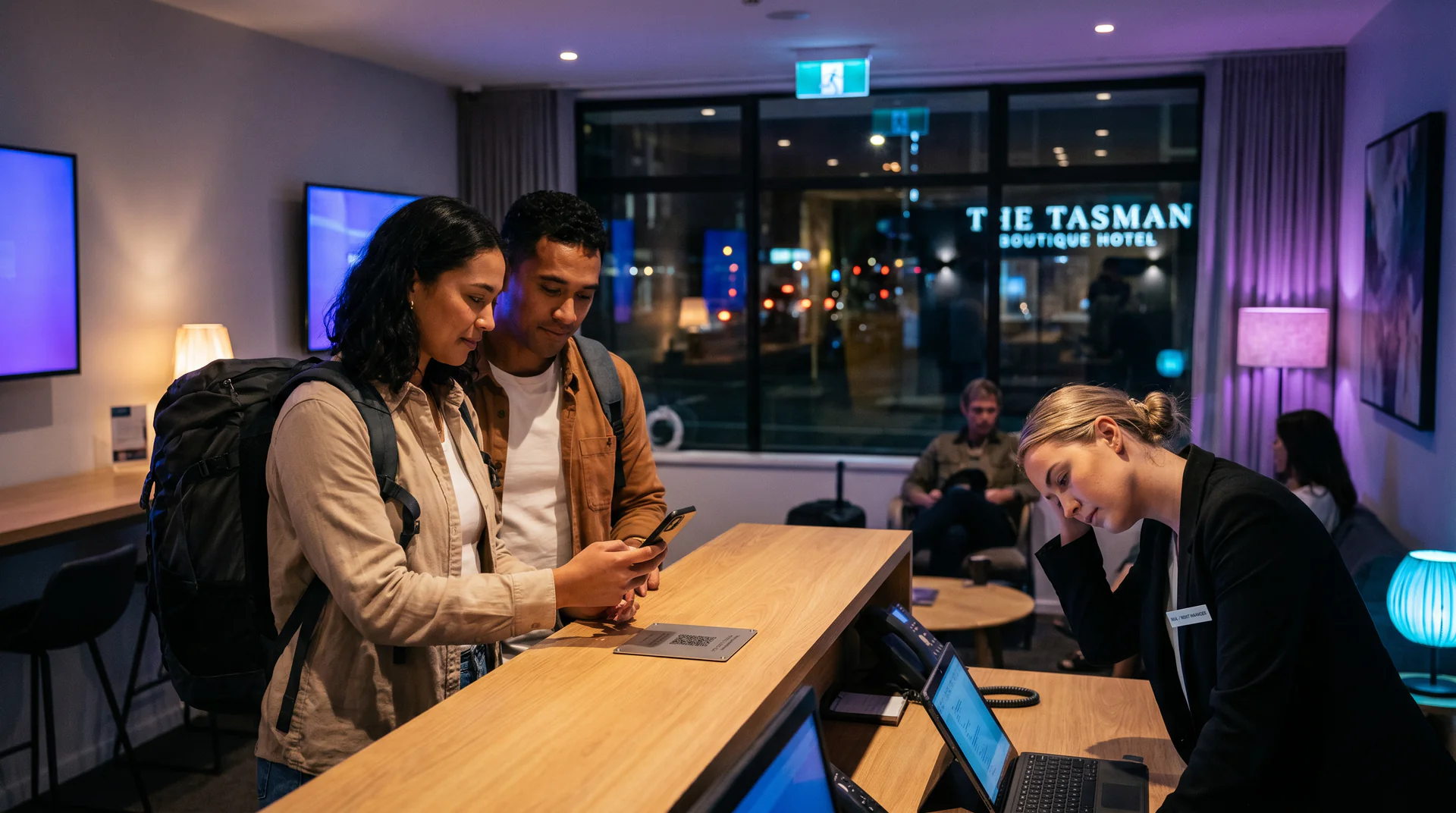
A boutique hotel in the city. Twenty-three rooms. One person on the front desk after 8pm. It’s 11pm on a Tuesday and a guest from Korea has just arrived. She’s traveled for roughly 14 hours. She’s tired. She has four questions.
Is laundry available? Is breakfast included? How does the hot water work in her room? Can she extend her stay by one night?
Simple questions. The kind that take 90 seconds to answer if you speak the same language as the person asking.
She doesn’t speak much English. The night staff member doesn’t speak any Korean.
What happens next is not a failure of effort. The staff member tries. They point at things. They pull up a translation app on their phone. They manage to answer maybe two of the four questions clearly. The guest nods politely. She goes to her room still unsure about the hot water and the breakfast.
By the next morning, before she’s even checked out, the negative review is half written in her head.
The Gap That’s Always Been There
This is the part of hospitality that small hotels have always struggled with.
You cannot staff for every language. A 23-room boutique property doesn’t have the budget to hire a Korean-speaking receptionist, a Mandarin-speaking concierge, and a Spanish-fluent night manager. Even a large chain with 200 rooms doesn’t have that.
The traditional answer has been to hope. Hope that Google Translate gets close enough. Hope that guests are patient. Hope that the language barrier doesn’t end up in a one-star review about “unhelpful staff.”
That’s not a system. That’s luck.
And it plays out constantly. Hotels catering to international guests face this exact scenario dozens of times a week. Guests from Japan, Germany, Brazil, South Korea, France. Each one with questions that are completely reasonable, completely answerable, and completely lost in translation.
The gap isn’t the staff. The gap is the tool they don’t have.
What a Genie Does at 11pm
A genie lives in the knowledge base of a hotel. That knowledge base includes everything the hotel knows: breakfast hours, laundry options, check-out times, how the hot water system works, whether late check-out is available, how to connect to the WiFi, what the cancellation policy is.
The genie is accessed through a QR code. One code, printed on a card, placed in every room. Guests scan it on arrival.
When the Korean guest scans that QR code, the genie speaks Korean. Not a rough machine translation. Fluent, natural Korean, drawing from the same knowledge base as the English version of the genie. Same source of truth. Different language.
She asks about laundry. The genie tells her where it is, what it costs, and what time collection happens.
She asks about breakfast. The genie tells her the hours, what’s included, and where the dining room is.
She asks about the hot water. The genie walks her through exactly how the system works in her room, because that information is in the knowledge base.
She asks about extending by one night. The genie checks the available information, lets her know the process, and captures her request so the front desk sees it first thing in the morning.
Four questions. Four clear answers. The whole conversation takes about three minutes. She puts her bag down, runs a shower, and goes to sleep.
The negative review never gets written.
Step by Step: How the Genie Actually Works Here
Step one: The QR code in the room. The hotel deploys the genie through a QR code placed on the room welcome card. No app download needed. Guests scan it on their phone. It opens immediately.
Step two: The guest speaks in their language. The genie handles 40-plus languages. When the guest starts speaking or typing in Korean, the genie responds in Korean. It doesn’t ask the guest to switch to English. It meets them where they are.
Step three: The genie pulls from the hotel’s knowledge base. The answers aren’t guesses. They’re pulled directly from the documents and FAQs the hotel uploaded when setting up the genie. Breakfast times, laundry policies, room guides, extension procedures. The hotel wrote this content once. The genie delivers it in any language, on demand.
Step four: Escalation where it matters. If a guest asks something outside the knowledge base, the genie doesn’t pretend to know. It routes the question clearly so the front desk can follow up. No dropped conversations. No confused guests waiting for an answer that never comes.
Step five: The morning handover. Any requests captured overnight, including the room extension request, arrive as a summary for the morning staff. They start the day knowing exactly who asked what and what needs to be actioned.
What This Looks Like Across a Week
One Korean guest is not an edge case. Hotels in major cities regularly host guests from South Korea, Japan, China, Germany, France, Mexico, and Brazil, often in the same week.
Each of those guests arrives with the same basic questions. Each of those questions has an answer that exists somewhere in the hotel’s own documents. The gap isn’t information. It’s delivery.
With a genie deployed across every room, the night staff member isn’t on the phone trying to mime “breakfast is at 7am.” They’re doing the parts of their job that actually require a human: security walkthroughs, handling physical incidents, managing check-ins that need judgment calls.
The genie handles information delivery. That’s where it excels.
Hotels that have deployed voice AI for international guest support have reported meaningful shifts in a few key areas. Guest satisfaction scores for international travelers tend to improve by 20-35% when language barriers are removed. Negative reviews citing “communication issues” drop significantly, often by 30-40% within the first few months. Staff report lower stress during overnight shifts because they’re not caught in impossible translation situations.
These aren’t guarantees. Every property is different. But the underlying math is straightforward. Guests who get clear answers go to bed happy. Guests who go to bed confused write reviews.
The Part Hotels Miss
There’s a version of this problem that hotels think about, and a version they don’t.
The version they think about: having a translation app available at the front desk. Running Google Translate on a tablet. Printing multilingual welcome packs.
The version they don’t think about: what happens after the guest reaches their room. At 11pm. When the front desk is one tired person. When the guest has a specific question about the hot water that isn’t in the printed welcome pack.
That’s where the experience actually breaks down. Not at check-in, where staff are ready and the lighting is good and there’s time to figure something out. In the room. At night. When the guest is tired and the question feels urgent and there’s no obvious way to get help.
A QR code in the room solves that. Not because it’s clever, but because it’s reachable. The guest doesn’t have to go back to the front desk. They don’t have to try to explain something complex in a second language. They just scan, ask, and get an answer.
That’s the whole thing. Reachable, in the language the guest actually thinks in.
What the 23-Room Hotel Gets
The boutique hotel doesn’t have a multilingual concierge. It has one person after 8pm and a knowledge base.
With a genie deployed across its rooms, it has something the large chains struggle to offer: a consistent, fully branded guest experience in every language, at any hour, without adding headcount.
The 23-room property suddenly feels like somewhere that knows what it’s doing. Guests from Seoul, Tokyo, Berlin, and São Paulo get the same quality of answer as guests who speak English as their first language.
Reviews go up. Late-night chaos goes down.
That’s what reachable looks like in practice.
Ready to See It for Your Property?
If your hotel hosts international guests and your current answer to language barriers is “we do our best,” there’s a better option.
A genie can be deployed across your rooms using a simple QR code. It draws from your own policies and room guides. It speaks the languages your guests actually use.
See how it works for hospitality businesses at /travel-hospitality, or explore the full platform at /explore.
You wrote the knowledge base once. The genie delivers it in every language, every night, without fail.