 Use Case general
 The CNC Threw a Fault Code. The Manual Is 600 Pages. The Line Is Backing Up.
See how voice AI helps manufacturing floor operators resolve fault codes in seconds, not minutes, using a genie that knows every machine manual on the floor.
 Help Genie
 The Moment Everything Depends On One Operator
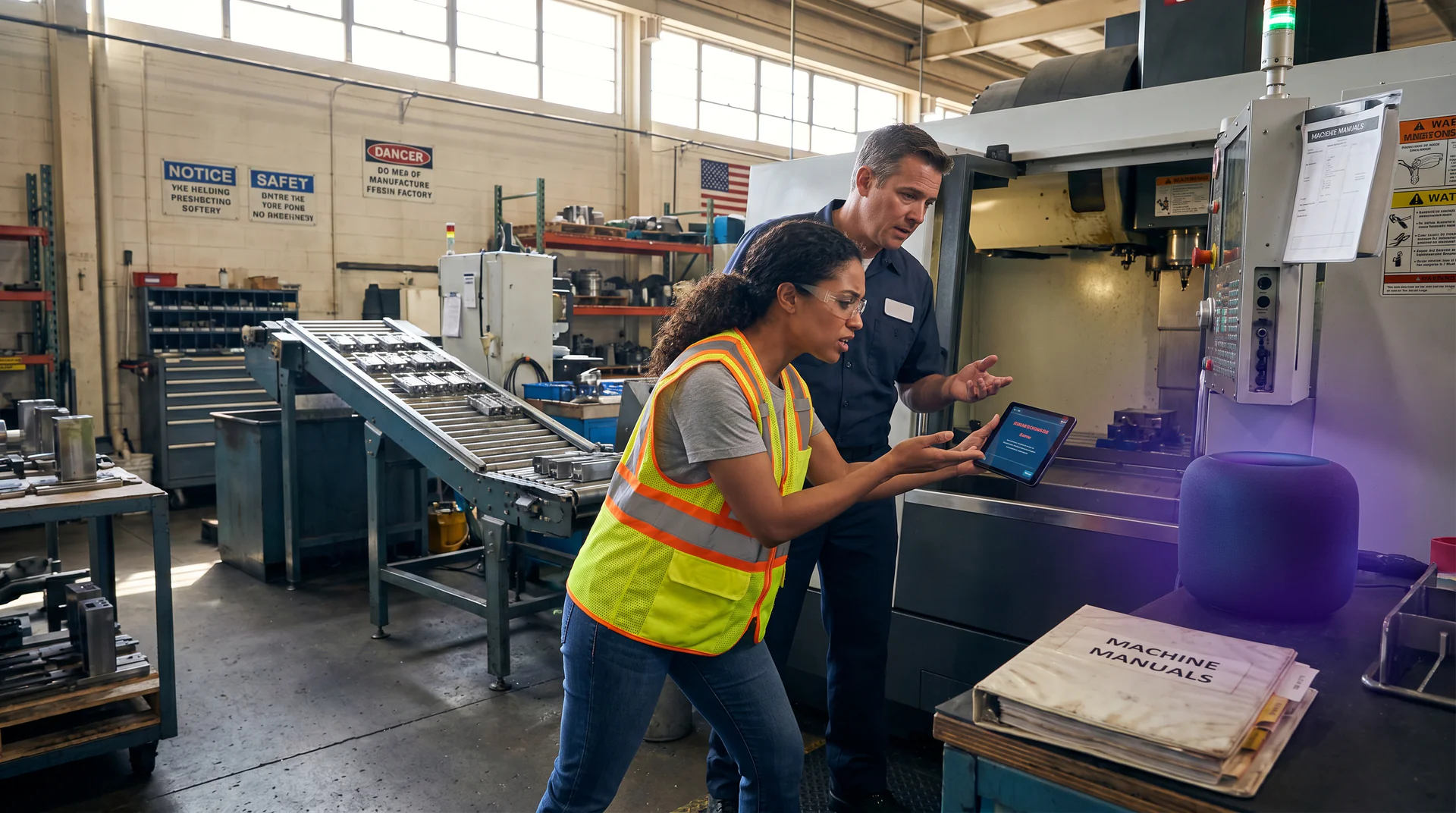
The CNC operator is 7 weeks into the job.
The machine just threw fault E47.
They’ve never seen it before. The line behind them is starting to back up. The supervisor is in a meeting. The manual is 600 pages, printed, sitting on a shelf across the room, assuming anyone has even filed the right revision.
They have roughly 90 seconds to either fix it or call the line down.
This is not an edge case. This happens on manufacturing floors every single day, in plants of every size, across every type of equipment. The newer the operator, the longer the pause. The longer the pause, the more it costs.
And right now, most plants have no good answer for this moment.
The Gap That Slows Every Floor Down
The knowledge exists. That’s the frustrating part.
The fault tree is documented. The maintenance log has seen E47 before. The engineering bulletins from the supplier clarify the most common cause. The safety procedure covers exactly when to escalate. All of it is written down somewhere.
But “somewhere” is not good enough at 2:47pm when the line is backing up.
Here’s what actually happens on most manufacturing floors today. The new operator freezes for a moment, then starts flipping through the manual hoping the index works. Or they pull out their phone and search a forum. Or they interrupt a senior operator who is mid-task on their own machine. Or they call the line down, flag the supervisor, and wait.
Every one of those paths is slow. Most take 10 to 20 minutes before the operator even has a clear answer, let alone the confidence to act on it.
For a small or mid-size plant running on tight margins, that wait time is not a minor inconvenience. Line downtime in discrete manufacturing can cost anywhere from a few hundred to several thousand dollars per hour depending on the equipment and product. Multiply that across shifts and you start to see the real number behind “the operator wasn’t sure what to do.”
The other thing most plants haven’t accounted for is the knowledge drain. Senior operators know this stuff in their heads. When they leave, or when they move to another cell, that knowledge doesn’t transfer. It just disappears. The new operator is left with the same 600-page manual and the same 90-second window.
How the Genie Handles It
A Help Genie genie deployed on the manufacturing floor works differently from any reference tool operators have used before.
Before go-live, the knowledge base is built from the actual documentation the plant already owns. Machine manuals. Fault trees. Maintenance logs. Engineering bulletins. Supplier service notes. Safety procedures. SOPs. All of it uploaded and indexed. The genie reads everything and can answer questions about any of it, instantly, in plain language.
When the operator asks, “what is fault E47 on the Mazak and what do I do about it,” the genie answers in about 5 seconds.
Not a list of documents to search through. Not a link to page 312. A direct answer: the likely cause, the immediate steps to attempt a resolution, and the threshold that says “stop here and escalate to maintenance.” It cites the exact page for anyone who wants to verify.
The operator stays at the machine. The line stays running. The supervisor stays in the meeting.
The interaction takes less than a minute from question to action. The operator looks senior. The knowledge that used to live only in a veteran’s head is now in everyone’s pocket.
What This Looks Like in Practice
Walk through a shift.
An operator on the night crew encounters an unfamiliar hydraulic pressure warning on a press they haven’t run before. They ask the genie. It pulls the relevant section from the equipment manual, cross-references the plant’s maintenance history for that machine, and tells the operator the most common cause in their specific context, the fix, and when to call it in.
A different operator on the morning shift is onboarding to a new cell. They ask routine questions throughout the day: how to set the offset on a particular tool, what the safe operating temperature range is, where the lockout procedure is for that specific unit. The genie answers each one in seconds. No senior operator pulled away from their own work. No supervisor interrupting their planning time.
A third operator asks about a fault code that has appeared three times this week. The genie answers the immediate question. But it also notes, at the operations level, that the same fault is recurring on the same machine.
That last part matters more than most plants realize.
The Insight Layer Most Plants Are Missing
Here’s what changes over time when a genie is on the floor.
The genie sees patterns. Not just the question, but the frequency, the machine, the shift, the timing.
If fault E47 is being asked about 12 times a week across the floor, that is a signal. It might mean the machine needs a scheduled maintenance check. It might mean there’s a training gap in a particular shift. It might mean the engineering bulletin is outdated and needs to be replaced with a cleaner procedure.
Right now, most plants have no way to surface that signal. The questions get asked, the answers come from wherever they come from, and the operations team never sees the data.
With a genie, every question is logged. Maintenance has data they’ve never had access to before. Which fault codes come up most often. Which machines generate the most questions. Which shifts have operators asking about the same procedures repeatedly. Which procedures are unclear enough that people ask follow-up questions.
This is the information that drives better maintenance scheduling, better training programs, and better documentation. Not gut feel. Actual frequency data from real operator questions, every shift, every day.
For a plant running 2 or 3 shifts with 20 to 50 operators on the floor, the aggregate query data across a month can surface maintenance risks weeks before they become unplanned downtime events. Industry estimates suggest unplanned equipment downtime costs manufacturers anywhere from 5 to 20% of productive capacity. Even catching one failure event early more than pays for the tool.
What Makes This Work for Smaller Plants
Large plants have the budget for dedicated maintenance engineers and shift supervisors with deep machine knowledge. Small and mid-size plants often don’t.
A 30-person precision machining shop. A food production facility running 2 shifts with high turnover. A contract manufacturer scaling a new product line with operators who are still building experience. These are the operations where the knowledge gap hurts the most, and where a genie makes the biggest difference.
The setup doesn’t require a software team or a major IT project. You upload the documentation you already have. PDFs, maintenance logs, supplier manuals, internal SOPs. The genie reads them and is ready to answer questions. From there it’s deployed on the floor: accessible by phone, by a QR code posted at each machine, or through a web interface on a shared terminal.
Operators ask questions in natural language. The genie answers in natural language. No training required beyond “ask it like you’d ask a person.”
For an operation where onboarding a new operator to full floor competency currently takes 6 to 12 months of working alongside experienced staff, cutting that curve by even 30 to 40% has a direct impact on output, safety, and retention.
The 600-Page Manual Finally Doing Its Job
The knowledge was always there. The machine manuals were written by engineers who understood the equipment deeply. The maintenance logs captured years of real-world failure patterns. The safety procedures were reviewed and approved.
None of it was accessible at the moment an operator needed it most.
A genie changes that. It puts every page of every manual into a format that answers a direct question in plain language, in seconds, on the floor. It captures the questions being asked and surfaces them as operational intelligence. And it does all of this without pulling a single senior operator or supervisor away from their work.
The line stays running. The operator builds confidence faster. The operations team gets data they’ve never had.
That’s what voice AI looks like in manufacturing. Not a concept. Not a future plan. A genie that reads the manual so the operator doesn’t have to.
Ready to put your machine manuals to work? See how a genie deploys for manufacturing operations at /manufacturing, or run the numbers for your floor at /roi-calculator.