 Use Case general
 How Voice AI Handles Retail Floor Shift Changes on Saturday Mornings
New staff, changed promos, a live customer. Here's how a genie gives every retail floor worker instant access to your best answers.
 Help Genie
 Saturday Morning. Half the Team Is New.
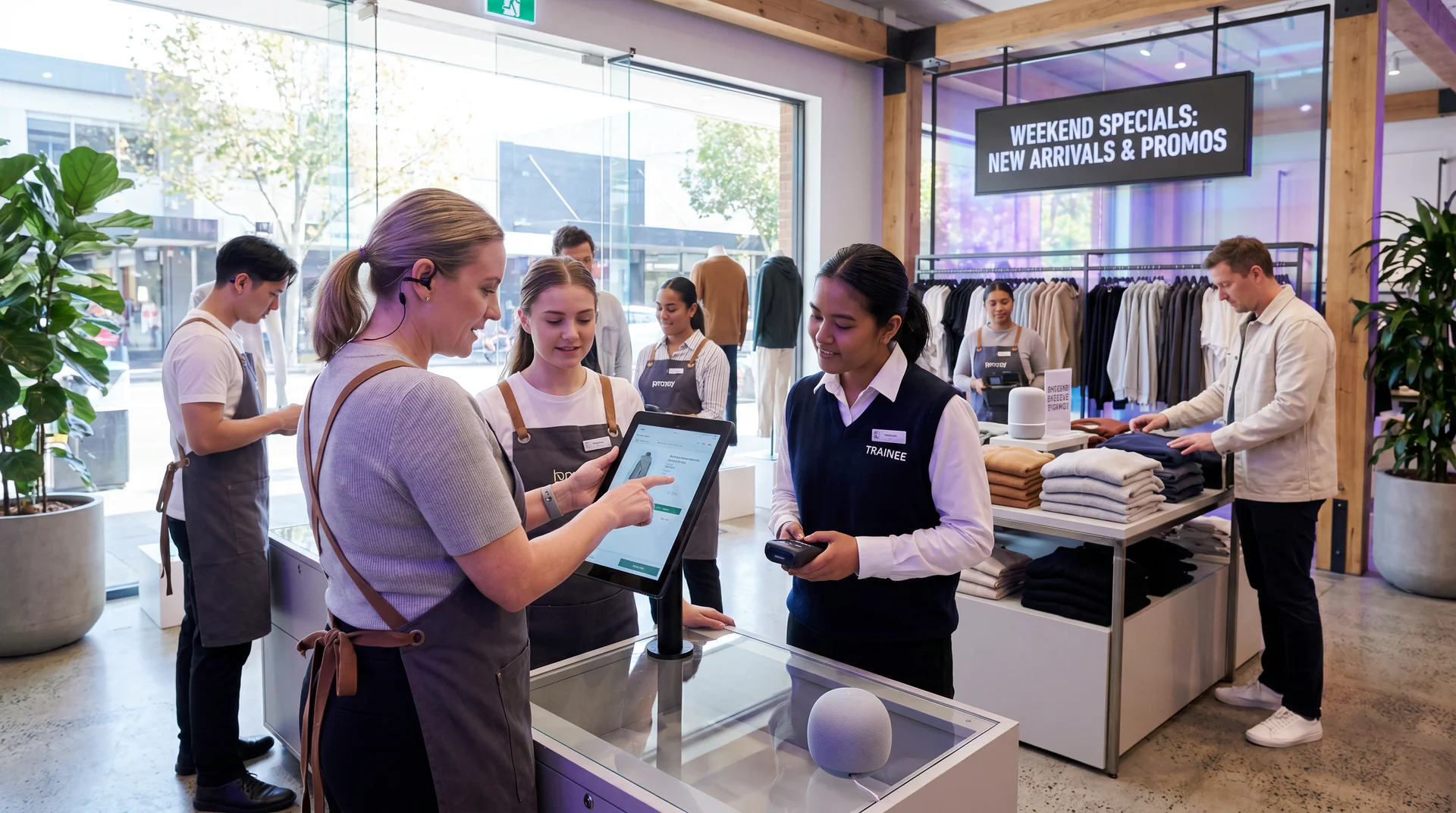
Picture the scene. It’s 9:15am on a Saturday. The floor is filling up. You’ve got two staff members who started last week, one who’s been there a month, and your most experienced person is on a phone call in the back.
A customer walks up to the newest face on the floor and asks a direct question. Which products qualify for the promotion that started Tuesday? Does the new supplier line carry a warranty? What’s the return window if they bought it as a gift?
The new staff member knows they should know this. They don’t. They mumble something. They look around for the manager. The manager is tied up. The customer waits thirty seconds, decides it’s not worth it, and leaves.
That interaction happens dozens of times a week in retail. It costs real money. And it’s not a training problem. It’s a turnover-meets-complexity problem.
The Gap That Training Can’t Fix
Retail businesses don’t lack training. They lack time to transfer knowledge fast enough to keep pace with how quickly people rotate through.
Promotions change weekly or more. Suppliers drop off new product lines mid-week with no briefing. Loyalty program rules get updated. Return policies have edge cases. Warranty terms differ by brand. And all of that needs to live in the head of whoever is standing on the floor at a given moment, including the person who started four days ago.
Traditional onboarding can’t keep up. You can run a training session on Monday and by Thursday the promotion has changed and the training is already out of date. Written SOPs sit in folders nobody opens. Group chats get buried. The shift handover note is either missing or five lines long.
So knowledge doesn’t transfer cleanly. It transfers unevenly, based on who happened to be rostered on when the update was shared, who was paying attention, who remembered to pass it on. The result is an inconsistent customer experience that depends entirely on which staff member a customer happens to approach.
That inconsistency is expensive. Industry estimates put retail conversion rates in the range of 20-40% for in-store visits, and staff confidence and product knowledge are consistently cited as factors that move that number. A customer who gets a confident, accurate answer buys. A customer who gets a shrug walks.
What a Genie Does Differently
A Help Genie genie is not a training manual. It’s not a quiz. It’s not another thing staff have to remember to check before their shift.
It’s a voice AI agent that knows your business, lives on a phone or tablet, and answers questions in plain language the moment someone asks.
Here’s how it plays out on that Saturday morning floor.
Step 1: Staff Ask in Their Own Words
The new team member opens the genie on their phone. They don’t need to know which folder the promotion document is in. They don’t need to find the right page in the product manual. They just ask, in whatever words come naturally.
“What’s included in the Tuesday promo?”
“Does the new range from the supplier have a warranty?”
“Can a customer return a gift without a receipt?”
The genie understands natural language. It pulls the answer from your knowledge base, which contains your actual policies, your current promotions, your supplier product information, and whatever else you’ve loaded into it.
Step 2: The Answer Matches What Your Best Staff Member Would Say
This is the part that matters. The answer isn’t a generic policy paragraph. It’s the answer your most experienced team member would give, because it draws from the same source material they’d draw from, just faster and without needing them to be available.
“The Tuesday promotion applies to all items in the seasonal range. It’s 20% off at the register. Gift cards are excluded.”
“The new line carries a 12-month manufacturer warranty. You can register it on the supplier’s website or we can do it in-store.”
Specific. Accurate. Confident. That’s what the customer hears, delivered by a new staff member who had to ask the genie because they genuinely didn’t know.
Step 3: Edge Cases Get Handled Too
A customer doesn’t always ask the simple version of the question. They ask the edge case. “What if I bought it online and want to return it in store?” “Is the promotion stackable with my loyalty points?”
Your genie handles that too, because the knowledge base contains the full detail, not just the headline version. Staff don’t have to guess. They don’t have to say “I’ll have to check on that” and disappear for three minutes. They ask the genie right there, in front of the customer if needed, and they get the answer.
Step 4: The Knowledge Base Stays Current
When the promotion changes, you update the knowledge base. Not a staff meeting. Not a group chat that seventeen people may or may not read. One update. The genie reflects it immediately. Every staff member who asks a question about the promo from that point forward gets the updated answer.
Same when a new product line comes in. The supplier drops off the spec sheet on a Thursday afternoon. You upload it. By Friday morning’s opening shift, any staff member can ask the genie about the product and get an accurate answer without a dedicated briefing session.
This is what makes a retail floor shift change manageable. Not better training. Not more training. A knowledge base that stays current and a genie that delivers it on demand.
What Changes on the Floor
The most visible shift is confidence.
New staff members stop looking uncertain. They stop looking around for someone more senior. They ask the question, they get the answer, they deliver it to the customer. The customer experience is consistent whether they’re talking to someone who started last week or someone who’s been there two years.
And your experienced staff get some breathing room. They spend less time fielding internal questions. Less time being tracked down by newer colleagues who need to know the return policy again. They can focus on the interactions that actually need their expertise: complex complaints, high-value customers, judgment calls that genuinely require experience.
In terms of measurable outcomes, retailers using voice AI for internal knowledge delivery have reported reductions in the time staff spend searching for product or policy information in the range of 30-50%. Fewer escalations to managers. Faster response times to customer questions. And a measurable reduction in the number of “I’ll have to find out for you” moments that kill a sale mid-conversation.
For small retail businesses running lean teams, those numbers compound quickly. If you’re losing even two or three sales per shift to staff uncertainty, and you’re running five or six shifts a week, a genie that eliminates that gap pays for itself fast.
This Is Not a Training Problem
It’s worth saying again, because most retail operators keep trying to solve it with training.
You can’t train fast enough. People rotate through faster than knowledge transfers. The promo changes before the new hire finishes their first week. The supplier briefing happens at 3pm on a Thursday when three of your five staff aren’t rostered.
The solution isn’t more training sessions. It’s putting the knowledge somewhere that every staff member on every shift can access it instantly, in their own words, without a manager in the loop.
That’s what the genie does. It stops being a training problem and becomes an access problem. And access is something you can actually solve.
Your Top Performer Is Whoever Picks Up the Phone First
That’s the shift. Not the most senior staff member. Not the one who happened to be in the room when the briefing happened. Whoever pulls out their phone and asks the genie first.
That’s the retail floor shift change that actually matters. Not the handover note. Not the 6am briefing. The moment any staff member can access the same answer your best person would give, on demand, without waiting.
If your retail operation runs on a team that’s constantly changing, dealing with promos that update weekly and product lines that appear without warning, a genie built on your knowledge base is the most practical fix available.
See how it works for your floor. Visit /explore to start building your knowledge base, or run the numbers on what missed sales are actually costing you at the ROI calculator.