 Use Case general
 How a Genie Answers the 15 Subcontractor Questions Nobody Has Time For
A new subcontractor at 7am shouldn't have to find a foreman to ask where to park. Voice AI handles site inductions so your team never gets pulled away.
 Help Genie
 7am. The Foreman Is Already Buried.
A new subcontractor shows up at 7am with their tools and a three-week scope of work. They’ve never been on this site before. They don’t know anyone.
The site foreman is mid-conversation with the steel crew about a delivery that was supposed to arrive yesterday. There’s nothing casual about it. It’s that kind of morning.
The new sub stands near the gate, waiting for a gap in the conversation. The gap doesn’t come.
They have around 15 questions in their head. Where do I park. Where is the toilet. Where is the safe pedestrian walkway. Which zone is mine. Who do I report to when there’s an issue. What time is morning tea. Which gate do I bring materials through. Do I need to sign in anywhere.
These aren’t complicated questions. But they need answers before work starts. And right now, the only person who knows the answers is stuck talking about rebar.
This is subcontractor day one. It happens on sites everywhere, every week. And most of the time, it gets handled the same way: someone gets pulled away from something important, rushes through an informal briefing, and hopes the new arrival absorbed enough to get started safely.
The Gap Nobody Talks About
Foremen don’t get hired to do 14 inductions a week. But that’s often what happens on busy sites with rotating subcontractors.
A mid-sized commercial project might bring on new subs several times a month. Residential developers running multiple builds at once deal with this constantly. Every time a new face shows up, someone has to stop what they’re doing and become the welcome desk.
The cost isn’t just time. It’s the quality of information that gets passed on. When someone is rushing through a site briefing between tasks, details get missed. Safe walkways get pointed at vaguely. Sign-in procedures get glossed over. The new sub gets 60% of what they need and figures out the rest by watching other people.
That’s how small incidents happen. That’s how a first day turns into a lost day.
And it’s not a people problem. The foreman isn’t being careless. They’re just doing ten things at once, like they always are. The problem is that site knowledge lives inside a few people’s heads instead of somewhere every new arrival can access it on their own.
What a Genie Does Differently
A genie is a voice AI agent that lives in your knowledge base. For a construction site, that knowledge base is built from your site-specific induction information: safety rules, site layout, sign-in procedures, break times, contact names, material delivery protocols.
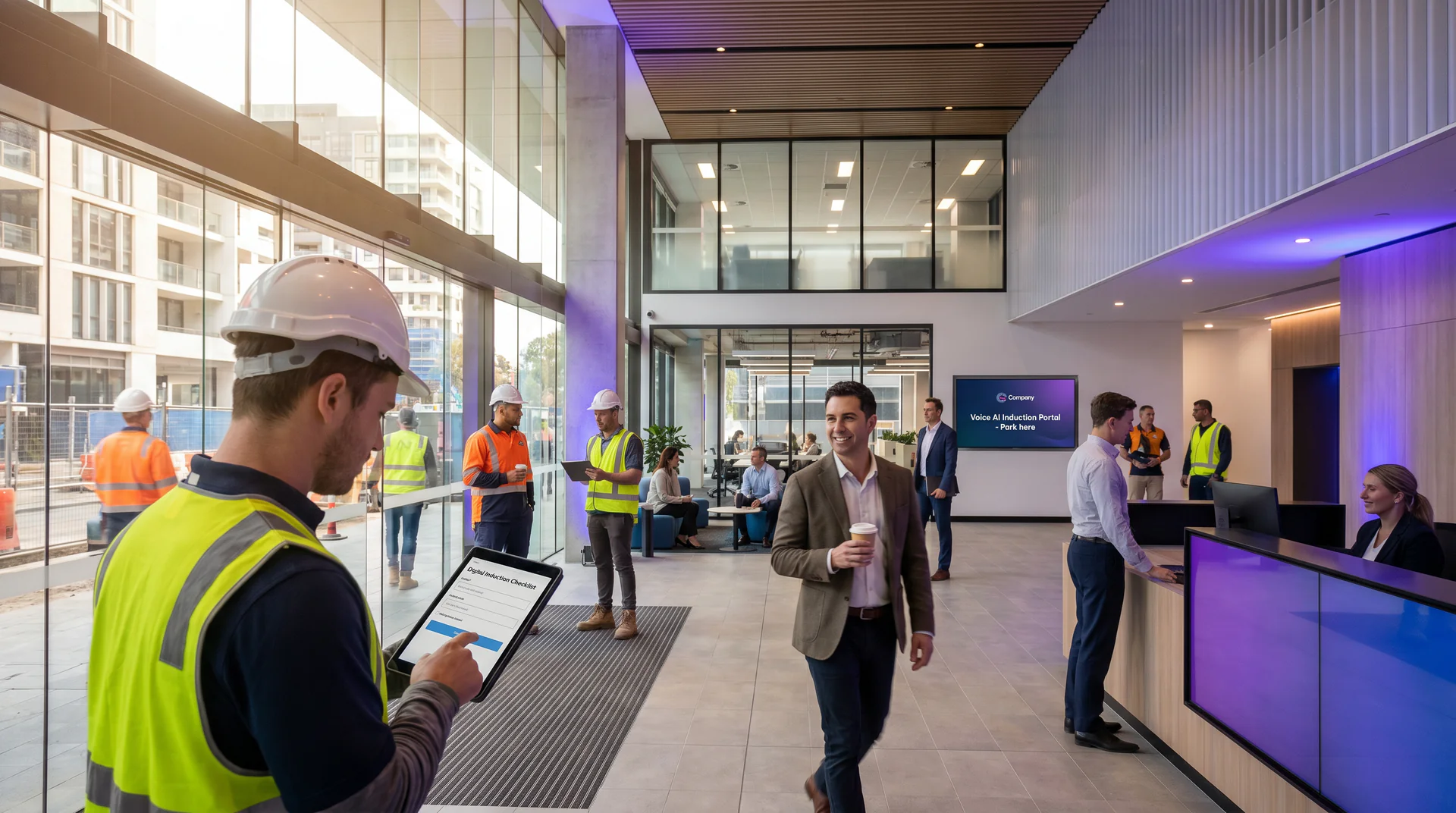
You deploy it via a QR code on the site sign-in board. The new sub scans it at the gate. The genie introduces itself and runs through the induction.
Here’s how that actually works on subcontractor day one.
Step 1: The Scan at the Gate
The sub sees a QR code on the site entry board. Maybe there’s a short line of text next to it: “New to site? Scan here first.” They pull out their phone and scan.
The genie opens in their browser. No app to download. It speaks, introduces itself by site name, and asks if they’re a new arrival.
Step 2: The Induction Runs Itself
The genie works through the site induction in plain language. It covers parking, pedestrian walkways, hazard zones, sign-in procedures, morning tea timing, the correct gate for material deliveries, and who to contact when something goes wrong.
It doesn’t read from a script mechanically. It talks through the information the way a person would. If the sub has a question, they ask it. The genie answers from the knowledge base.
The whole thing takes around 10 minutes. Most of the 15 questions the sub walked in with get answered without them having to ask a single one.
Step 3: The Foreman Stays on the Steel Conversation
The sub walks onto site informed. They know where they’re going, what the rules are, and who to call if something comes up.
The foreman finishes the conversation about the delivery, checks in with the steel crew, and gets on with the morning. Nobody got pulled away. Nobody had to interrupt anything.
The site starts the day running properly.
The Details That Make This Work
A few things matter for this to hold up in practice.
The knowledge base has to be site-specific. A generic construction safety briefing doesn’t help anyone. The genie needs to know THIS site. Where the toilets actually are. Which gate is for deliveries at this address. What the sign-in process is for this particular project. That information gets uploaded when the site is set up, and it gets updated when things change.
The genie has to handle follow-up questions. Not every sub will have the same 15 questions. Some will have more. The genie needs to be able to handle “what happens if I see a hazard and the foreman is unavailable” and “can I bring my ute in through the south gate” and “is there somewhere I can store my tools overnight.” If the answer is in the knowledge base, the genie gives it.
The QR code placement matters. It needs to be at the point of arrival, before the sub goes looking for someone to ask. On the sign-in board, on the site entry sign, or on the temporary fencing near the main gate. The scan has to be the obvious first step.
The genie works before business hours. Not every site starts at 9am. When the foreman is already running at 7am, the genie is already running too. It doesn’t need a warm-up.
What This Looks Like at Scale
On a single site, a genie might run 3-5 inductions a week during an active build phase. That’s 3-5 conversations the foreman didn’t have to have. Over a 20-week project, that’s somewhere in the range of 60-100 inductions handled without anyone being pulled off task.
For a builder running multiple sites at once, that number compounds fast. If each site has a rotating roster of subcontractors and each induction takes 15-20 minutes of a foreman’s time, the weekly load adds up to hours of productive site management time that’s currently being spent as a welcome desk.
Across small and medium building companies, admin and coordination tasks can account for 20-30% of a site manager’s week. A genie doesn’t fix all of that. But it handles one specific, recurring drain on that time completely.
The sub experience improves too. Showing up to a site and knowing what to do from the moment you arrive is a different start to the day. It signals that the site is organized. It reduces the anxiety of being new somewhere unfamiliar. And it means the first hour of a three-week engagement actually becomes productive.
This Is What “The Site Answers” Means
The old model relies on whoever is at the gate at 7am being the source of all site knowledge. Some mornings that works fine. Other mornings the person at the gate is dealing with a delivery problem, a safety issue, and three phone calls at once.
The new model is simpler: the site itself answers the questions every new arrival has, every time, regardless of who’s busy.
A genie on the sign-in board doesn’t replace the foreman. It takes away the part of the foreman’s job that shouldn’t belong to them in the first place.
It pays for itself the first month a site manager gets to actually run their site instead of running inductions.
See How It Works
If you’re running sites with rotating subcontractors, or managing builds where new faces show up regularly, a genie built around your site knowledge is worth looking at.
Visit /explore to see how Help Genie works across industries, or use the ROI calculator to see what recurring inductions are actually costing you in foreman time.