 Use Case general
 How Voice AI Handles the 11pm Late Check-In With Zero Stress
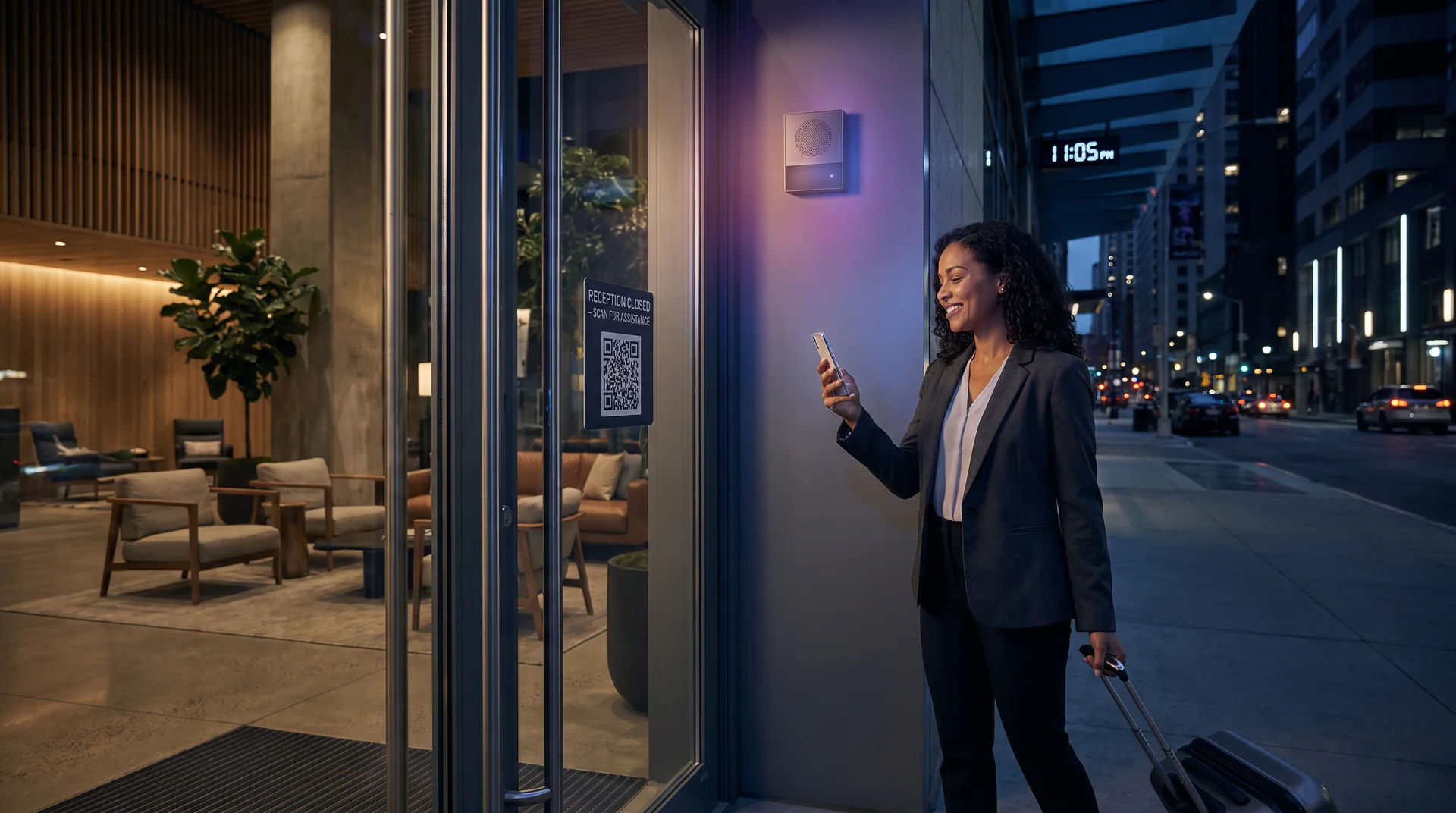
A guest arrives at 11pm. Reception is closed. A QR code on the door and a voice genie answers everything in 5 seconds.
 Help Genie
 The Moment That Breaks the Guest Experience
It’s 11pm. A guest rolls their luggage through the front door of a boutique hotel. The lobby is quiet. Reception is dark. There’s a sign on the desk that says something about calling a number, but the font is small and the lighting is worse.
They pick up their phone. The number rings out. Or goes to voicemail. Or connects to a tired staff member who has to find the right code in a spreadsheet while the guest stands there, tired, hungry, probably a little irritated.
Three questions are burning in their head. What’s the entry code? Where is room 14? Where do I park the car?
Simple questions. Answerable in seconds. But right now, there’s no one to answer them.
This is one of the most common failure points in travel and hospitality, and it happens every single night across thousands of properties.
The Gap That Costs You More Than You Think
Late arrivals are not rare. Flights get delayed. Road trips run long. Guests book the late rate on purpose. In the accommodation industry, a meaningful share of arrivals happen outside standard reception hours. Estimates from accommodation operators consistently put after-hours arrivals at somewhere between 20-35% of total check-ins, depending on property type and location.
For large hotels, this gets absorbed by 24-hour front desk staff. But for boutique hotels, serviced apartments, holiday rentals, bed-and-breakfasts, and smaller motor lodges, a 24-hour front desk is not economically viable.
So what happens instead?
A laminated sheet with instructions that may or may not be current. A phone number that may or may not be answered. A lockbox code that was emailed at 3pm and has since been buried under 47 other emails. A WhatsApp message that the guest has to scroll back through while standing in a dark carpark.
None of this is the guest experience you want to deliver. And the cost is real. A bad arrival experience shapes the entire stay. It’s what gets mentioned in the review, sometimes even when everything else was excellent.
How the Genie Handles It
The fix is a QR code on the front door.
Not a PDF. Not a static FAQ sheet. A QR code that connects the guest directly to a voice AI genie, loaded with the specific knowledge base for that property.
Here’s how it plays out.
The guest arrives at 11pm. They see the QR code on the door, the entrance gate, or the lobby notice board. They scan it. The genie is immediately available, by voice or by text, whichever the guest prefers.
The guest asks: “What’s my entry code?”
The genie confirms the booking, retrieves the code, and reads it out. The guest types it in. The door opens.
Walking down the corridor, they ask: “Where’s room 14?”
The genie gives directions. Second floor, turn left, third door on the right.
Getting back in the car to park, they ask: “Where do I park?”
The genie tells them. Guest carpark behind the building, use the blue remote on the key ring.
All three questions. Under five seconds each. The guest is in their room before a phone call would have been answered.
This is not a complicated workflow. The genie is drawing on a knowledge base built from the property’s own information: room locations, entry codes, parking instructions, wifi passwords, breakfast times, checkout procedures. The property owner loads that information once. The genie handles the rest, every night, without needing to be scheduled, rostered, or woken up.
What the Genie Knows (and Can Handle)
The late check-in scenario is the most obvious one, but it’s worth being clear about what a well-built genie can actually cover in this context.
Entry and access. Codes, keypads, lockbox locations, gate remotes. The genie can confirm these and walk a guest through the process step by step if they’re having trouble.
Room orientation. Where things are, how the heating works, how to connect to the TV, where extra towels are stored.
Parking. Where to park, what’s permitted, whether there are height restrictions, what to do if the carpark is full.
Local information. Late-night food options, how to get a taxi, whether the supermarket nearby is still open. A well-built knowledge base can include curated local content, not just property FAQs.
Morning logistics. What time is breakfast, where is it served, what’s the checkout time, is late checkout available.
The guest doesn’t have to guess which question is “allowed.” They just ask. The genie handles what it knows and, if something falls outside its knowledge base, it lets the guest know clearly and offers an alternative, like a contact method for urgent issues.
The Experience From the Guest’s Side
Think about the difference.
Old experience: arrive at 11pm, find a note, try a phone number, wait on hold or get voicemail, feel like a burden for calling, finally get in the room feeling stressed and slightly unwelcome.
New experience: arrive at 11pm, scan a QR code, talk or type to a genie, get three clear answers in under 30 seconds, walk into the room feeling like the property had it sorted before you even arrived.
The second experience doesn’t just resolve the problem. It creates a positive impression at exactly the moment the guest is most vulnerable to a bad one. Tired, late, unfamiliar environment. That’s when the property’s reliability matters most.
And the guest never needs to download an app. They just scan a standard QR code with their phone camera. That low friction matters a lot at 11pm.
The Experience From the Operator’s Side
The obvious benefit is staff hours. If a property handles 15-20 late arrivals per week, and each one previously required a 5-10 minute phone interaction, that’s 75-200 minutes of staff time per week, roughly 65-175 hours per year, handling questions that a genie can answer in seconds.
But the less obvious benefit is the quality of those staff hours. When reception staff know the genie is covering routine late-night queries, they’re freed to focus on genuine issues: a heating system that’s failed, a guest with a medical need, a booking dispute that requires real judgment. The genie handles the predictable. The team handles the unexpected.
For owner-operators running a property largely on their own, this is even more significant. Not being woken at 11pm to read out a parking code is not a small quality-of-life improvement.
Properties that deploy this kind of after-hours coverage also tend to see measurable reductions in negative reviews related to arrival experience. In hospitality, a single negative review can cost more in future bookings than a full year of voice AI subscription costs. The economics are clear.
The Setup Is Simpler Than You’d Expect
Getting a genie live for a property like this doesn’t require a developer or a long integration project.
The process is three steps. Load the knowledge base (entry instructions, room information, parking details, local FAQs). Customize the genie (name it, set the tone, align it with the property’s brand). Go live with a QR code that links directly to the genie.
The QR code can be printed, laminated, and attached to the front door in an afternoon. From that point, every late arrival has access to the same reliable, consistent information, regardless of whether it’s 11pm on a Tuesday or 2am on a long weekend.
The knowledge base can be updated any time. Changed the entry code? Update the knowledge base. New parking arrangement? Update it. The genie starts answering the new information immediately.
What This Looks Like at Scale
For a single property, this solves a specific, recurring problem. For a group of properties, or for a property management company overseeing multiple listings, the value compounds quickly.
One knowledge base structure, adapted for each property. One QR code per location. Consistent guest experience across the portfolio, without requiring a staff member at each site.
This is where voice AI in travel and hospitality moves from a convenience to a genuine operational advantage. Consistent delivery at multiple locations, overnight, without scaling headcount.
Ready to See It in Action?
Late check-ins are one scenario. There are dozens more across the guest journey where a genie can cover the gap between what guests need and what staff can realistically provide around the clock.
See how Help Genie works for travel and hospitality at /travel-hospitality, or run your numbers at the ROI calculator to see what covering after-hours conversations could mean for your property.
Your guest is in the room before reception would have answered the phone. That’s the standard worth building toward.