 Use Case general
 The 600-Page Manual Nobody Reads (And the Genie That Knows All of It)
See how voice AI turns a vehicle owner's manual into a real-time support tool that answers customer questions 24/7, without tying up your service team.
 Help Genie
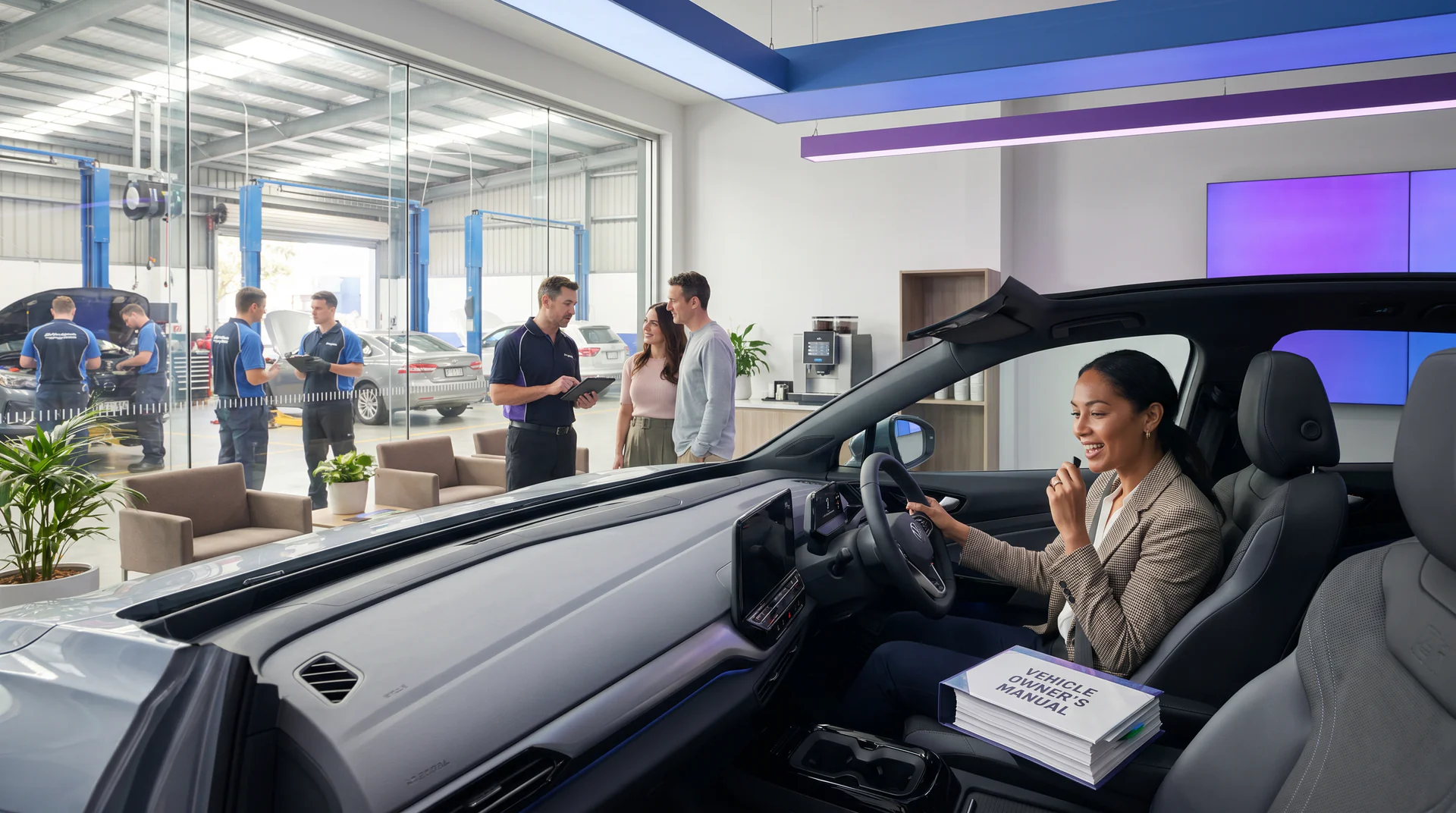
 It’s 9pm. She’s in the driveway. The wrench light is on.
She picked up her car three weeks ago. The handover was great, the salesperson was friendly, and somewhere in the back seat there’s a 600-page owner’s manual she has not touched since page four.
Now she’s sitting in the dark, staring at a small amber wrench icon on the instrument cluster. She doesn’t know if it means pull over immediately or just ignore it until Monday. She doesn’t want to call anyone this late. She types into the link from her welcome email.
“Wrench light came on this morning. I drove to work. Should I be worried?”
The genie answers in plain English. That’s the service reminder. It’s mileage-based, not a fault warning. She’s hit the 15,000km mark. Here’s how to book her free first service. Here’s how to clear it temporarily if she needs to.
Thirty seconds. No hold music. No apologetic voicemail.
That’s what happens when the vehicle owner’s manual becomes a conversation.
The manual nobody reads
A new car comes with roughly 600 pages of documentation. Most owners read page one, which is all warnings, and pages two through four, which explain how to adjust the seat. After that the manual goes in the glovebox, under the registration paperwork, and stays there for the entire life of the vehicle.
This isn’t a literacy problem. It’s a format problem. Nobody reaches for a 600-page PDF at 9pm in a driveway. They reach for their phone.
And when they do, they ask questions like these.
How do I pair my phone? There’s a wrench light on, what does that mean? The boot won’t open from the key fob. How do I turn off the lane-keep nudge? How do I engage tow mode? The lights flash three times when I lock it, is that normal? Why is the AC blowing through the windscreen vents instead of the face vents?
These are not strange edge cases. They are the 30 questions your dealership service team answers every single day, in slightly different words, from slightly different customers, who all bought slightly different cars with slightly different feature packs.
What fails without a genie
Your customer service team is fielding these calls constantly. Half the time they end up checking the manual themselves, on a PDF, on the manufacturer portal, while the customer waits on hold. They know the answers well enough to find them. But finding them takes time, and that time costs money.
The math is straightforward. If your team takes 30 owner manual calls a day, and each one averages 6-8 minutes, that’s 3-4 hours of staff time every day on questions that have known answers sitting in a document you already own.
Meanwhile your customers who call outside business hours get nothing. They get voicemail. They get anxiety. And they form an impression of your business that has nothing to do with the quality of the car you sold them.
The vehicle owner’s manual was never the problem. The delivery mechanism was.
How the genie handles it
A genie reads the manual. All 600 pages. Every feature pack variant. Every model year in your inventory. You upload the documentation to the genie’s knowledge base, and it knows the content the way a well-trained technician knows it, except it’s available at 9pm on a Saturday and it never puts anyone on hold.
Here’s how the setup works in practice.
Step 1: Load the knowledge base
You upload the owner’s manual, any supplementary guides, the feature pack documentation, and any FAQs your team has built up over time. The genie reads all of it. If you sell multiple models, you can have a genie per model or a single genie that understands the differences between them.
This is the same knowledge your service advisors carry around in their heads, now accessible through any channel.
Step 2: Put it somewhere the customer will actually find it
The genie sits behind a phone number the customer can text. It lives in the welcome email sent on delivery day. It’s a QR code sticker in the glovebox, right there where the manual is. It can be embedded on your website. Wherever the customer reaches for their phone, the genie is there.
There’s no app to download. No account to create. The customer texts or clicks, and the conversation starts.
Step 3: The customer asks. The genie answers.
The customer texts: “The boot won’t open from the key fob.”
The genie doesn’t say “please hold while we locate your vehicle information.” It asks a clarifying question if it needs to. Are you pressing the button on the fob itself or the button on the door? It narrows the answer based on what the customer tells it. Then it gives the actual fix, in plain language, with the relevant page reference if the customer wants to verify.
If the question is genuinely complex, something that needs a technician’s eyes, the genie says so and offers to connect the customer with the service team during business hours. It captures the question so the advisor already knows the context when they follow up.
The genie handles the 30 common questions automatically. The service team handles the ones that actually require hands and expertise.
Step 4: Every conversation becomes a record
When the customer asks about the wrench light, that conversation is logged. If a particular question is coming up repeatedly across multiple customers and multiple vehicles, that pattern appears in the analytics. You can see which models are generating the most owner questions, which features are confusing people, and where your post-sale documentation has gaps.
That’s not just support. That’s product feedback and process improvement, automatically.
The outcome
For dealerships and vehicle retailers who deploy a genie across their owner manual knowledge base, the measurable changes tend to cluster around a few areas.
Staff time on repeat calls drops significantly. Industry estimates for similar knowledge base deployments suggest that 40-60% of inbound support queries fall into “known answer” categories that a genie can handle without human involvement. For a dealership taking 30 manual calls a day, that’s a real reduction in load on customer service staff.
Customer satisfaction improves at the moments that matter most. The first 90 days after purchase are when owner questions peak. Getting a real answer at 9pm, in plain language, on the first try, changes how customers feel about the business long after the sale. It’s the difference between a customer who tells friends “I had a question about the car and they sorted it straight away” and one who says “I could never get through to anyone.”
After-hours coverage becomes real rather than theoretical. Many dealerships have after-hours voicemail. Very few have after-hours answers. A genie changes that without adding headcount or changing anyone’s shift pattern.
And the manual, finally, becomes what it was always supposed to be. Not a document you file and forget. A resource you can actually use.
This works beyond automotive
The vehicle owner’s manual is one of the clearest examples of this pattern, but it’s not the only one.
Any business that ships a product with documentation faces the same gap. Appliance retailers. Marine dealers. Equipment suppliers. The customer gets a manual, the manual goes in a drawer, and the calls start within weeks.
If you have documentation, you have the raw material for a genie that can answer owner questions 24/7. The knowledge already exists. The question is whether it’s locked in a PDF or available in a conversation.
Head to the /appliances or /automotive pages to see how genies work for specific product categories. If you’re figuring out where to start, the /roi-calculator will show you what the numbers look like for your business.
The manual was always meant to be a conversation
Six hundred pages of careful documentation, written by engineers who knew exactly what every light, every mode, and every feature was designed to do. None of it reaches the customer at the moment they need it, because a PDF in a glovebox isn’t a conversation.
A genie is.
Your customer is in the driveway. The wrench light is on. She has her phone in her hand. The question is whether you’re there to answer it.
See how it works for your business at /explore.