AI Call Handling for Electricians During Storm Season
Storm season floods electricians with calls. Learn how AI call handling triages electrical emergencies from routine requests and captures every lead 24/7.

A storm rolls through your service area at 3 AM. Trees take down power lines. Transformers blow. Generators that haven’t been tested since last year fail to kick on. By sunrise, your phone is ringing nonstop. Half the callers have genuine emergencies (sparking outlets, burning smells, standing water near electrical panels). The other half want to schedule a panel upgrade they’ve been putting off for months.
Your two-person office staff can’t tell the difference fast enough. And they definitely can’t answer 80 calls before lunch when they normally handle 20 in a full day.
AI call handling for electricians solves the triage problem that storms create. It answers every call, separates the sparking outlet from the panel upgrade quote, and gets your dispatchers the information they need to send the right crew to the right place.
The Storm-Surge Problem Electricians Know Too Well
Every trade that responds to weather events faces the same basic challenge. Call volume spikes far beyond what your office can handle, and it spikes at the worst possible time. Your techs are already in the field dealing with emergency calls. Your office staff is scrambling. And the calls just keep coming.
For electricians, storms create a specific mix of call types that makes triage critical. Safety emergencies (sparking outlets, burning smells, exposed wiring, water near electrical panels) need immediate dispatch. Power restoration calls (whole-house outages, partial power loss, flickering lights) are urgent but not life-threatening. Generator calls (units that won’t start, transfer switch failures) are time-sensitive for customers with medical equipment or sump pumps. Routine requests like panel upgrades and EV charger installs are important business but not a storm-day priority.
When all four types hit your phone lines simultaneously, someone with a burning smell behind their outlet plate is waiting on hold behind someone asking about a hot tub hookup. That’s not just bad customer service. It’s a liability problem.
- All calls hit the same queue regardless of urgency
- Hold times stretch past 15 minutes during surges
- Office staff rushes through calls, missing safety details
- After-hours emergencies go straight to voicemail
- Routine callers clog the line during peak emergency volume
- AI triages every call by urgency within 90 seconds
- No shared human-operator queue; verify storm-volume latency and capacity
- Structured safety questions catch critical details
- 24/7 coverage handles the 3 AM emergency calls
- Routine requests scheduled separately, keeping emergency lines clear
How AI Triage Works for Electrical Emergencies
The key difference between a generic answering service and AI built for electricians is understanding what to ask and why. A call center operator reads a script. A well-configured AI genie understands the difference between “my power is out” and “I smell smoke coming from my outlet.”
The Emergency Dispatcher for the electrical subcategory is designed for exactly this. When a caller reaches the line, the opening is direct: “Electrical emergency? Your safety is our priority. Tell me what’s happening.”
That opening matters. It immediately signals to the caller that they’ve reached someone who takes their situation seriously. From there, the AI works through a structured triage:
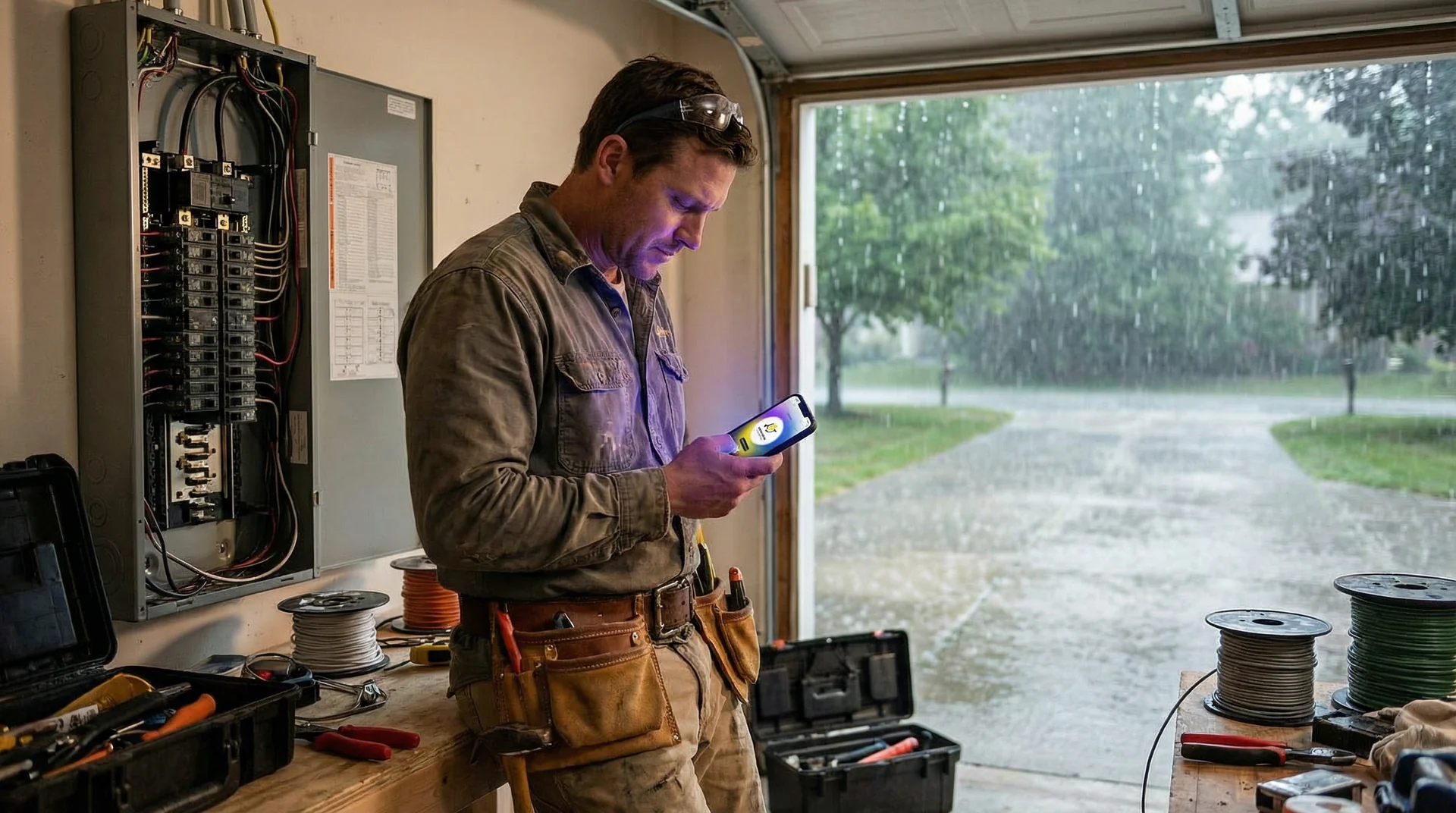
The safety assessment step is what separates real triage from simple call answering. A caller who says “my power is out” could be a nuisance outage (the utility’s problem) or a serious panel issue. The AI asks about other homes on the street, whether the breaker tripped, and whether there’s any water in the basement near the panel. Those answers determine whether you’re dispatching an emergency crew or telling the caller to contact the utility company.
Commercial vs. Residential: A Sorting Problem AI Handles Fast
Storms don’t just affect homeowners. Commercial clients lose power too, and their calls have different urgency profiles. A restaurant that lost refrigeration has a food safety clock ticking. A medical office without backup power has patients to relocate. A warehouse with a compromised fire suppression system needs immediate attention.
The Job Qualifier routes commercial and residential calls to the right team. Its opening: “Need an electrician? I can help match you with the right team. Is this for a home or business?” Simple question, but it prevents the all-too-common problem of sending a residential crew to a 480-volt commercial panel or quoting residential rates for a commercial emergency call.
During storm season, this routing becomes critical. Your commercial team might need to prioritize the medical office over the restaurant. Your residential team might need to focus on homes with elderly residents or medical equipment. The AI collects the details that make these prioritization decisions possible before a dispatcher is ever involved.
The After-Hours Gap That Costs You Customers
Storms don’t respect business hours. The worst electrical emergencies tend to happen at night, when wind and rain are heaviest. A homeowner wakes up at 2 AM to a burning smell. A business owner gets an alarm notification that the backup generator failed. A property manager discovers water leaking near the main electrical panel.
These callers aren’t going to leave a voicemail and wait until 8 AM. They’re going to call every electrician in their phone until someone answers. And whoever picks up first gets the job.
The Emergency Dispatcher operates 24/7. At 2 AM on a Wednesday after a storm, it answers on the first ring. It assesses safety risk. It collects location, contact info, and a description of the problem. For true emergencies (fire risk, water and electricity contact, exposed high-voltage wiring), it can trigger immediate escalation to your on-call technician. For urgent but non-dangerous situations, it captures all the details and queues the call for first-thing-in-the-morning dispatch.
Your on-call tech gets woken up for the calls that actually require it. Not for the caller who wants to schedule a panel upgrade and happened to think about it at midnight.
Try The Emergency Dispatcher, your after-hours electrical emergency specialist to see how it handles urgent calls.
Turning Storm Season Into Quote Season
Not every storm call is an emergency. A lot of callers use the storm as a wake-up call. Their panel is 30 years old. They’ve been meaning to install a whole-house generator. They want to add a transfer switch so the next outage doesn’t catch them off guard.
These are high-value leads. A generator install runs $7,000 to $15,000. A full panel upgrade is $2,000 to $4,000. But during a storm surge, your staff doesn’t have time to have a 10-minute conversation about quote details.
The Quote Collector handles these conversations without pulling your team away from emergency dispatch. It gathers project details (panel age, amperage, number of circuits, what they want to add), contact information, and timeline preferences. When the storm passes and your team has capacity, those quotes are sitting there ready to go. Complete project descriptions. Accurate contact info. Real buying intent.
The alternative is what usually happens: routine callers get voicemail during the storm, never call back, and eventually hire another electrician two months later when they get around to it. You lose the lead because you couldn’t have the conversation at the moment the customer was motivated.
Storm season creates two opportunities for electricians. The obvious one is emergency dispatch revenue. The less obvious (and often more valuable) one is the wave of quote requests from customers who just realized their electrical system isn't ready for the next storm. AI captures both without forcing your team to choose between them.
Safety Guidance That Protects Your Reputation
Electrical emergencies carry real danger. A caller standing in a flooded basement with a live panel needs to hear “get out of the basement now” before anything else. A caller touching a sparking outlet needs to hear “turn off the breaker at the main panel and don’t touch the outlet again.”
The Safety Guide provides immediate safety information while the caller waits for a technician. This isn’t medical advice or a liability risk. It’s the same guidance any responsible electrician would give over the phone: stay away from water near electrical sources, don’t touch exposed wiring, locate your main breaker.
This safety-first approach protects callers. But it also protects your business. A caller who received clear safety instructions from your AI and then a fast dispatch will remember that experience. They’ll tell their neighbors. They’ll leave reviews that mention your company took their safety seriously before anything else.
What Storm Preparedness Looks Like Now
The trades industry has always been seasonal. Electricians, roofers, HVAC techs, and plumbers all deal with weather-driven demand spikes. The difference now is that customers expect instant response regardless of how busy you are. A 10-minute hold time that was acceptable five years ago loses customers today.
If you’re an electrical contractor heading into storm season, the preparation checklist looks different than it did a few years ago. You need emergency call triage that runs 24/7 without adding staff, commercial and residential routing that happens before dispatch, quote collection that captures motivated leads during the surge, safety guidance that protects callers and your liability exposure, and scheduling for the routine calls that come in alongside emergencies.
The electrical subcategory page shows how each of these capabilities works with Help Genie’s five electrical genies. From emergency dispatch to appointment scheduling, every call type has a dedicated handler.
See all five electrical genies at Help Genie for Electricians. Emergency triage, job routing, quote collection, safety guidance, and scheduling. All running before the next storm hits.
The Storm Is Coming. Your Phones Should Be Ready.
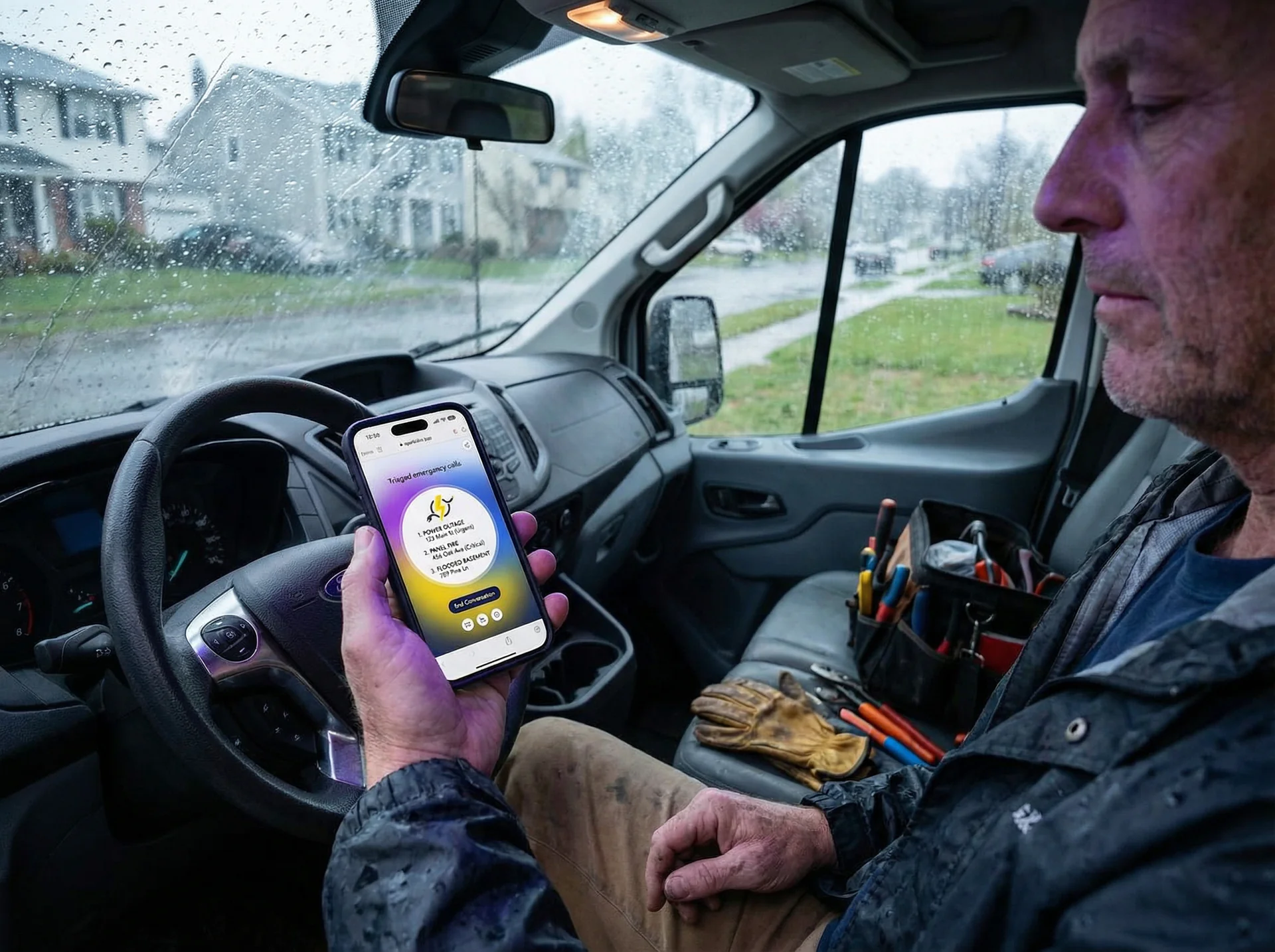
You can’t predict when the next major storm will hit your area. But you can predict what happens when it does. Phones ring constantly. Staff can’t keep up. Emergency calls wait behind routine inquiries. After-hours emergencies go to voicemail. And your competitors who answer first get the business.
AI call handling for electricians isn’t about replacing your team. It’s about making sure your team spends their time on dispatch and service calls instead of answering the phone 80 times a day. Every call gets answered. Every emergency gets flagged. Every quote request gets captured. And when the storm passes, you’ve got a full pipeline instead of a voicemail box full of missed opportunities.
You might also want to check out our look at AI emergency response for HVAC companies and AI phone answering for roofing companies. Same storm, different trades, same solution.
Help Genie Tips
Get more from your voice genie

Build on-call schedules for after-hours routing
Different team members on different nights? Configure on-call schedules so your genie always routes calls to whoever is available, without you lifting a finger.

Set different genie behavior for after-hours calls
Your genie can act differently at night. Triage emergencies, collect more info from callers, or simply take messages. You control what happens when the office is closed.

Sync appointments to Google Calendar or Outlook
When your genie books a showing, service call, or consultation, it can push the appointment directly to your calendar. No double-booking, no manual entry.

Clone and customize genies for different locations or roles
Running multiple locations or departments? Clone an existing genie, swap the details, and deploy. Each genie gets its own number, knowledge, and branding.
Ready to try it?
Set up a voice genie for your business in minutes.
Keep exploring
Further reading and useful tools
Best Jobber AI Receptionist Alternatives (2026)
Honest roundup of Jobber AI Receptionist alternatives for home service businesses. Compare native Jobber add-ons, voice genies, and field-service AI CSRs.
ComparisonBest Sameday AI Alternatives (2026)
Honest roundup of Sameday AI alternatives for home service businesses. Compare minute bundles, flat-rate voice genies, and field-service AI receptionists.
GuideAI Answering Service for Australia: A Complete Setup Guide
How Australian service businesses deploy voice AI genies on local numbers — AUD pricing, Sydney and Melbourne context, after-hours triage, and a practical path to go live.
GuideAI Receptionist for New Zealand Businesses: A Practical Setup Guide
How Kiwi trades and service businesses deploy a voice AI genie on NZ phone numbers — NZD pricing, local spelling, after-hours triage, and a six-step path to go live.
Case StudyBlueLine Plumbing: After-Hours Voice AI Triage for Auckland Trades
How an Auckland plumbing firm used a branded voice genie to capture after-hours emergencies and routine bookings — illustrative scenario with example metrics.
Use CaseYour Parts Catalogue Shouldn't Live Inside One Person's Head
When your best counter person goes on leave, the whole counter struggles. Here's how a voice AI genie reads your full parts catalogue so your team doesn't have to.
Help Genie
The Help Genie Team
The Help Genie team builds voice AI genies that resolve everyday support on their own — across phone, chat, web, and email — in your voice, 24/7. We write about what we learn shipping it to real businesses.
Building voice AI for 11+ industries, from trades to hospitality.
- voice AI
- customer support
- lead capture
- multi-channel genies