AI Phone Support for Office Equipment Service Calls
Office equipment dealers lose service contracts when support calls go unanswered. See how AI handles troubleshooting, dispatching, and toner orders.

A law firm’s main copier goes down at 9 AM on a Monday. They have 300 pages of discovery documents to print before a 1 PM hearing. They call their office equipment dealer. The phone rings. And rings. And goes to voicemail.
The service tech is already on a call. The parts counter is helping someone in person. The office manager is processing a lease renewal. Nobody picks up. The law firm calls again at 9:15. Same result. By 9:30, the office manager at the firm is Googling “copier repair near me” and considering whether their next service contract should be with someone else.
Office equipment is a relationship business. Dealers win and keep contracts based on how quickly and effectively they respond when something breaks. AI phone support is becoming the differentiator between dealers who keep their service contracts and those who lose them to the competitor with a faster response time.
The Service Call Bottleneck
Office equipment dealers face a unique phone challenge. Their service calls are technical, time-sensitive, and varied. A single service call can require troubleshooting guidance, technician dispatch, parts ordering, or all three. And the people best equipped to handle these calls are the same people who are out servicing equipment.
Here’s the typical scenario at a mid-size copier dealer:
- 3 to 5 service technicians in the field at any given time
- 1 to 2 people handling phones, also managing walk-ins and parts counter
- 20 to 40 service calls per day, with spikes when a firmware update goes wrong or a heat wave causes overheating failures
- Each call takes 5 to 15 minutes depending on complexity
The math doesn’t work during busy periods. When 8 calls come in within the same hour and you have 2 people answering phones, 6 of those callers are waiting on hold or hitting voicemail.
How AI Transforms the Service Call Flow
The breakthrough for office equipment dealers is that many service calls follow predictable patterns. “My copier is jammed.” “I need toner.” “The printer is showing error code SC542.” “We need a tech out here.” AI can handle the initial triage and resolution for a significant portion of these calls.
Troubleshooting: Resolving Issues Without a Truck Roll
The Troubleshooter is the first line of defense. When a customer calls about a paper jam, an error code, or a print quality issue, the AI walks them through basic resolution steps.
“I see you’re having trouble with your MPC3504. Is the screen showing an error code?” Followed by step-by-step instructions: open this panel, remove the paper from this area, close the panel, press the button. Clear, calm, patient guidance that works regardless of the caller’s technical skill level.
This matters because roughly 30% of service calls can be resolved over the phone. Every phone-resolved call saves a truck roll ($75 to $150 in labor and fuel) and gets the customer’s equipment back online in minutes instead of hours.
Supply Orders: The Simplest Win
“I need toner for our Ricoh in the conference room.” This call shouldn’t require human involvement. The customer knows what they need. The system knows what equipment they have. The order should take 60 seconds.
The Supply Bot handles this exactly. Toner, drums, staples, waste containers. The customer calls, the AI confirms the equipment and supply type, and the order is placed. For managed print customers with supply contracts, this is especially seamless because the supply type is already tied to their account.
Service Dispatch: Getting a Tech on the Way
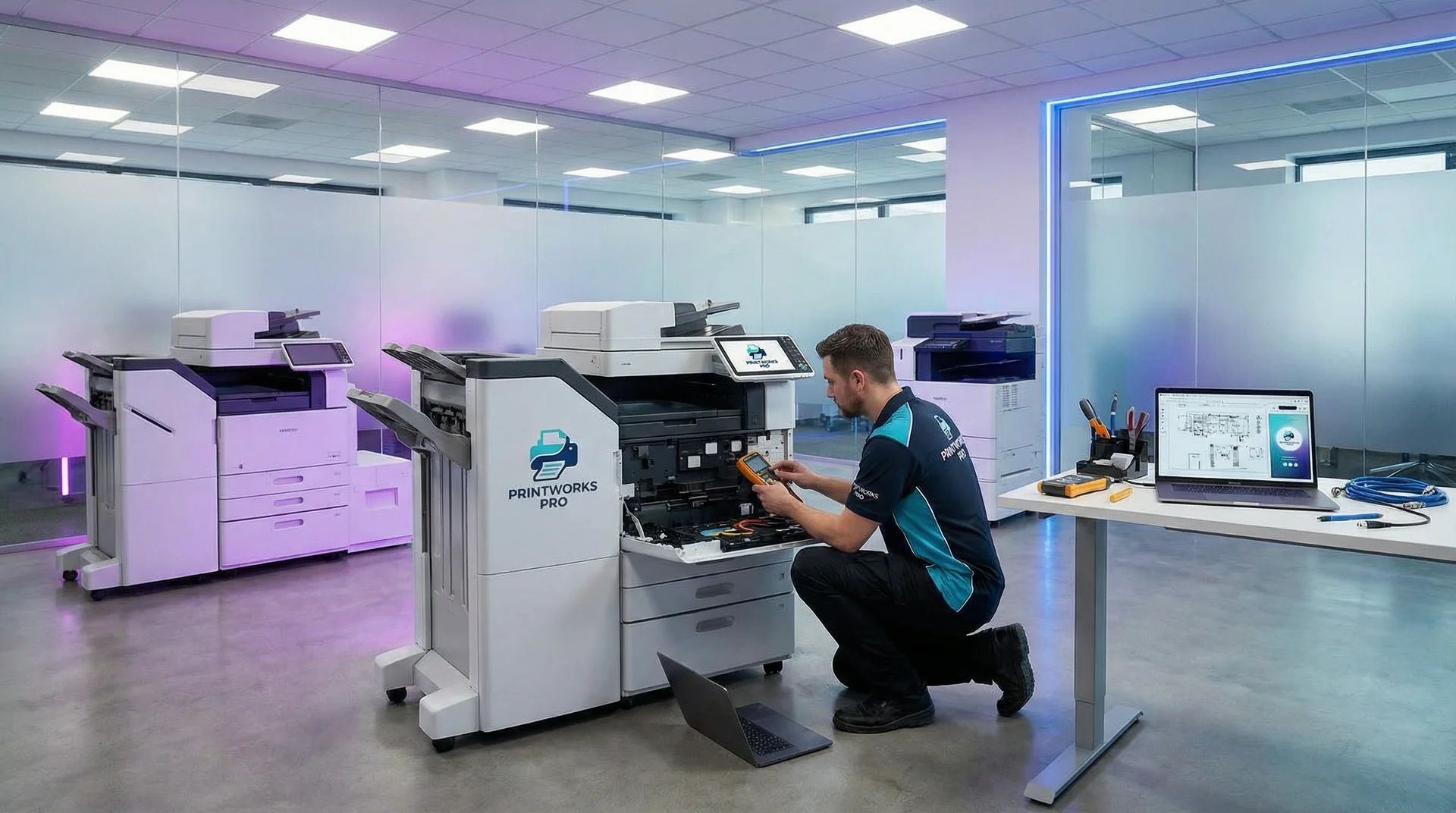
When troubleshooting doesn’t resolve the issue, the customer needs a technician. The Service Dispatcher captures everything the tech needs before arriving: equipment model, serial number, symptoms, error codes, what they’ve already tried, and the customer’s availability.
The tech shows up with the right parts and the right expectations. No wasted trips. No “let me go back to the shop and get the right part.” First-time fix rates go up. Customer satisfaction goes up. The tech’s day is more efficient.
The Meter Reading Problem
Managed print service contracts bill based on usage. Collecting meter readings from customers is the bane of every MPS provider’s existence. Customers forget to submit them. Staff spends hours making follow-up calls. Billing gets delayed.
The Meter Reader collects readings over the phone. When a customer calls in (or when the system proactively reaches out), it asks for the black-and-white and color counts, confirms them, and logs them directly. No spreadsheets. No email chains. No chasing customers for numbers they can’t find.
This is a small workflow that consumes a disproportionate amount of administrative time. Automating it frees up hours per month for your billing team.
Retention: Why Service Response Is the Real Battlefield
In office equipment, the initial sale matters. But the real money is in the service contract. A $15,000 copier sale generates a one-time margin. The $400/month service contract generates $4,800/year in recurring revenue, often for 3 to 5 years. That’s $14,400 to $24,000 per contract in lifetime value.
Losing a service contract because of slow support response is losing $14,400 or more per customer. And the trigger is almost always the same: the customer called when they needed help, nobody answered, and they decided your competitor might take their equipment more seriously.
AI phone support eliminates this retention risk. Every service call gets answered. Every issue gets triaged. Every customer feels like they’re your most important account.
- Service calls go to voicemail during busy periods
- Every call requires human handling, even for toner orders
- Techs arrive on-site without complete problem details
- Meter reading collection is a manual time sink
- Slow response erodes customer confidence and retention
- Every service call answered instantly, 24/7
- 30% of issues resolved over the phone without dispatch
- Techs get complete diagnostic details before arriving
- Meter readings collected automatically
- Faster response strengthens contract retention
The Competitive Differentiator
Most office equipment dealers in a given market offer similar products from the same manufacturers. Ricoh, Canon, Konica Minolta, Xerox. The hardware is comparable. The lease terms are similar. What differentiates one dealer from another is service.
When a prospect is evaluating two dealers for a fleet deployment, the dealer who can say “Every service call is answered on the first ring, your issues are triaged immediately, and our average response time is under 2 hours” has a meaningful advantage over the one who says “We’ll get back to you as soon as we can.”
The office equipment industry page covers the full range of voice AI applications for copier dealers, managed print providers, and office technology companies. And the managed print services page details every genie built for the service and support workflow.
Getting Started
The simplest entry point for office equipment dealers is supply ordering. It’s the most straightforward call type, it requires zero technical judgment, and it immediately reduces the volume of calls your team handles manually.
Once supply ordering is automated, add troubleshooting for your most common equipment models. Then service dispatch. Each layer removes more routine volume from your team and lets them focus on complex service issues and customer relationships that actually require human expertise.
Try The Service Dispatcher to see how it triages and dispatches service calls for office equipment.
Your service team is the reason customers stay. AI makes sure they’re reachable, informed, and focused on the work that matters most.
Explore all office equipment genies and see how each one handles a specific service workflow.
Help Genie Tips
Get more from your voice genie

Add custom pronunciations for your industry
Genie mispronouncing a brand name, medical term, or street name? Add custom pronunciations so your voice genie nails every word your callers expect to hear.

Route urgent calls to a real person instantly
Set up smart transfer rules so your genie hands off to the right team member when it detects urgency, a VIP caller, or a question it cannot answer. Conference or warm handoff.

Cover nights, weekends, and holidays automatically
Your genie picks up every call outside business hours, qualifies leads, handles emergencies, and books appointments for the next morning. No answering service needed.

Capture exactly the info you need from every caller
Define custom fields your genie should collect: budget, timeline, property type, vehicle make, service needed. Every call ends with structured data, not a scribbled note.
Ready to try it?
Set up a voice genie for your business in minutes.
Keep exploring
Further reading and useful tools
Automated Supply Reordering for Managed Print
How The Supply Bot voice genie handles toner and consumable orders, tracks supply levels, and keeps managed print customers running without service interruptions.
GuideVoice AI for Office Equipment Dealers: The Complete Guide
How copier dealers, managed print, and office tech firms use voice AI to answer service, supply, and contract calls 24/7 without missing revenue.
BlogHow to Run an Office Equipment Demo That Actually Wins the Sale
A practical guide to running office equipment demos for small businesses, including how voice AI can help you book more of them.
BlogAI Demo Scheduling for Copier Dealers
Copier dealers miss leads when reps are in the field doing demos. AI captures, qualifies, and schedules product demonstrations automatically.
ComparisonBest AgentZap Alternatives (2026)
Honest roundup of AgentZap alternatives for AI receptionists. Compare minute-based AI, flat-rate voice genies, and human answering services.
ComparisonBest Smith.ai Alternatives (2026)
Honest roundup of the top Smith.ai alternatives, from human answering services to flat-rate voice AI. Compare pricing models and find the right fit.
Help Genie
The Help Genie Team
The Help Genie team builds voice AI genies that resolve everyday support on their own — across phone, chat, web, and email — in your voice, 24/7. We write about what we learn shipping it to real businesses.
Building voice AI for 11+ industries, from trades to hospitality.
- voice AI
- customer support
- lead capture
- multi-channel genies