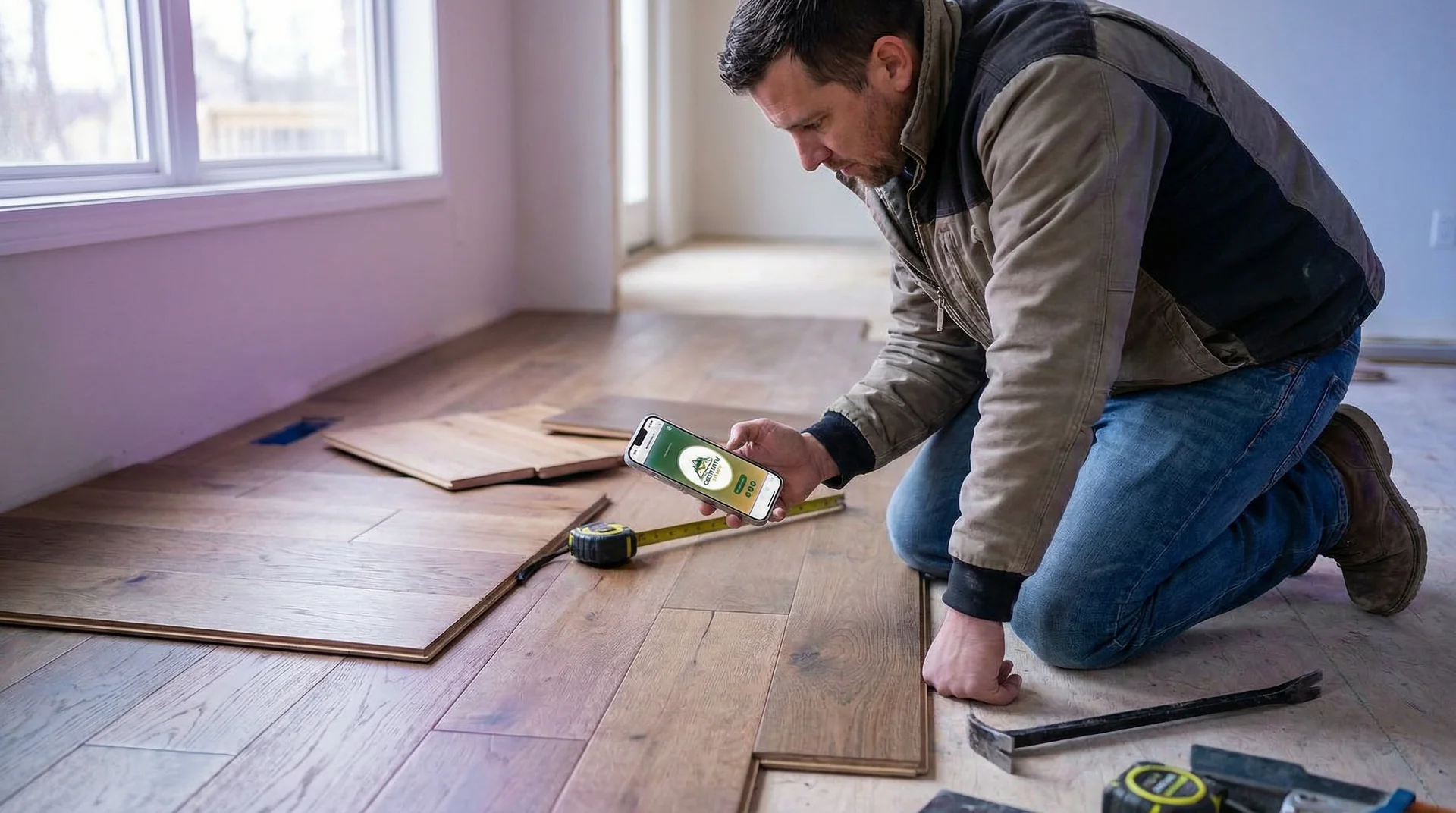
AI Estimate Intake for Flooring Contractors
Flooring contractors waste 40% of estimate visits on unqualified leads. AI pre-qualifies square footage, materials, and budget before you send a crew.

A flooring contractor can do three to five in-home measurements per day. Each visit takes 45 minutes to an hour, plus drive time. That’s your entire estimating capacity. Now consider that roughly 40% of those visits don’t convert. The homeowner’s budget doesn’t match the material they want. The square footage is half of what they described on the phone. Or they’re just getting a third quote to satisfy their spouse and have already picked someone else.
That’s two wasted estimate visits per day. Ten per week. Over a year, your estimator spends hundreds of hours measuring rooms for projects that were never going to close.
Why Flooring Estimates Get Wasted
The flooring industry has a qualification problem that’s baked into how the business works. Customers call with a vague idea of what they want. “I need new floors in my living room and kitchen.” That’s all you get before scheduling the estimate visit.
But the details that determine whether this job is profitable are hiding behind questions nobody asks on the first call:
- Square footage matters enormously. A 200-square-foot bathroom retile and a 2,000-square-foot whole-home hardwood installation require completely different crews and timelines.
- Material selection drives budget. The customer who wants hand-scraped hickory hardwood but has a luxury vinyl plank budget is going to be disappointed, and you’ll have wasted a trip.
- Subfloor condition changes everything. Concrete slab, plywood, existing tile, or old hardwood underneath all affect installation methods and costs.
- Scope creep is common. Flooring is often part of a larger renovation. What starts as “just the kitchen” becomes the kitchen, hallway, powder room, and family room once the homeowner sees the samples.
AI pre-qualification addresses all of these before your estimator ever gets in the truck.
How AI Pre-Qualifies Flooring Leads
A voice genie built for flooring contractors collects the critical details that determine whether an estimate visit is worth scheduling.
Material Advisory Conversations
Most homeowners don’t know the difference between LVP and laminate, or why engineered hardwood might be better than solid hardwood for their slab foundation. They just know they want “something that looks like wood” or “tile for the bathroom.”
The Material Advisor has these conversations by phone, helping callers understand their options based on practical factors:
- Pets and kids? LVP or tile handles scratches and spills better than solid hardwood
- Concrete slab foundation? Engineered hardwood or LVP, since solid hardwood needs a plywood subfloor
- High-moisture areas? Tile or waterproof LVP for bathrooms and laundry rooms
- Budget under $5 per square foot installed? Laminate or entry-level LVP
- Budget over $10 per square foot installed? Solid hardwood, natural stone, or premium tile
By the time the homeowner books an estimate, they have a realistic material preference that matches their budget. Your estimator arrives knowing what to quote instead of spending 30 minutes on material education.
Project Scope Collection
The Estimate Scheduler collects the project details that make estimate visits productive:
- Room count and approximate square footage per room
- Current flooring type and condition
- Whether furniture removal is needed
- Timeline expectations (ASAP, within a month, seasonal planning)
- Budget range for the total project
- Whether this is part of a larger renovation
This information lets your estimator prepare accurate ballpark ranges before the visit. When they arrive, the conversation starts at “here’s what we recommend for your specific situation” instead of “so what rooms are we talking about?”
Showroom Visit Booking
Not every lead needs an in-home estimate first. Some callers want to see and touch materials before committing to a measurement visit.
The Showroom Guide books showroom appointments with the caller’s material preferences already noted. When they arrive, the relevant samples are pulled and ready. A homeowner interested in wide-plank white oak doesn’t need to browse through 200 carpet samples to find the hardwood section.
- Estimate visits scheduled with minimal project information
- 40% of visits wasted on budget mismatches or unqualified leads
- Estimators spend time educating on material differences in the home
- Showroom visitors browse aimlessly without guidance
- Square footage, materials, and budget captured before scheduling
- Pre-qualified leads convert at twice the rate
- Material education happens by phone, estimate visits focus on measuring
- Showroom visits prepared with relevant samples pulled and ready
A Real Scenario: Spring Renovation Season
It’s March, and your phone is ringing constantly. Homeowners who spent the winter planning renovations are ready to get quotes. Your two estimators are already booked three weeks out. Every wasted visit pushes a real customer further down the calendar.
Call one arrives at 9 AM. A homeowner wants to replace carpet in four bedrooms and the hallway. The AI asks about room sizes (they estimate 800 total square feet), subfloor type (plywood over crawlspace), and budget. The homeowner mentions $4,000-$5,000 total. At that budget and square footage, LVP or mid-range carpet makes sense. The AI discusses both options, the homeowner decides on LVP, and an estimate is booked for next week with full details attached.
Call two hits at 9:30 AM. A couple just bought a house with original 1970s linoleum throughout. They want hardwood everywhere. The AI collects the scope (1,400 square feet across living areas), asks about the subfloor (concrete slab in the kitchen, plywood elsewhere), and discusses budget. The couple was thinking $8,000. For 1,400 square feet of hardwood, that’s about $5.70 per square foot installed, which puts them in the engineered hardwood range. The AI explains the difference between solid and engineered, recommends engineered for the slab sections, and books both a showroom visit and an estimate.
Call three comes in at 10 AM. Someone wants “just a quick quote for bathroom tile.” The AI collects the basics: one bathroom, roughly 50 square feet of floor plus a shower surround. Budget is $2,000-$3,000. That’s reasonable for the scope. Estimate booked.
Three calls. Three qualified leads with complete project details. Your estimators will arrive prepared, and none of these visits will be a budget-mismatch surprise.
The Math on Pre-Qualified Estimates
The average flooring job runs $3,000-$10,000 for standard rooms. Whole-home projects hit $15,000-$30,000. Your estimator’s time is the bottleneck.
When you eliminate the 40% of wasted visits through AI pre-qualification, the impact is immediate:
-
More capacity. Two fewer wasted visits per day means two more qualified homeowners get measured this week instead of waiting another week.
-
Higher close rates. Pre-qualified leads who understand their material options and have realistic budgets convert at roughly double the rate. Your estimator is quoting projects that are actually going to happen.
-
Faster revenue. Shorter wait times for estimates mean faster project starts. A homeowner who gets measured this week starts their project next month. A homeowner who waits three weeks for an estimate might lose motivation entirely.
The home building and renovation industry rewards contractors who respond quickly and arrive prepared. AI makes both possible even during the busiest season.
Handling the Renovation Coordination Angle
Flooring is rarely a standalone project. Most homeowners replacing floors are doing it as part of a larger renovation. The kitchen remodel that includes new cabinets, countertops, and flooring. The whole-home refresh after purchasing a new house. The finished basement that needs carpet or LVP over concrete.
When AI captures the full renovation scope on the first call, your team can plan accordingly. If the kitchen cabinets are being installed next month and the homeowner wants flooring done right after, your estimator knows to measure for the post-cabinet layout. If they’re finishing a basement, the AI asks about moisture testing and subfloor preparation.
This coordination awareness prevents the most common problem in renovation flooring: showing up to measure a room that isn’t ready yet. When the AI captures renovation timelines alongside flooring details, your scheduling becomes more accurate and your crew doesn’t waste trips to job sites where other trades haven’t finished their work.
It also opens up upsell opportunities. A homeowner calling about kitchen flooring might not have considered matching the hallway and entryway. When the AI naturally asks “will you be updating the adjacent rooms as well?” it plants the seed for a larger project. Your estimator arrives ready to quote the full scope instead of just the kitchen, potentially doubling the job value from $4,000 to $8,000.
If you’re working in the broader home building space, check out how AI helps kitchen and bath remodelers qualify projects for a similar approach.
Fill Your Estimate Calendar With Qualified Leads
Spring renovation season doesn’t have to mean a calendar full of visits that go nowhere. AI pre-qualification ensures your estimators spend their limited time with homeowners who have realistic expectations, appropriate budgets, and genuine intent to move forward.
Try the Material Advisor for your flooring business and see how it handles material selection conversations. Or explore all voice genies built for flooring contractors to find the right combination for your team.
Help Genie Tips
Get more from your voice genie

Set different genie behavior for after-hours calls
Your genie can act differently at night. Triage emergencies, collect more info from callers, or simply take messages. You control what happens when the office is closed.

Add custom pronunciations for your industry
Genie mispronouncing a brand name, medical term, or street name? Add custom pronunciations so your voice genie nails every word your callers expect to hear.

Capture exactly the info you need from every caller
Define custom fields your genie should collect: budget, timeline, property type, vehicle make, service needed. Every call ends with structured data, not a scribbled note.

Train your genie with your own business data
Upload PDFs, spreadsheets, website pages, or just paste text. Your genie learns your pricing, services, policies, and FAQs instantly with no coding and no wait.
See how it worksReady to try it?
Set up a voice genie for your business in minutes.
Keep exploring
Further reading and useful tools
Voice AI for Home Builders: The Complete Guide
How home builders, remodelers, roofers, and flooring pros use voice AI genies to capture every new-build, reno, and storm-season lead 24/7
Industry InsightsWhy Most Trades Businesses Qualify Too Late Without a Quoting Genie
Voice AI quoting is changing how owner-operators filter leads. Here's why qualification before the site visit matters more than conversion.
Industry InsightsThe Defects Period Is Breaking Your Best Person
Every home builder has one person drowning in warranty queries. Here's why the defects period is a structural problem, and what voice AI can do about it.
GuideHow to Build a Support Function Checklist for Your Small Business Using Voice AI
A step-by-step support function checklist for small business owners who want their genie handling frontline queries 24/7 without growing headcount.
BlogHome Builders: Cut No-Shows 30-40% With 24/7 Booking
Stop losing tours to slow follow-up. See how home builders book more tours, qualify buyers automatically, and cut no-shows by 30 to 40 percent.
BlogHow AI Handles Storm Season Contractor Call Surges
A single storm can flood contractors with 200+ calls. Learn how AI triages storm damage inquiries, captures insurance details, and wins jobs.
Help Genie
The Help Genie Team
The Help Genie team builds voice AI genies that resolve everyday support on their own — across phone, chat, web, and email — in your voice, 24/7. We write about what we learn shipping it to real businesses.
Building voice AI for 11+ industries, from trades to hospitality.
- voice AI
- customer support
- lead capture
- multi-channel genies